make preferable
Astronomers have found that white dwarfs—the remnants of stars like the Sun—can come in a wide range of hues, including green, pink, purple, and turquoise. Previously, the color of these objects, like that of other stars, was thought to be determined primarily by their temperature. However, a new study has shown that the chemical composition of their dense atmospheres also plays an important role.
Cosmic “zombies” that feed on the remains of their planets
As Space.com reports, the discovery is particularly notable because white dwarfs can take on unusual colors when they consume debris from planets, asteroids, and comets. In such cases, these dead stars resemble cosmic “zombies” that continue to feed on the remains of their planetary systems.
“Most stars, including most white dwarfs, behave like ideal emitters: their color is determined almost entirely by temperature. However, no one had really explored what other possibilities there might be for white dwarfs,” said study lead Mark Hollands of the University of Warwick.
According to Hollands, these extremely dense stellar remnants turned out to be capable of taking on colors that scientists had not expected.
Why “white dwarfs” can change color
White dwarfs form after stars with masses comparable to the Sun's exhaust their fuel supplies and can no longer resist their own gravity. Their cores contract, and the remaining matter becomes extremely dense. According to the data cited in the study, the density of matter in a white dwarf can be millions of times greater than that of the Sun's photosphere.
Under these conditions, chemical elements begin to interact with the surrounding dense helium plasma and absorb light across a broader range of the spectrum than they do at normal densities. As a result, a white dwarf's color can differ from the familiar white or pale blue glow characteristic of hot stellar remnants.
What determines the color?
The researchers found that the possible colors depend on the chemical composition of a “white dwarf's” atmosphere. Objects with a high carbon content, for example, may have a pink or purple hue. White dwarfs whose atmospheres have been enriched with material from consumed asteroids, comets, and other remnants of former planetary systems may turn yellow.
Cooler white dwarfs with mixed hydrogen-helium atmospheres can glow turquoise or pale blue. This hue results from interactions between hydrogen molecules and helium atoms in the dense atmosphere.
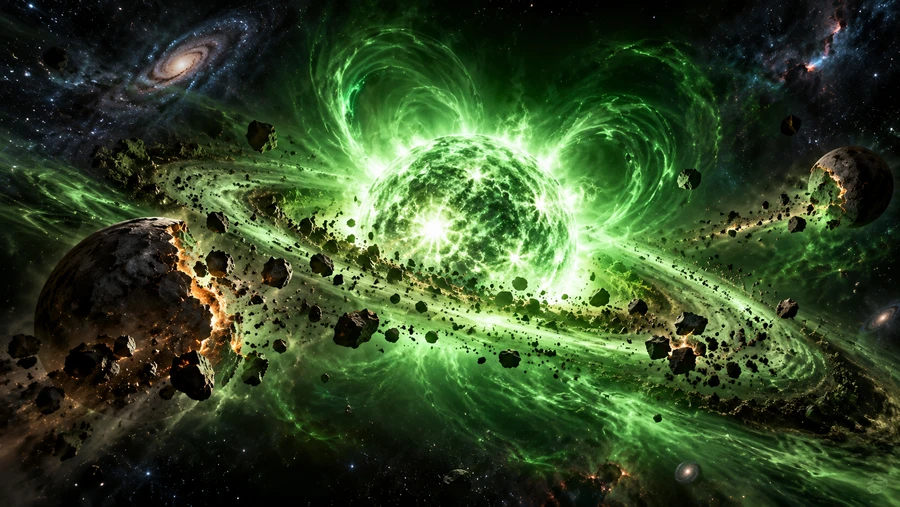
A green glow may be particularly unusual. As the scientists explain, traces of sodium in a white dwarf's atmosphere can produce it by absorbing the orange part of the spectrum, leaving a distinctive greenish glow.
Thus, the view of white dwarfs as uniformly white or bluish objects may be incomplete. Their true color palette is much more diverse, and the chemical composition of their atmospheres offers scientists a fresh perspective on the processes that occur after stars die and their planetary systems are destroyed.