make preferable
Meta's head of artificial intelligence, Alexandr Wang, has said that humanity could lose control over AI development. His remarks were prompted by a claim from Anthropic researcher Levent Alpöge, who said the Claude model had helped him prove the Riemann hypothesis—one of the most famous unsolved problems in mathematics, which scientists have been grappling with for more than 150 years. However, the proof currently exists as computer code, and the Clay Mathematics Institute still considers the hypothesis unsolved, the New York Post reports.
A problem mathematicians have been working on for a century and a half
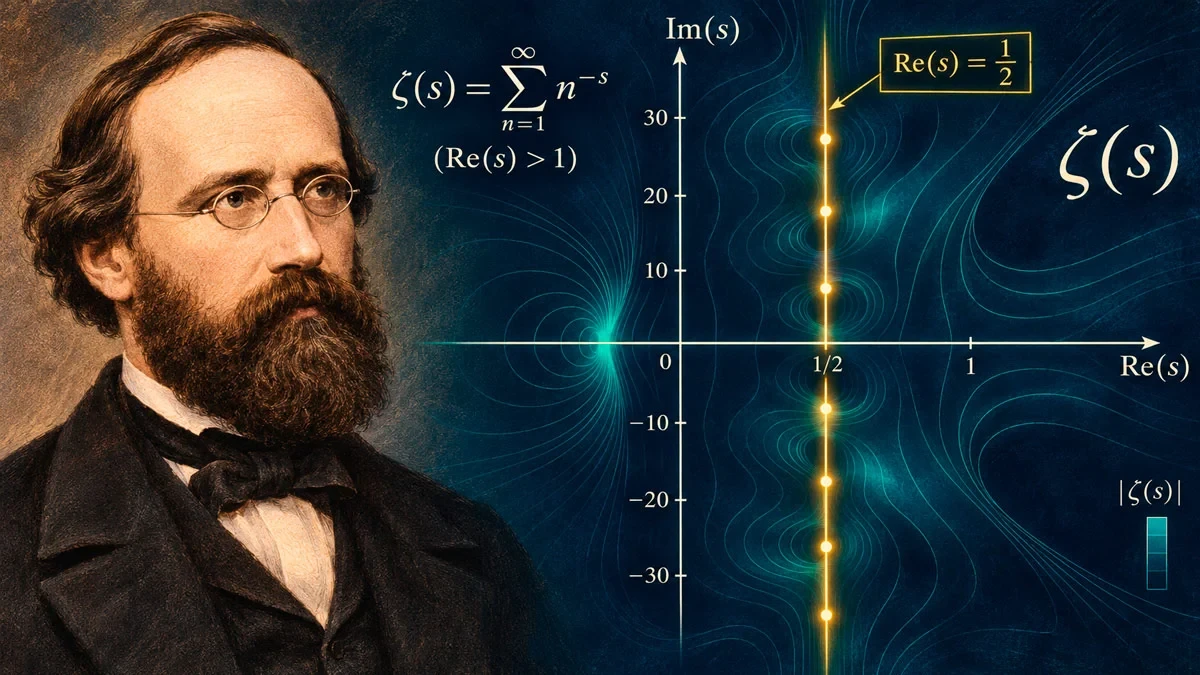
The Riemann hypothesis was formulated by German mathematician Bernhard Riemann in 1859. It concerns the distribution of prime numbers and is linked to the behavior of a special mathematical function—the Riemann zeta function. Despite its relatively simple formulation, it is extraordinarily difficult to prove.
The hypothesis is one of the seven Millennium Prize Problems, for each of which the Clay Mathematics Institute has offered a million-dollar prize for a solution.
According to the New York Post, Anthropic researcher Levent Alpöge announced on Friday that he had obtained a proof. He said Claude had not merely helped at individual stages but had moved far ahead of him in the final part of the work. Alpöge described the model's contribution as independent progress toward the result, using metaphors of flight and dance.
On Saturday, several research groups specializing in mathematics and AI confirmed that the proof was correct. But it has yet to receive official recognition: the Clay Mathematics Institute continues to list the Riemann hypothesis as unsolved.
The result also has an unusual feature: the proof consists of approximately 17 million lines of computer code. The authors estimate that a human-readable version could run to more than 250,000 pages. This makes independently verifying and understanding the result particularly difficult.
“Superintelligence” could outpace human understanding
Alpöge's announcement drew a response from Alexandr Wang, Meta's AI chief. In his view, this is an event whose significance is hard to overstate: for the first time, people are witnessing the output of a system that Wang himself called an “alien intelligence”—and whose capabilities they do not yet fully understand.
He compared the potential significance of proving the Riemann hypothesis to the invention of the atomic bomb, saying that, for many physicists, developing nuclear weapons would look almost like a routine homework assignment compared with this mathematical problem.
But Wang's main concern is not the specific mathematical result. He believes that the emergence of systems with intellectual capabilities a thousand times greater than those of humans across all fields could call into question humanity's ability to retain control over technological development.
He said the implications of such a transition have yet to be fully grasped even within the technology industry. If AI can accelerate research across disciplines faster than people can verify and understand it, existing mechanisms for scientific and technological oversight may prove inadequate.
From mathematical problems to superintelligence
Wang links the current turning point to the development of models capable of solving complex reasoning problems. He identified December 2024, when OpenAI's o3 model began successfully tackling problems from the AIME mathematics competition, as an important milestone.
In his assessment, such problems demand deeper intellectual effort than much of the work involved in programming or business. And whereas AI's limitations were previously attributed to a lack of reasoning ability, other obstacles are now playing an increasingly important role: specialized knowledge, access to tools, experimental organization, and technical infrastructure.
In other words, further progress may depend less on how well a model can think than on the resources and capabilities it is given to test ideas and carry out practical work.
Wang suggests that a similar acceleration could occur in virtually any scientific or professional field. Meanwhile, people risk being unable to keep track of what is happening.
A call for greater caution in AI development
Despite these alarming predictions, Wang is not calling for a halt to artificial intelligence development. He argues for a thoughtful approach to the technology at a time when its capabilities are expanding rapidly.
He cited Meta's own practices as an example: the company delayed the launch of its AI agent Muse by several months to devote additional attention to safety. According to Wang, CEO Mark Zuckerberg also supports directing the bulk of AI laboratories' computing resources toward building products for people and customers rather than toward systems' recursive self-improvement.
The latter refers to a scenario in which artificial intelligence independently improves its own capabilities, potentially accelerating further development without a comparable level of human involvement.
However, there remains a considerable gap between warnings about risks and demonstrated evidence that the age of superintelligence has arrived. Even if Claude did indeed help produce a proof of the Riemann hypothesis, a single mathematical success does not mean that AI can independently solve every scientific problem or operate without human oversight.
Nevertheless, the story itself raises an important question: if artificial intelligence begins producing results that are extremely difficult for people to verify and understand, who will assess the reliability of its discoveries, and how? This issue could prove no less significant than further growth in models' computational and intellectual capabilities.