make preferable
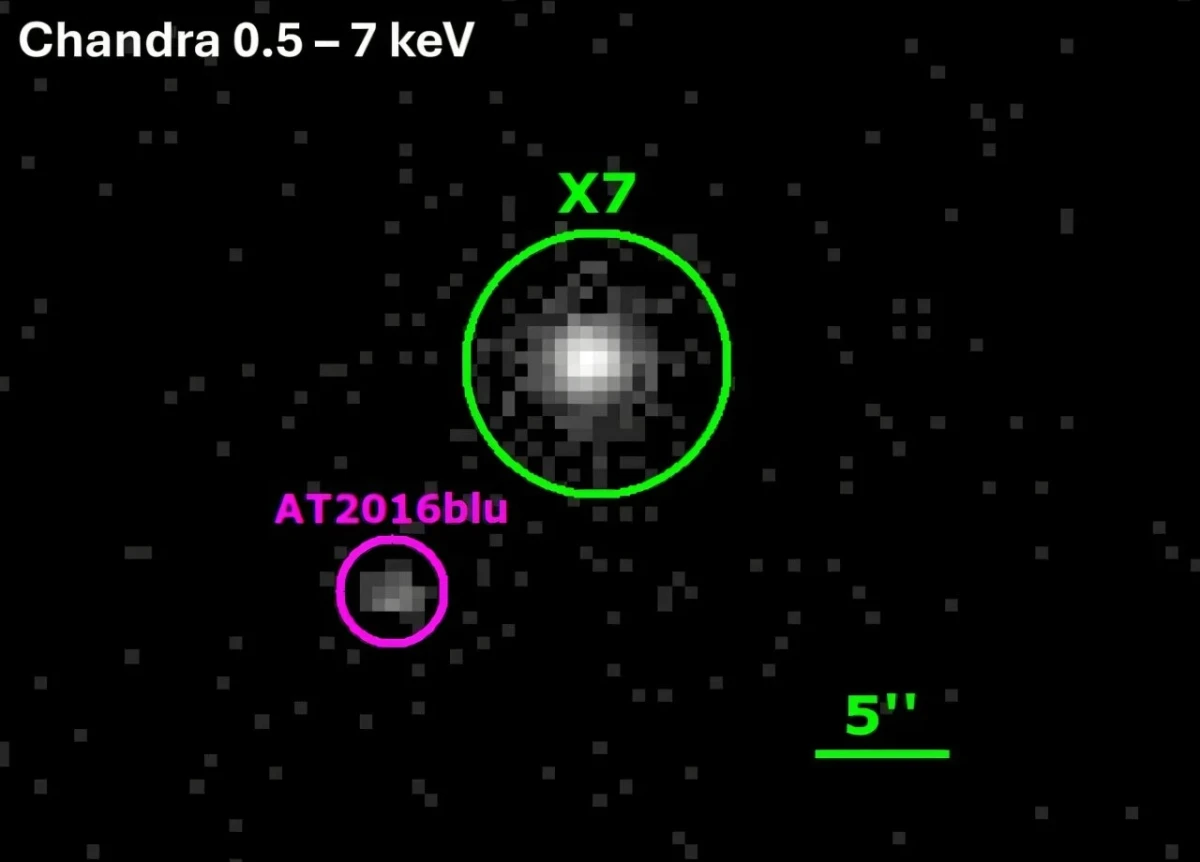
Astronomers have discovered what causes unusual outbursts in the massive star AT 2016blu, which has regularly brightened dramatically and then faded over the past 15 years. Observations by NASA’s Chandra X-ray Observatory suggest that these events may be caused by a hidden companion—a stellar-mass black hole or a neutron star that periodically draws material away from the star. The findings were published in The Astrophysical Journal.
AT 2016blu lies in the spiral galaxy NGC 4559, approximately 30 million light-years from Earth. Its mass is at least 33 times that of the Sun. Astronomers have been monitoring its unusual behavior for about 15 years. Between 2012 and 2026, they recorded at least 27 visible-light outbursts occurring at intervals of roughly 113 days. A star that behaves like a supernova but does not die
AT 2016blu belongs to a class of stars known as luminous blue variables—hot, massive objects characterized by significant changes in brightness. However, this star stands out even among them: its outbursts are so powerful that they resemble supernova explosions. In a true supernova explosion, a massive star is destroyed, ejecting its material into space. AT 2016blu, by contrast, survives each outburst and continues to exist. Astronomers therefore call such objects “supernova impostors.”
“At first, this star’s behavior puzzled us: it kept acting like a supernova, but clearly it is not one, since it survives these outbursts roughly three times a year,” said study co-author Nuria Torres-Albà of the University of Virginia. The scientists suspected that the recurring visible-light outbursts might result from periodic bursts of high-energy X-rays. To test this hypothesis, they needed to obtain X-ray data precisely when the star next brightened.
A hidden companion draws material away from the star
The key data were obtained in March 2026 using the Chandra observatory. Its observations showed that during an outburst, AT 2016blu was at least 100 times brighter in X-rays than it had been in 2001–2002, before such outbursts had been observed.
The most likely explanation is that the star has a compact companion—a stellar-mass black hole or a neutron star. The two orbit their common center of mass along an elongated orbit, approaching each other roughly every 113 days.
At their closest approach, the compact object captures some of the material expelled by the massive star. Once caught in its gravitational field, the material begins to swirl at tremendous speeds approaching the speed of light. As a result, it becomes extremely hot and turns into a powerful source of X-rays.
“We suspected that the bright, recurring optical outbursts might actually be powered by periodic bursts of high-energy X-rays. The dense gas surrounding the system is heated by the X-rays and then begins to glow in visible light,” explained study co-author Nathan Smith of the University of Arizona. This is precisely why the researchers needed to synchronize their X-ray observations with the next optical outburst.
The discovery could explain the nature of rare X-ray sources
AT 2016blu’s X-ray brightness makes it a candidate ultraluminous X-ray source. These rare objects emit extremely intense X-rays and remain poorly understood. According to current theories, some may contain neutron stars, while others may contain black holes.
The new study points to a possible connection between these sources and powerful, recurring outbursts from massive stars. This is particularly intriguing given that many ultraluminous X-ray sources also show significant variations in the intensity of their emission.
The discovery could help astronomers better understand the behavior of massive stars in the late stages of their evolution, including before a supernova explosion. Scientists suggest that changes in the brightness of some of these stars may be linked to the presence of a compact companion or another massive star orbiting them.
To observe AT 2016blu, the researchers used not only Chandra but also the Katzman Automatic Imaging Telescope (KAIT), the Las Cumbres Observatory network, and data from the American Association of Variable Star Observers. More than 30 amateur astronomers took part in the monitoring effort.
It was thanks to these long-term optical observations that the scientists were able to predict the timing of the next outburst in early 2026 and arrange targeted Chandra observations in March, when the star was in an active phase.