make preferable
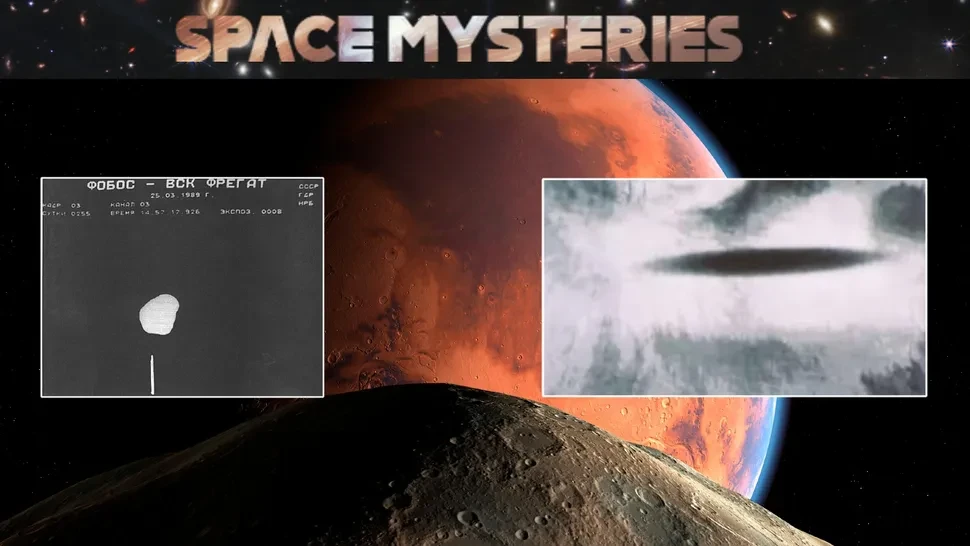
In March 1989, the Soviet interplanetary probe Phobos 2 unexpectedly stopped communicating with Earth. Shortly beforehand, the spacecraft had transmitted its final images of the Martian moon Phobos, some of which appeared to show an unusual elongated shadow. It sparked speculation about a mysterious object and even claims that an alien spacecraft had destroyed the Soviet probe.
However, there is a perfectly scientific explanation for the strange image. Studies showed that the shadow's unusual shape could have resulted from the spacecraft's orbit, the viewing direction, and the operation of its scanning instrument. The exact cause of the loss of Phobos 2 itself, however, remains unknown, according to Space.com.
The Last Major Mission of the Soviet Planetary Program
Phobos 2 launched on July 12, 1988, from the Baikonur Cosmodrome aboard a Proton rocket. Its main objective was to study Mars and its largest moon, Phobos. The mission plan called for a close approach to the moon and the deployment of landers on its surface.
The mission became especially important after the failure of its predecessor, Phobos 1. That probe lost contact with Earth on September 2, 1988, because of an erroneous sequence of commands sent from the ground. As a result, Phobos 2 was the only spacecraft left that could carry out the planned research program.
On January 30, 1989, the probe entered orbit around Mars. Technical problems soon emerged, however: one of its three onboard processors was already out of operation, and a second was also showing signs of malfunction.
Despite this, the spacecraft managed to continue operating. Over the following weeks, it transmitted scientific data on Mars and its surroundings and obtained more than three dozen images of Phobos. By March, the scientific instruments were reportedly functioning normally, and the two remaining processors were controlling the probe.
But on March 27, 1989, while preparations were underway for another imaging session of Phobos, contact suddenly broke off.
Why the Probe Stopped Responding
To obtain navigation images of Phobos, the spacecraft had to turn so that its antennas temporarily pointed away from Earth. This meant that a loss of contact during imaging was expected.
However, contact could not be restored after the maneuver was completed. Over the following hours, engineers received only a few brief radio signals. These may have indicated that the probe had begun tumbling out of control.
If the spacecraft lost its orientation, it could have stopped pointing its solar panels toward the Sun. In that case, its energy reserves would gradually have run out, making communication with Earth impossible.
Experts consider a failure of the onboard computer control system the most likely explanation. One processor had already failed, and a second was experiencing problems. If that processor failed completely during the approach to Phobos, the remaining processor might not have been sufficient to fully control the probe.
A loss of electrical power may have been an additional factor. The spacecraft lacked a reliable system that would shut down nonessential instruments when the battery charge became critically low, preserving power for essential systems.
A collision with particles or debris near Phobos was also considered. However, subsequent simulations by Soviet specialists and American researchers at NASA's Jet Propulsion Laboratory did not support this hypothesis.
The exact sequence of events remains unknown. After a few brief contacts, the probe was never heard from again.
Where the Mysterious Shadow in the Images Came From
The unusual images transmitted by Phobos 2 before contact was lost became a separate part of the story. In some photographs, an elongated dark shape resembling a cigar-shaped object could be seen below the spacecraft or near Phobos.
In the early 1990s, this feature attracted the attention of Marina Popovich, a Soviet test pilot and the first woman in the USSR to break the sound barrier. In December 1991, she presented the photographs at a press conference in San Francisco and said they might show an unidentified object near the Martian moon. Popovich suggested that it could have been an alien spacecraft.
Her prominence in aviation and space circles brought the theory additional publicity. However, no compelling scientific evidence for the existence of such an object emerged.
The explanation for the unusual shadow lies in the observing conditions. At the time the images were taken, Phobos 2 and the moon it was studying were in nearly the same orbit and moving at similar speeds. The Termoskan multispectral scanning instrument imaged not only the moon itself but also its shadow on the surface of Mars.
Because of the viewing geometry, the shadow could appear as an elongated dark streak. The viewing direction and the way the scanner operated also played important roles. In addition, researchers suggested that the spacecraft itself might have been swaying slightly at the time.
In 1991, a NASA-led team of specialists analyzed the Termoskan observations and concluded that the image's unusual shape was most likely explained by a combination of these factors.
There is also independent confirmation that an elongated shadow of Phobos is a perfectly ordinary phenomenon. In 2005, Europe's Mars Express spacecraft captured images of a similar shadow on the surface of Mars. It, too, had a distinctly elongated shape caused by the angle of the sunlight and the viewing geometry.
Thus, the mysterious “object” in the Phobos 2 images does not require an explanation involving extraterrestrial technology. It was apparently the shadow of the Martian moon, distorted by the imaging conditions.
What Phobos 2 Managed to Discover
Despite the mission's premature end, the spacecraft transmitted a substantial amount of scientific information. According to researchers Paolo Ulivi and David Harland, the volume of data obtained by the two probes in the Phobos program exceeded the results of all previous Soviet missions to Mars.
However, the loss of the spacecraft had consequences beyond the scientific program. Specialists from more than a dozen countries took part in the project, contributing equipment and funding worth millions of dollars. The failure dealt a serious blow to international cooperation amid sweeping political and economic changes in the Soviet Union.
The story of Phobos 2 remains unusual even decades later. On the one hand, scientists have provided a reasonably convincing explanation for the mysterious shadow in its final images. On the other, the technical cause of the probe's loss has never been definitively established.
Ultimately, one of the last major Soviet missions to other planets left behind both valuable scientific data and an unresolved engineering mystery. And although the story of an alien spacecraft was never substantiated, the fate of the probe itself truly remains unknown.