make preferable
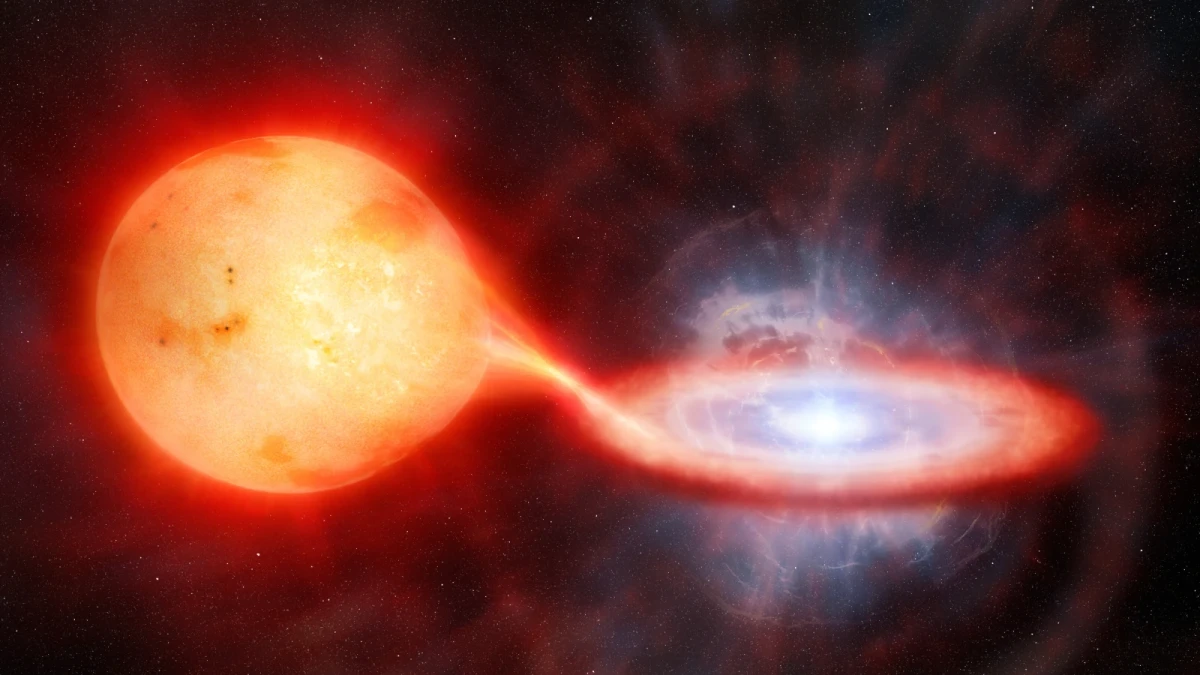
For several years, astronomers have been awaiting an eruption from the binary star system T Coronae Borealis, known as the “Blaze Star.” When it happens, the object will briefly become so bright that it will be visible to the naked eye. The last such eruption was observed in 1946, so scientists believe another could occur within the next few years. However, predicting the exact date remains impossible.
Two Stars and One Anticipated Eruption
T Coronae Borealis, or T CrB, is not a single star but a binary system located in the constellation Corona Borealis, the Northern Crown. It consists of a dense white dwarf and a swollen red giant.
The white dwarf has a strong gravitational pull and gradually draws material from its companion. Gas accumulates on the white dwarf's surface until it reaches a critical amount. This triggers a thermonuclear reaction, causing a powerful outburst known as a nova.
Unlike a supernova, this type of eruption does not destroy the star. The white dwarf survives, and once the ejected material disperses and the system returns to its previous state, the process of gas accumulation can begin again.
In T CrB, such events occur roughly once every 80 years. The last recorded eruption took place in 1946. During a nova, the system's brightness increases by about a thousand times before gradually fading.
Why Astronomers Cannot Give an Exact Date
Although another eruption is considered virtually inevitable, determining exactly when it will begin is extremely difficult.
Bradley Schaefer of Louisiana State University explains that scientists cannot measure with great precision the rate at which gas reaches the white dwarf's surface. The exact mass of material needed to trigger the thermonuclear reaction is also unknown.
These two parameters determine the timing of the next eruption. Astronomers know that material has been accumulating for decades and that the system is probably approaching a critical state. But determining exactly how long it will take to reach that point remains impossible.
Scientists have tried to use changes in T CrB's brightness to make predictions, comparing them with the system's behavior before the 1946 eruption. However, some episodes of dimming and subsequent brightening, which initially generated excitement among observers, never led to the main event.
Elizabeth Hays, head of NASA's Astroparticle Physics Laboratory at Goddard Space Flight Center, believes the eruption will most likely occur within the next few years. She says she would be surprised if it did not happen before 2030—84 years after the previous eruption.
An additional difficulty is that the bright red giant outshines the much fainter white dwarf. This makes it difficult for astronomers to observe processes on its surface in detail and determine the temperature and pressure of the accumulating material.
Hays compares predicting a nova to forecasting the weather: the conditions for an event may already be in place, but determining exactly when it will happen is still difficult.
What the Eruption Will Look Like from Earth
Observers on Earth will most likely receive no noticeable visual warning that the explosion is beginning. However, an early X-ray flash may precede the main event.
Amateur astronomers around the world are closely monitoring the system. According to Schaefer, observations are being made at intervals of roughly one to two minutes. If T CrB brightens by about one magnitude, news of the event could spread around the world within minutes.
Observatories and telescopes will be able to quickly begin observation programs prepared in advance. This is particularly important because the main outburst will develop rapidly: once the thermonuclear reaction begins, the system will reach peak brightness in less than a day.
T CrB currently has an apparent magnitude of about +10, making it impossible to see without optical instruments. During the eruption, its magnitude could reach approximately +1.7. This would make the object brighter than Polaris—as though a new star had appeared in the night sky.
However, the effect will be short-lived. Hays estimates that within just a few days, its brightness will fall below the threshold for naked-eye visibility under dark skies. After about a week, the object will become too faint to see even with binoculars.
The eruption will remain detectable by astronomical instruments for much longer, however. Radio, X-ray, and gamma-ray emissions will be detectable for months or even years.
Where to Look for the “Blaze Star”
T CrB lies in Corona Borealis, a small constellation located between Hercules and Boötes. It is easy to recognize by its distinctive arc of several stars, resembling a crown or semicircle.
The system can be found near the star Epsilon Coronae Borealis, which has an apparent magnitude of about +4.28. In November, the constellation is visible in the evening, although for observers in the United States it drops below the horizon a few hours after sunset and reappears in the northeast before dawn.
Even if the eruption occurs unexpectedly, amateur astronomers are unlikely to miss it: the system is under constant observation. And although no one can yet give an exact date for the event, scientists hope that T CrB's next eruption will allow them to study the rare process of material accumulation and a thermonuclear explosion on the surface of a white dwarf in virtually real time.