make preferable
An unusual triple star system that should not have survived discovered 28 light-years from Earth
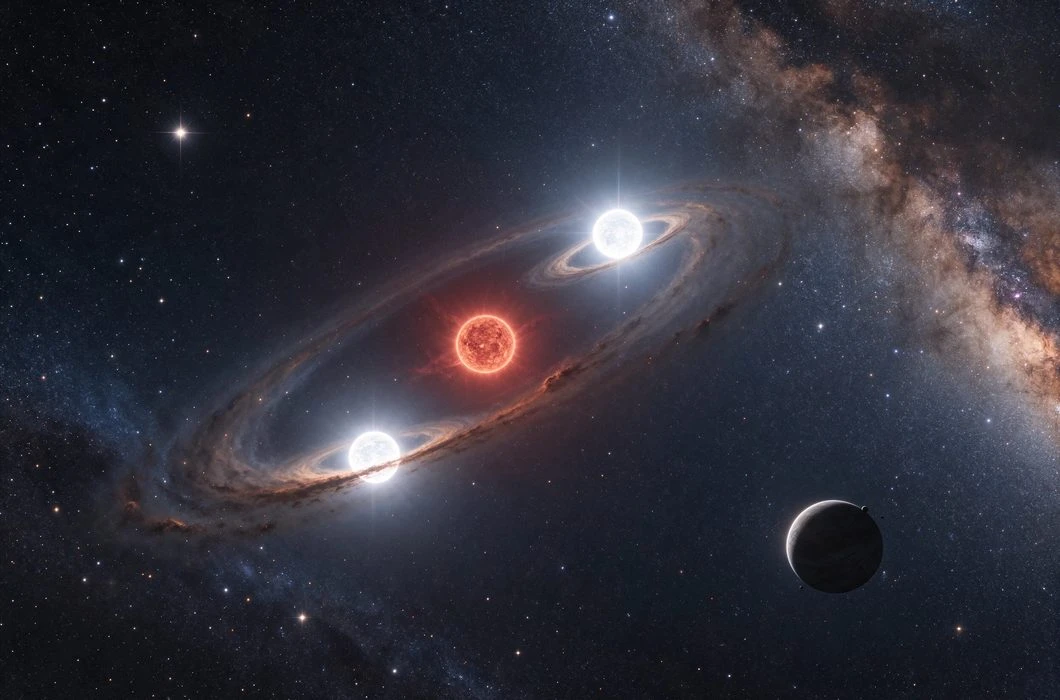
Astronomers have discovered a rare triple star system, Welopō'ai, just 28 light-years from the solar system. It contains a red dwarf and two white dwarfs—the remnants of stars that have already completed their life cycles. However, the main mystery of the discovery is not the system's unusual composition, but the fact that, according to existing models of stellar evolution, it should not have survived in this form at all.
The system was discovered by chance: researchers were searching for planets around the red dwarf, but instead found an object that turned out to be another star—or, more precisely, its burned-out core. According to lead researcher Étienne Artigau of the Trottier Institute for Research on Exoplanets at the University of Montreal, nothing like it is known to exist within at least 100 light-years of Earth, Space.com reports.
How the search for a planet led to the discovery of a white dwarf
Two of the three objects in the Welopō'ai system are white dwarfs. These are the extremely dense remnants of stars whose masses were comparable to the Sun's. When such a star runs out of hydrogen in its core, its structure begins to change: its outer layers expand, and the star becomes a red giant. Eventually, the outer envelope is shed into the surrounding space, while the remaining core contracts to a size comparable to Earth.
Red dwarfs live much longer: because of their low mass, they use up their hydrogen reserves more slowly. This is why one such object remains in Welopō'ai, while the two more massive stars have already completed their evolution and become white dwarfs.
One of the white dwarfs and the red dwarf were known to astronomers before this study. Artigau's team observed the system using the SPIRou infrared spectropolarimeter, installed on the Canada–France–Hawaii Telescope. The instrument searched for planets by measuring how their gravity causes their host star to wobble slightly.
The method relies on measuring radial velocity—the motion of a star toward or away from the observer. As a star and a planet orbit their common center of mass, this motion leaves a signature in the spectrum of the star's light: spectral lines shift because of the Doppler effect.
But in the case of Welopō'ai, the signal was too strong to come from a planet. The object in a close orbit around the red dwarf caused radial velocity changes of about 16 kilometers per second. Follow-up observations with the eight-meter Gemini North telescope established that it was a white dwarf.
Three stars with very different fates
The newly identified system consists of three objects at different distances from one another. The closer white dwarf orbits the red dwarf at a distance of about 4.6 astronomical units—roughly 688 million kilometers. This is slightly less than the distance from the Sun to Jupiter.
The more distant white dwarf lies about 129.3 astronomical units from the red dwarf, or nearly 19.3 billion kilometers. It takes about a thousand years to complete one orbit around the system.
The proximity of the first pair allowed the researchers to determine the masses of both objects with high precision. The red dwarf has about 42% of the Sun's mass, while the newly discovered white dwarf has roughly 62%. According to the scientists' calculations, before becoming a white dwarf, this star had a mass about 40% greater than the Sun's.
Precise measurements are particularly important for studying white dwarfs. Their current mass is linked to the mass of the original star, making it possible to test models of stellar evolution. These objects also offer an opportunity to study matter in an extremely dense state.
A white dwarf is supported against further contraction by electron degeneracy pressure. This arises from the quantum properties of electrons and prevents them from being packed arbitrarily close together. If the remnant's mass becomes too great, this mechanism can no longer counteract gravity, and further evolution may lead to the formation of a neutron star.
Why this system should not have survived
The main mystery of Welopō'ai concerns the past of its members. The system probably originally consisted of three stars: two similar to the Sun and one low-mass red dwarf. Over time, the two more massive stars became red giants and then shed their outer envelopes, leaving white dwarfs behind.
The problem is that the red giant stage involves a dramatic increase in a star's size. Its outer layers can expand over enormous distances, significantly altering its gravitational interactions with nearby objects.
According to current understanding, this expansion should have disrupted the red dwarf's orbit. Depending on the stars' original arrangement, it could have ended up inside a red giant's envelope or even collided with it. In either case, it is difficult to explain how the red dwarf survived this stage and retained its current stable orbit.
The researchers have yet to propose a convincing scenario that explains the observed configuration. Patrick Dufour of the University of Montreal openly acknowledges that the team has no simple explanation for the system's origin.
The name Welopō'ai combines two Hawaiian words and means “the path of family traits.” It refers to the shared history of the three stars, which have passed through different stages of evolution but remained in a single system.
What could help unravel the history of Welopō'ai
Astronomers plan to continue observations to measure the gravitational interactions among the three objects more precisely. This could help reconstruct their original orbits and reveal how the red dwarf escaped the destructive effects of its neighbors during their red giant stages.
The system's proximity to Earth gives researchers an important advantage: a distance of just 28 light-years allows for highly precise measurements. In addition, Welopō'ai is of interest not only as an astronomical rarity, but also as a natural laboratory for testing models of stellar evolution and studying the matter inside white dwarfs.
The discovery is described in a paper published on November 19 in the journal Astronomy & Astrophysics. For now, it raises more questions than it answers. But systems like this make it possible to test how well current models explain the fate of stars—and where gaps remain in our understanding of the universe.