make preferable
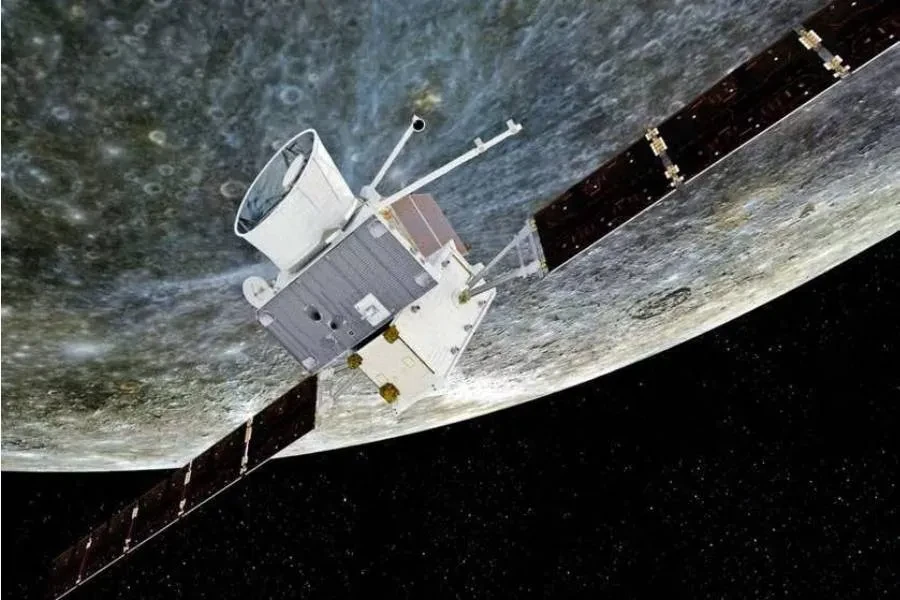
The European-Japanese BepiColombo mission has successfully entered orbit around Mercury. This marks only the second time in history that a spacecraft has become an artificial satellite of the planet closest to the Sun. In December, the mission's two research modules are scheduled to separate, after which Mercury will be studied simultaneously by two separate spacecraft for the first time.
The European Space Agency (ESA) announced the successful completion of the maneuver. BepiColombo entered an elongated elliptical orbit at an altitude of about 590 km at its closest point and 11,640 km at its farthest.
How the spacecraft entered orbit around Mercury
To be captured by the planet's gravity, BepiColombo had to slow down. The maneuver was performed by four engines on the European Mercury Planetary Orbiter (MPO). They fired as the spacecraft approached Mercury's south pole and operated for about 37 minutes.
The spacecraft approached the planet from its night side. Once the braking maneuver was complete, it was in its first orbit around Mercury.
The BepiColombo mission launched in October 2018 and became the second in history, after NASA's American MESSENGER spacecraft, to achieve this goal. Studying Mercury from orbit remains a difficult task: its proximity to the Sun exposes spacecraft to intense heat, while entering orbit requires a substantial change in velocity.
Two spacecraft to study one planet
BepiColombo is a joint project of the European Space Agency and the Japan Aerospace Exploration Agency (JAXA). From the outset, the mission has consisted of two scientific spacecraft designed to study different aspects of the planet.
The European Mercury Planetary Orbiter (MPO) will study Mercury's surface, chemical composition, and internal structure. The Japanese Mercury Magnetospheric Orbiter (Mio) will study the planet's magnetic field and its interaction with the solar wind—the stream of charged particles constantly flowing from the Sun.
The spacecraft are scheduled to separate on December 9–10 and begin operating independently. BepiColombo will then become the first mission to have two separate research spacecraft operating simultaneously in orbit around Mercury.
The European MPO is expected to reach its final operational orbit by March 2027. Full-scale scientific observations are scheduled to begin in April of the same year.
Why Mercury remains a mystery
Despite its proximity to Earth in cosmic terms, Mercury remains one of the least-studied planets in the Solar System. Exploring it is complicated by extreme conditions: daytime surface temperatures can reach +450 °C, while at night they can drop to around −180 °C.
This temperature difference is due to the planet's characteristics and its near-total lack of an atmosphere capable of retaining heat effectively. In addition, its proximity to the Sun creates further difficulties for scientific instruments.
BepiColombo's two spacecraft will make it possible to study different aspects of Mercury simultaneously—from its geology and internal structure to its magnetic field and the effects of the solar wind. This will help build a more complete picture of a planet that remains one of the least-explored worlds in the Solar System.