make preferable
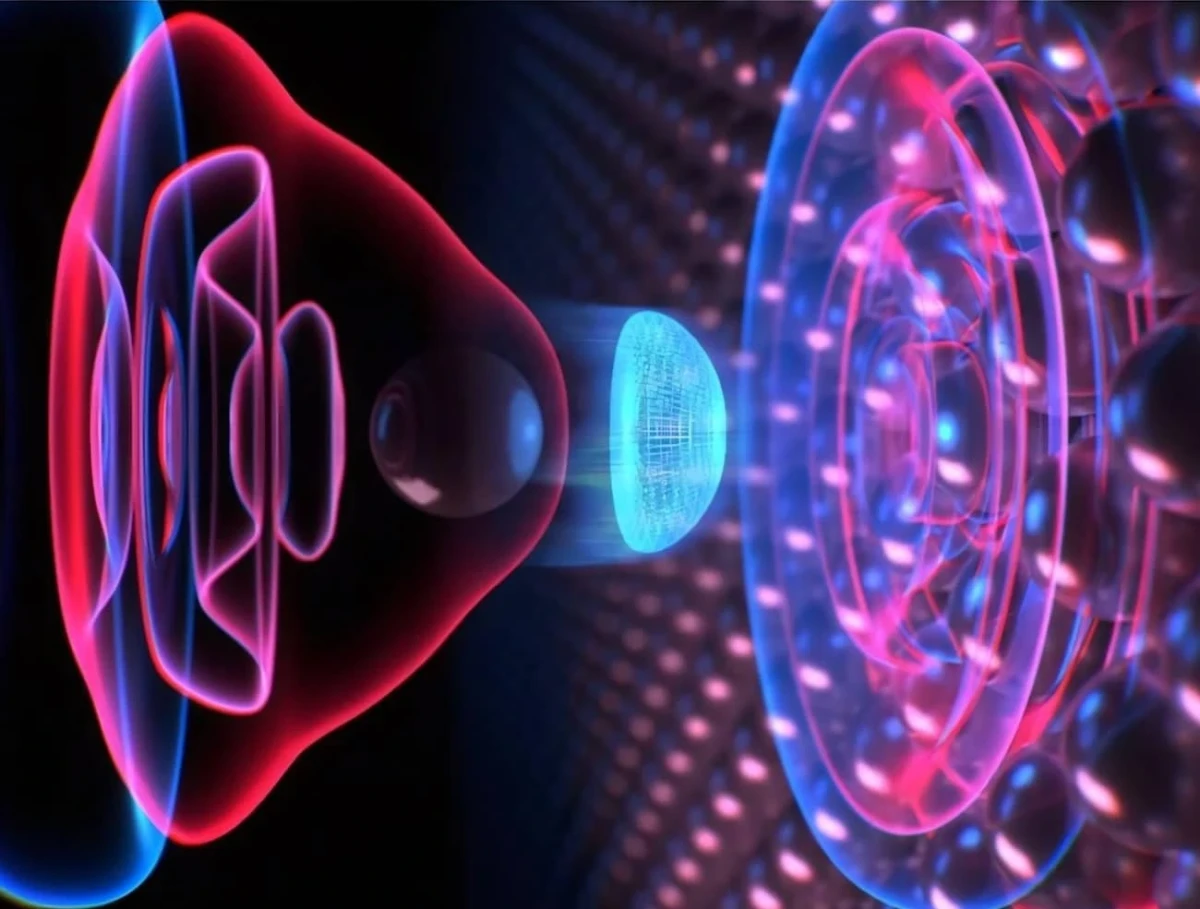
Physicists have discovered an unusual version of the Hall effect in which an electric current is deflected sideways without the use of a magnetic field. The key role in this phenomenon is played not by magnetism, but by a sufficiently strong electric voltage, which temporarily changes the behavior of electrons inside the material. The discovery broadens our understanding of quantum materials and shows that certain effects usually associated with a substance's magnetic properties can also arise under strong electrical driving.
The study by researchers at Rice University in the United States was published in Physical Review Letters. The authors described a previously unknown regime called the “fully nonequilibrium response.” It represents a new variety of the Hall effect and demonstrates that a material's response to an electric field can change significantly depending on the strength of the applied voltage.
Electric Voltage Makes Current Change Direction
The classical Hall effect was discovered more than a century ago. It occurs when an electric current is passed through a conductor while the material is placed in a magnetic field. The magnetic force deflects charge carriers, producing a voltage in a direction perpendicular to the original current.
Physicists later discovered other forms of this phenomenon. For example, the quantum anomalous Hall effect can occur without an external magnetic field. In this case, the necessary condition is provided by the material's own internal magnetic properties.
The new study highlights another possibility: the transverse current characteristic of the Hall effect can arise under a strong electric voltage even when there is no magnetic field either outside or inside the material.
To understand why this result is unusual, it is necessary to consider the concept of time-reversal symmetry. In physics, it describes a situation in which the laws of motion remain the same if the direction of time is imagined to be reversed.
Under ordinary conditions, a magnetic field breaks this symmetry. The emergence of a particular transverse electrical response is therefore usually regarded as a sign of broken time-reversal symmetry.
However, the experimental data examined by the researchers revealed something unexpected: the material exhibited a signal usually associated with the breaking of this symmetry, even though neither an external nor an internal magnetic field was detected.
Two Regimes of Response to Voltage
The researchers established that the quantum nonlinear anomalous Hall effect can manifest in two successive regimes. At relatively low voltages, the material behaves as expected: the current depends on the square of the applied voltage. This nonlinear relationship is consistent with the preservation of time-reversal symmetry.
But as the voltage increases, the situation changes. The electrons acquire additional momentum under the influence of the electric field, and the relationship between current and voltage becomes linear. The result is a signal that superficially resembles an effect associated with symmetry breaking and the material's magnetic properties.
Yet no actual magnetic field appears. Moreover, the new state is not permanent: as soon as the voltage is reduced, the material returns to its original regime, in which time-reversal symmetry is preserved.
The researchers called this temporary transition to a new state the fully nonequilibrium response. “We discovered something that can look like magnetism in an equilibrium system, whose physics we understand fairly well. But it is not actually magnetism, and the system itself is out of equilibrium,” explained the study's first author, Shouvik Sur, a former researcher at Rice University.
According to Sur, the transition point between the two regimes depends on the specific material: in some cases, a relatively low voltage is sufficient, while in others, much stronger electrical driving is required.
Nonequilibrium Physics Helps Explain Quantum Materials
The researchers made the discovery while studying a topological semimetal—a special class of materials whose electronic properties are linked to the topological characteristics of their quantum state.
The work built on studies of a theoretical model of a strongly correlated topological semimetallic state previously proposed by the group of Rice University physicist Qimiao Si. Hall effect measurements initially helped confirm the main principles of this model, but also revealed an unexplained feature that became the starting point for the new study.
According to Si, a professor of physics and astronomy at Rice University, the traditional understanding of the Hall effect was based primarily on the physics of equilibrium systems, in which external influences, such as electric voltage, are relatively weak.
In the new study, the researchers considered a situation in which the external driving becomes so strong that it pushes the material out of equilibrium. Under these conditions, electron behavior changes, and with it the electrical response of the entire system.
The findings are important not only for understanding the new version of the Hall effect. They also provide further motivation for studying strongly correlated topological semimetals and show that investigating nonequilibrium quantum phenomena can offer deeper insights into the properties of matter even in its ordinary equilibrium states.