make preferable
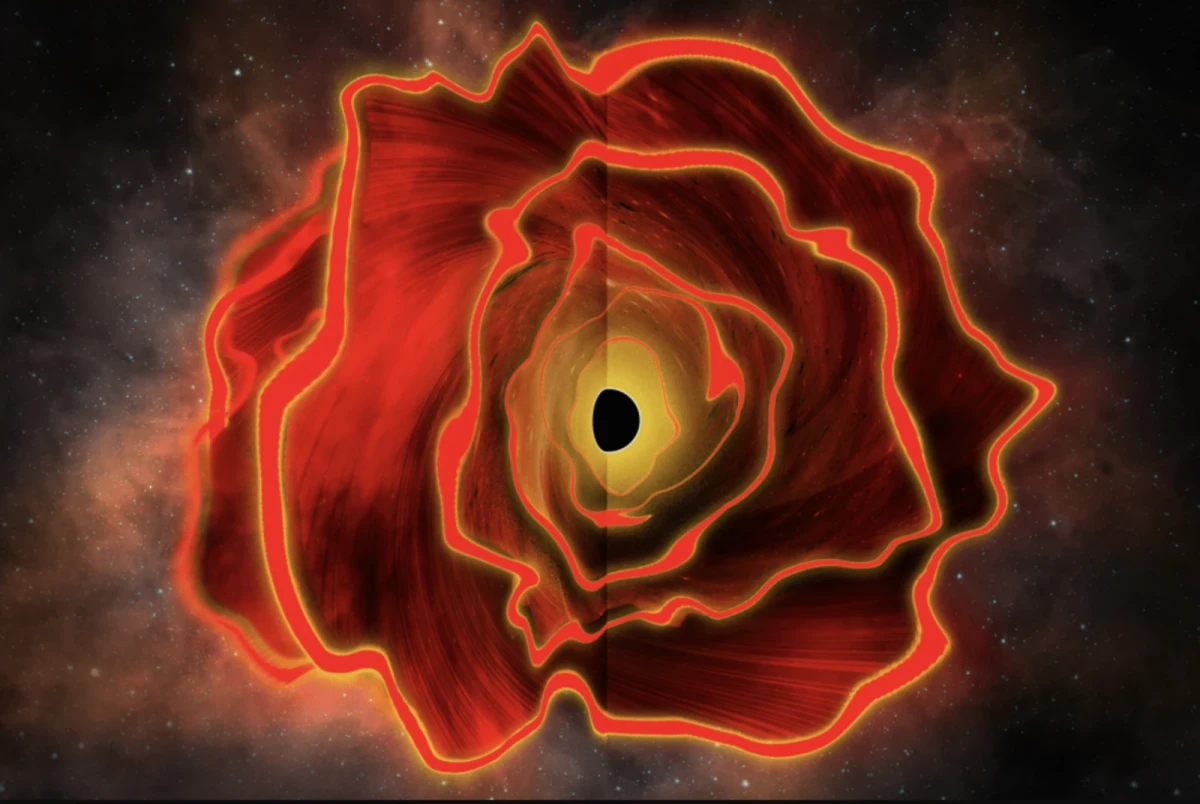
Astronomers have discovered three active black holes in the distant galaxy J0148-4214. Two lie in its central region, separated by only about 620 light-years, while the third is located on the galaxy's outskirts. This is the first evidence of three active black holes in a single galaxy at such an early stage in the history of the Universe.
Researchers at the Max Planck Institute for Extraterrestrial Physics made the discovery by studying data from the James Webb Space Telescope. The results were published in the journal Astronomy & Astrophysics. The finding offers new insight into how supermassive black holes formed and drew closer together in the young Universe.
Three black holes in a young galaxy
The galaxy J0148-4214 is more than 12.5 billion light-years from Earth. Because of the immense time its light took to reach us, astronomers see it as it was when the Universe was approximately 1.2 billion years old.
The researchers identified two black holes in the central part of the galaxy. The larger has a mass of about 80 million times that of the Sun, while the smaller has a mass of approximately 600,000 solar masses. They are separated by only about 620 light-years.
The third black hole lies much farther from the center, at a distance of about 5,500 light-years. Its mass is estimated at approximately 2 million solar masses.
All three objects are active: they consume surrounding material, which heats up under the influence of gravity and produces intense radiation. The smaller of the two central black holes behaves particularly unusually. Its rate of matter accretion exceeds the Eddington limit—the theoretical growth threshold at which radiation pressure begins to counteract further infall of matter into the black hole.
How the telescope distinguished the three objects
Data from an integral-field spectrograph aboard James Webb helped reveal all three black holes. Unlike conventional spectroscopic observations, this instrument can obtain a spectrum for every point in an image simultaneously.
The researchers noticed unusually broad hydrogen lines in the galaxy's spectrum. These are associated with gas moving at thousands of kilometers per second under the gravitational influence of the black holes.
Analyzing the distribution of these spectral features allowed the team to identify signatures of three active objects. With conventional observing methods, astronomers would probably have detected only the most massive black hole: the signals from the other two would have been much harder to distinguish.
According to lead researcher Hannah Übler, this is the first evidence of three active black holes in a single galaxy in such a distant part of the Universe. The scientists suggest that processes occurring early in cosmic history may have efficiently brought massive black holes closer together, creating conditions for their subsequent mergers.
When the black holes will merge
According to the researchers' calculations, the two central black holes could merge in about 700 million years. The third, located on the galaxy's outskirts, could subsequently join them.
Such events generate gravitational waves—ripples in spacetime that travel at the speed of light. These waves are expected to be detectable by the LISA space observatory, which the European Space Agency plans to launch in 2035.
The study's authors estimated a 38% probability that LISA could detect the first of the predicted merger events. For the second event, involving the possible merger with the third black hole, the estimate is 82%.
For now, these are predictions based on calculations of the system's dynamics, not a guarantee that future signals will be detected. Nevertheless, they show that the discovery could be significant not only for studying the distant galaxy but also for future gravitational-wave observations.
Why this discovery matters
Triple black hole systems have been found before, but the known examples were in relatively nearby, mature galaxies. The new observation reveals a similar configuration at a time when the Universe was still very young.
This is important for understanding how supermassive black holes grew and how they assembled into larger systems. If massive objects did indeed frequently draw close together during the early stages of galaxy evolution, their subsequent mergers could have played a substantial role in forming the black holes astronomers observe today.
The result is particularly valuable because the scientists were able to distinguish all three objects using spectral data, rather than simply detect an unusually bright galactic center. This demonstrates James Webb's capabilities for studying complex systems in the early Universe and paves the way for searches for other similar triplets.