make preferable
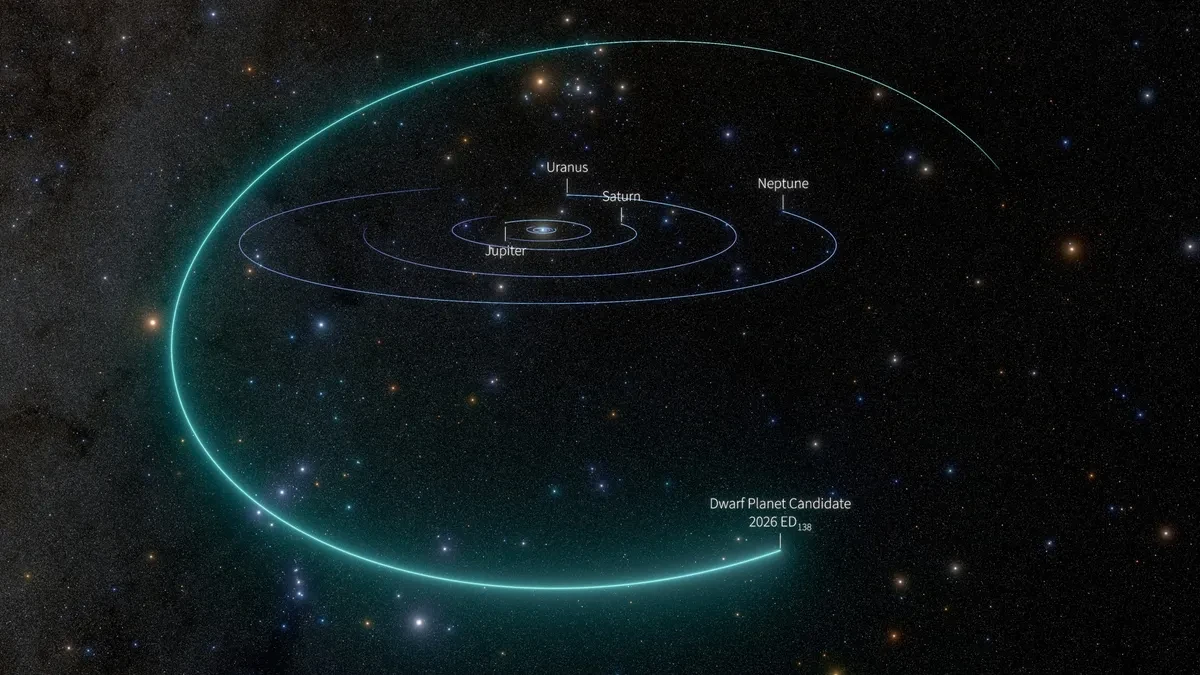
The Vera C. Rubin Observatory in Chile has discovered a distant icy object that could be one of the largest dwarf planets in the Solar System. Preliminary estimates put its diameter at between 600 and 1,500 km. The object, designated 2026 ED138, lies beyond Neptune's orbit, roughly 46 times farther from the Sun than Earth.
The discovery was announced on October 27. Scientists cannot yet confirm that the object is indeed a dwarf planet: doing so requires a more precise measurement of its size. If confirmed, it will join the short list of such objects, which currently includes Pluto, Ceres, Eris, Haumea, and Makemake.
A discovery in the observation archives
The object was discovered by Matthew Holman of the Center for Astrophysics | Harvard & Smithsonian. On October 13, he was examining previously collected data from the Vera C. Rubin Observatory using a search algorithm developed with his colleague Kevin Napier.
The program identified an unusual object beyond Neptune's orbit. Despite its enormous distance from the Sun, it was bright enough to suggest that it was larger than most known trans-Neptunian objects.
“My first reaction was delighted disbelief,” Holman said. According to him, such bodies are rare, so he immediately began checking whether either he or the algorithm had made a mistake.
Follow-up checks confirmed that the discovery was real. Between March 4 and July 11, 2026, the telescope recorded 2026 ED138 30 times over 20 nights. Additional data were also found in the observation archives of another instrument: the Dark Energy Camera, mounted on the four-meter Víctor M. Blanco Telescope in Chile. It had observed the object as far back as 2016.
Why the object could be a dwarf planet
Preliminary estimates put the diameter of 2026 ED138 at between 600 and 1,500 km. That size suggests that the body's own gravity may have pulled it into a nearly spherical shape.
The ability to take on a nearly spherical shape is one of the main criteria distinguishing dwarf planets from small asteroids. However, an estimated size alone is not enough to classify the object definitively.
To refine the estimate of its diameter, astronomers will need infrared observations. In particular, the James Webb Space Telescope could help, as it can study cold, distant objects and obtain the data needed to assess their physical characteristics.
For now, 2026 ED138 should be considered a dwarf planet candidate rather than a confirmed member of this category.
An orbit beyond Pluto
The object is currently about 46 astronomical units from the Sun. One astronomical unit corresponds to the average distance between Earth and the Sun, about 150 million km. By comparison, Pluto's average distance from the Sun is approximately 40 astronomical units.
The orbit of 2026 ED138 is tilted by about 25 degrees relative to the plane of the Solar System. The researchers believe this orientation may be the result of a gravitational interaction with Neptune that altered the object's trajectory.
Trans-Neptunian bodies are of particular interest to astronomers: they lie in the cold outer regions of the Solar System and may preserve information about its early history. Studying their orbits and sizes helps scientists understand how icy bodies formed and migrated on the outskirts of our planetary system.
The observatory that will spend ten years searching for new worlds
The discovery is one example of how large-scale sky surveys can reveal objects that previously went unnoticed. The Vera C. Rubin Observatory is located on Cerro Pachón in northern Chile. Its primary mirror is 8.4 meters in diameter, and its 3.2-gigapixel camera is considered the largest digital camera ever built for astronomy.
As part of the ten-year Legacy Survey of Space and Time (LSST), the observatory will photograph the entire southern sky every few days. Successive images will allow scientists to track the movements of celestial bodies and build a detailed picture of the Solar System.
Rubin has already discovered more than 11,000 new asteroids. In the coming years, its observations could help uncover other large bodies beyond Neptune's orbit, including new dwarf planet candidates.
“If its dwarf planet status is confirmed, ED138 will join a very small family of worlds,” Holman noted. He said repeated observations of the entire southern sky over ten years would reveal objects that had previously remained beyond the reach of astronomical surveys.
For now, the final classification of 2026 ED138 remains an open question. But even if the object is not granted dwarf planet status, its discovery shows how much there is still to learn about the distant outskirts of the Solar System.