make preferable
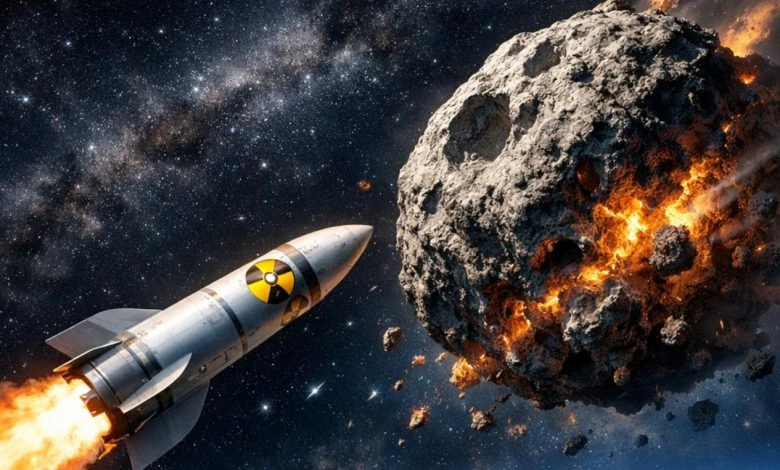
American researchers have developed a new computer model that can calculate the effects of a nuclear explosion near a hazardous asteroid much more accurately. Simulations showed that choosing which side to irradiate can change the effectiveness of deflection by almost a factor of five. The new model also runs more than 1,600 times faster than previous models, making it possible to explore a much wider range of scenarios for protecting Earth.
One asteroid, different outcomes
One possible way to prevent a hazardous asteroid from colliding with Earth is to detonate a nuclear device at some distance from it. The idea is that an intense burst of X-rays would heat and vaporize part of the celestial body's surface. The resulting stream of material would generate thrust, changing the asteroid's trajectory.
However, the effectiveness of this method depends on more than just the explosive yield and the distance to the target. As a new study by American scientists has shown, the side from which the asteroid is irradiated also matters enormously.
The researchers ran computer simulations in which the same asteroid was exposed to X-rays from different angles. In one case, the change in its linear velocity was 3.9 mm/s; in another, it was just 0.8 mm/s. Thus, the choice of irradiation direction produced an almost fivefold difference.
The effect on the celestial body's rotation was just as significant. For another simulated asteroid, the change in rotational speed varied by a factor of 17 depending on the direction of irradiation.
According to study leader Nathan Moore, a physicist at Sandia National Laboratories, the scientists had expected the point of exposure to matter, but had not anticipated such a large difference.
The findings were published in the scientific journal Icarus.
Why an asteroid's shape matters
The main problem with previous studies was their simplified representation of asteroids. For mathematical calculations, they were often modeled as spheres, even though real celestial bodies have irregular shapes, uneven surfaces, and numerous protrusions and depressions.
These features significantly affect how energy is distributed during irradiation. Depending on the surface geometry, the same explosion can cause different amounts of material to vaporize in different parts of the asteroid. As a result, both the magnitude and the direction of the resulting impulse change. Uneven exposure can also substantially alter the celestial body's rotation.
To account for these factors, Moore's team combined two computational tools developed at Sandia National Laboratories. The first, ALEGRA, is designed to simulate rapid, high-energy processes. The second, SPARTA, can calculate the effects of relatively weak forces acting over long periods.
Combining these approaches made it possible to account simultaneously for the asteroid's complex geometry and the physical processes that occur during exposure to X-rays.
The model is more than 1,600 times faster
An equally important achievement was the new algorithm's computational efficiency. According to Moore, it runs more than 1,600 times faster than previous approaches. This is what enabled the researchers to perform calculations that had previously been virtually impossible because of the computing resources required.
The model can use three-dimensional images of an asteroid captured by spacecraft to reconstruct its shape. Researchers can then specify the parameters of a hypothetical explosion: its yield, its distance from the celestial body, and the direction of the X-ray exposure.
The result is a detailed heat map showing which areas of the surface heat up and the extent to which material vaporizes. This is used to calculate the impulse transferred to the asteroid, changes in its velocity and rotation, and the potential extent of fragmentation.
This makes it possible not only to assess the overall effectiveness of a nuclear blast, but also to identify the conditions under which it is most likely to change the trajectory of a particular celestial body.
The key risk: turning an asteroid into a cloud of debris
When developing such methods, it is important to consider not only the possibility of deflecting an asteroid, but also the risk of breaking it apart. Splitting a celestial body does not in itself guarantee safety: instead of a single large object, numerous fragments could head toward Earth, posing a threat of their own.
The goal, therefore, is to transfer enough momentum to the asteroid to change its trajectory without destroying the body itself.
The new model still has a significant limitation. It accounts for the breakup and vaporization of surface rock, but cannot reliably predict how the asteroid as a whole will behave under the effects of the explosion. That will require further research and more advanced computational tools.
There is also a practical problem: accurate modeling requires detailed three-dimensional data on the asteroid's shape from all sides. Obtaining this information in advance will not always be possible, especially if a potentially hazardous object is discovered shortly before a possible collision.
Nevertheless, the new development makes nuclear deflection calculations much more accurate and allows researchers to account for factors that were previously beyond the capabilities of computer modeling. In the event of a real threat, this could prove crucial: simply knowing how powerful the explosion needs to be is not enough. It is also necessary to understand where to direct its effects so that the asteroid changes course rather than spinning faster or breaking apart into dangerous fragments.