make preferable
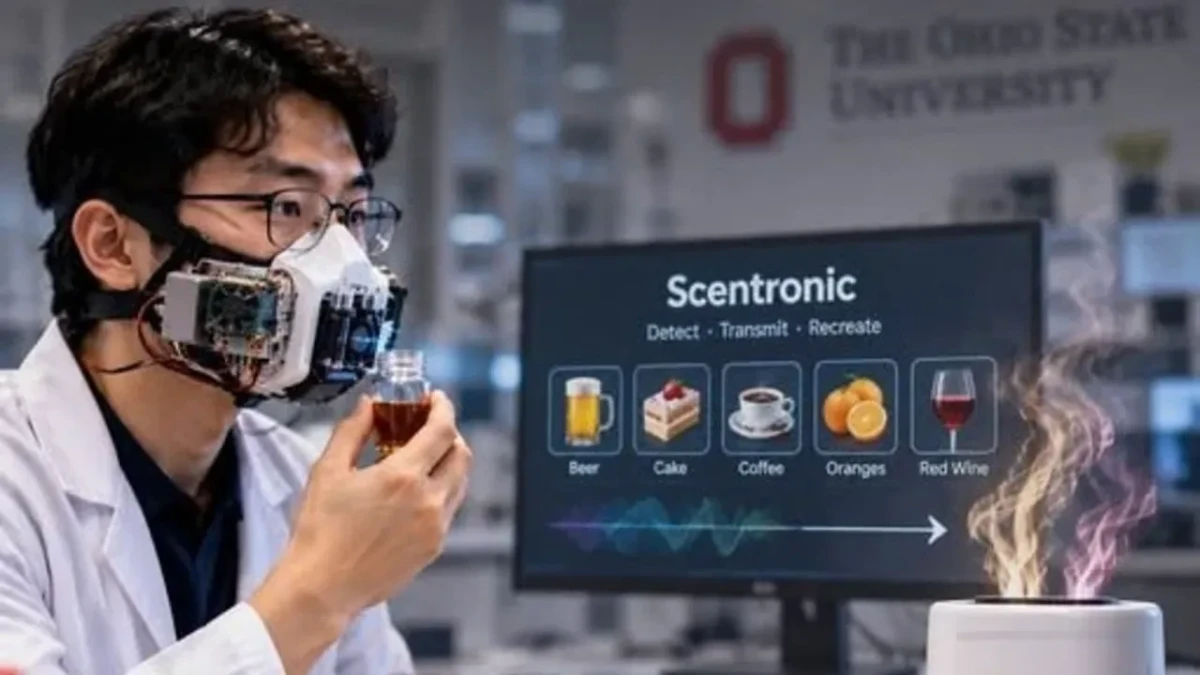
Researchers at Ohio University have unveiled Scentronic, a technology that can identify odors, transmit their digital characteristics over the internet, and reproduce a scent on another device. The development could find applications in medicine, virtual reality, the perfume and cosmetics industries, as well as the restaurant business and online food retail.
The system combines an electronic nose, artificial intelligence algorithms, and a compact scent-reproduction device. The electronic nose is equipped with six gas sensors that respond to volatile organic compounds—the substances that produce odors. The resulting signals are analyzed by machine learning algorithms that determine which category the detected scent belongs to.
During testing, the researchers used five scents: beer, cake, coffee, orange, and red wine. The k-nearest neighbors (k-NN) algorithm correctly classified every sample in the test set. Once a scent is identified, the data is transmitted via Wi-Fi through a cloud system to a remote device.
How Scents Are Reproduced
At the receiving end, a special generator uses a piezoelectric atomizer to turn a scented liquid into a fine aerosol. This allows the user to smell a scent that has been identified and transmitted from another device. The authors developed several wearable and compact device designs, including a bracelet, a pendant, and a portable unit. The system can also operate with multiple scent channels.
Importantly, what travels over the internet is not the odor molecules themselves, but digital data about the identified scent. The receiving device reproduces the smell using pre-prepared scented liquids. As a result, the technology cannot yet accurately transmit any arbitrary odor or reproduce every nuance of a complex scent composition.
From Medicine to Perfumery and Restaurants
One potential application for Scentronic is medicine. The system could help assess people's sense of smell remotely and determine their odor detection thresholds. Smell disorders can occur after viral infections or head injuries, and can also accompany neurodegenerative diseases. The ability to conduct such tests using electronic devices could prove useful for remote patient monitoring.
However, the technology's potential is not limited to medicine. In the perfume and cosmetics industries, systems like this could allow customers to sample the scents of perfumes, creams, and other products while shopping online. Today, consumers can see a product image and read its description, but cannot smell it. Transmitting scents over the internet could overcome this limitation.
The same opportunity exists for restaurants and food producers. Digital menus could be enhanced with the smells of dishes, allowing diners to experience the aroma of food before ordering. Food producers could use the technology to present new products remotely, while online stores could give customers a fuller experience of their offerings.
The researchers also tested the system in combination with virtual reality technology. They created a cup with five channels for delivering scents and five channels for liquids that provide taste sensations, and integrated it with a Meta Quest 3 headset. Users could select coffee or beer in the virtual environment, after which the device reproduced the corresponding aroma and dispensed the liquid.
What Limitations Remain
In tests involving volunteers, the system achieved an accuracy of 58.57% in recognizing scent intensity, 72.86% in identifying individual scents, and 71.43% in recognizing mixtures of two scents.
The authors note that the current version of Scentronic recognizes odors at the category level rather than determining their full chemical composition. Reproduction is also limited to the set of scented liquids preloaded into the device. More accurate transmission of complex odors will require additional sensors, more reproduction channels, and improved algorithms.
Nevertheless, the work demonstrates the potential to expand digital communication beyond images and sound. In the future, the internet could become a medium for transmitting other sensory experiences, including smells, opening up new possibilities for medicine, retail, entertainment, and the food industry.