make preferable
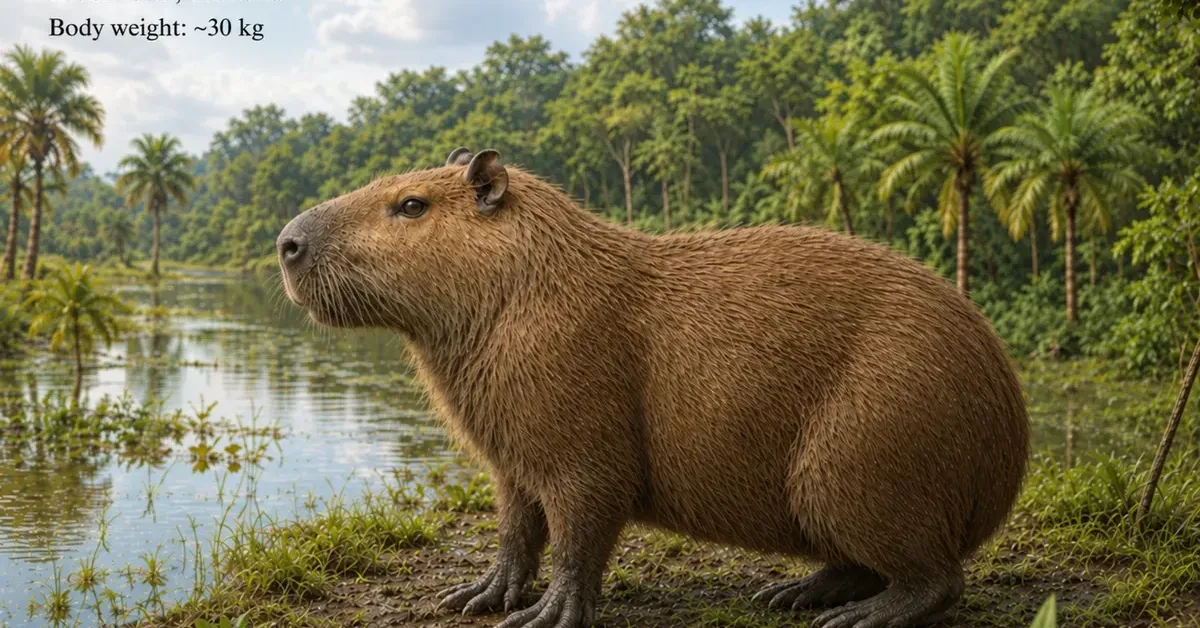
Paleontologists have discovered fossilized teeth in Thailand belonging to a previously unknown species of giant rodent that lived in Southeast Asia around 34 million years ago. Researchers estimate that the animal may have weighed around 30 kg—roughly as much as a large dog. The discovery suggests that large rodents appeared in Asia long before the largest members of this group emerged in South America.
The new species has been named Yakamys sirindhornae. Its remains were discovered in a coal mine in Krabi Province in southern Thailand. Scientists found just two fossilized teeth: a lower molar and an incisor. No complete skeleton or other bones from the animal have yet been discovered.
The study was published on November 11 in the scientific journal Scientific Reports. The research was led by paleontologist Yaowalak Chaimanee of the University of Poitiers and Professor Virginie Millien of McGill University.
The animal's size was reconstructed from two teeth
At first glance, two teeth might seem insufficient to reconstruct an entire animal. For paleontologists, however, teeth are one of the most important sources of information about extinct mammals. Their shape, size and enamel structure help not only to place an animal within a particular evolutionary group, but also to estimate its size.
The molar that was found measured nearly 1.3 cm across. By comparison, the molars of Hulgana, previously considered the largest Asian member of the same rodent family, were smaller by a factor of just under two in both length and width.
To estimate the body mass of Yakamys sirindhornae, the scientists used seven mathematical models relating tooth size to body mass in living rodents. The results varied: different formulas produced estimates ranging from 21 to 47 kg. The mean was around 32 kg, while the median was approximately 29 kg. The researchers selected around 30 kg as a working estimate.
The scientists stress that this is an approximate estimate, not a precise measurement. Without a more complete skeleton, it is impossible to establish the animal's actual size.
Giant rodents appeared in Asia much earlier than previously thought
The age of the find makes it particularly significant. Until now, the best-known examples of gigantism among rodents were associated mainly with South America. It was there that, millions of years later, the largest members of this group emerged, including Josephoartigasia monesi.
Today, the largest living rodent is the capybara, which can weigh around 60–65 kg. However, the history of large members of this order stretches much further back than modern animals might suggest.
Yakamys sirindhornae lived during the late Eocene, approximately 35–34 million years ago. Its discovery shows that substantial increases in body size were already occurring in the early stages of rodent evolution, long before the appearance of the South American giants. Moreover, this process was not confined to South America: Southeast Asia was also an important region in the early evolution of large rodents.
Scientists place the new species in the family Ischyromyidae, one of the early evolutionary groups of rodents. Its members were widespread across North America, Europe, Asia and Africa. However, the Asian fossil record of this group remains relatively sparse: previously known finds consisted mainly of small animals from China and India. The discovery in Thailand fills part of this gap and broadens our understanding of the diversity of ancient rodents in the region.
Could the ancient rodent have led a semiaquatic lifestyle?
The site where the fossils were discovered suggests that the animal inhabited a landscape with lakes and other bodies of water. The teeth were found in clay deposits formed in an ancient lake environment.
The researchers suggest that Yakamys sirindhornae may have spent some of its time near water, much like the modern capybara. However, there is no direct evidence yet of a semiaquatic lifestyle. More complete remains, particularly limb bones and a skull, are needed to draw such conclusions.