make preferable
The gamma-ray burst GRB 260310A, detected in March 2026, puzzled astronomers: the initial flash appeared relatively faint, yet its afterglow turned out to be one of the brightest in the past two decades. In visible light, it outshone the galaxy where the explosion occurred, and several weeks later, its X-ray emission brightened again.
An international team of researchers has proposed an explanation for this unusual pattern. They suggest that the explosion produced a jet—a narrow stream of material moving at nearly the speed of light. It likely had a complex structure: a narrow, energetic core surrounded by a wider, slower flow. This configuration could explain why the initial flash appeared unremarkable while its afterglow was exceptionally bright. The findings were published in The Astrophysical Journal Letters.
A Faint Flash and an Exceptionally Bright Afterglow
GRB 260310A was detected by NASA's Fermi Gamma-ray Space Telescope on March 10, 2026. The initial flash lasted about 53 seconds. Its intensity did not suggest a particularly powerful event, so the gamma-ray burst did not initially appear exceptional.
Follow-up observations, however, revealed a different picture. In visible light, the afterglow gradually brightened over several hours, becoming brighter than its host galaxy. It then began to fade. About three weeks later, the X-ray emission brightened significantly again, and a bright X-ray afterglow remained observable for several more months.
Astronomers combined data from several observatories, including the Chandra and XMM-Newton X-ray telescopes, the Einstein Probe space mission, the Large Binocular Telescope, and the Karl G. Jansky Very Large Array radio interferometer. Observations at the Calar Alto Observatory also revealed signs of a supernova—an explosion accompanying the death of a massive star.
This confirmed that the gamma-ray burst was associated with the end of a massive star's life. Explaining the unusual changes in the afterglow's brightness, however, proved considerably more difficult.
Why the Jet's Direction Matters
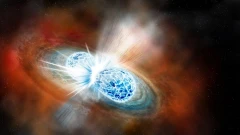
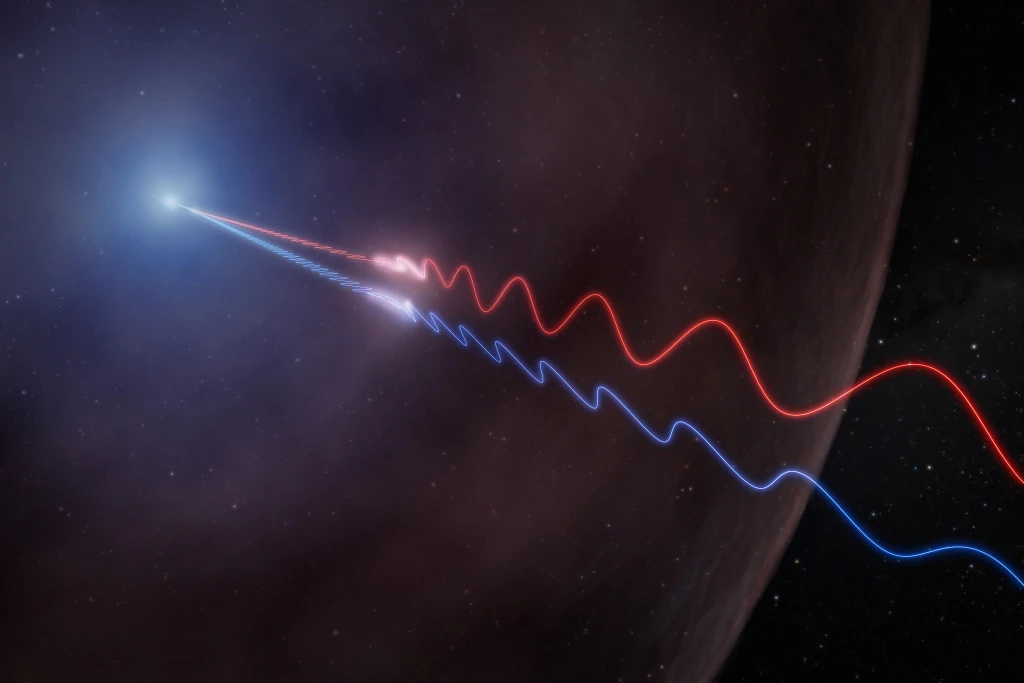
Gamma-ray bursts are among the most powerful brief releases of energy in the universe. One mechanism that produces them involves the collapse of a massive star. This process creates jets—narrow streams of material moving at close to the speed of light.
When these jets collide with the surrounding gas, they produce an afterglow. It can be observed at X-ray, visible, and radio wavelengths and can last much longer than the initial gamma-ray flash.
The brightness of an event depends not only on its true power but also on the angle of the jet relative to the observer. If the jet points directly toward Earth, its radiation appears especially intense. If it points away from us, the initial gamma-ray burst may appear much fainter.
“Like a flashlight, a jet appears brightest when we look straight at it. Most of our models are calibrated using events observed from that same perspective. This burst gave us a chance to look beyond the dazzling light,” explained the study's lead author, Yu-Han Yang.
The observations suggest that GRB 260310A may have been just such an event, with its jet pointing away from Earth. Its gamma-ray burst did not stand out from the rest, but its optical and X-ray afterglows ranked among the brightest 1% of observed events. Its radio emission ranked among the brightest 5%.
Two Components of a Single Jet
To explain the renewed brightening in X-rays, the researchers considered a model of a jet with a complex structure. According to this hypothesis, the jet consisted of a narrow, high-energy core surrounded by a wider, slower flow.
Early on, the observed afterglow may have come primarily from the jet's broad outer regions. Because its core was pointed away from Earth, it remained less visible. Later, as the jet expanded and the viewing conditions changed, emission from the core may have become easier for telescopes to detect. This would explain the renewed increase in X-ray brightness several weeks after the initial explosion.
For now, this structure remains an explanation proposed on the basis of observations and modeling, rather than a directly captured image of the jet. Nevertheless, it brings several unusual features of GRB 260310A together into a coherent picture.
“What seemed to us like an unremarkable gamma-ray burst could have appeared to an observer looking straight into the jet's core as a monstrous explosion,” Yang noted. The researchers estimate that the energy channeled into the narrow flow was comparable to the amount the Sun emits over roughly a billion years.
Why Such Events Matter for Astronomy
Astronomers detect hundreds of gamma-ray bursts every year, but unusual events often prove the most informative. They allow researchers to test models that describe typical observations well but may not account for more complex jet configurations.
“We see hundreds of gamma-ray bursts every year, but the unusual ones are the most informative. We could explain individual features of this burst, but bringing them all together into a single picture proved much harder,” said study co-author Roberto Ricci of the University of Rome Tor Vergata.
GRB 260310A shows that a gamma-ray burst's initial brightness does not always reflect the scale of the event. If a jet points away from the observer, its true power may be underestimated, while features of its afterglow can reveal a structure that is difficult to detect directly.
Further observations and comparisons with other gamma-ray bursts will help determine how common such jets are and whether their complex structure really explains the unusual behavior of GRB 260310A.