make preferable
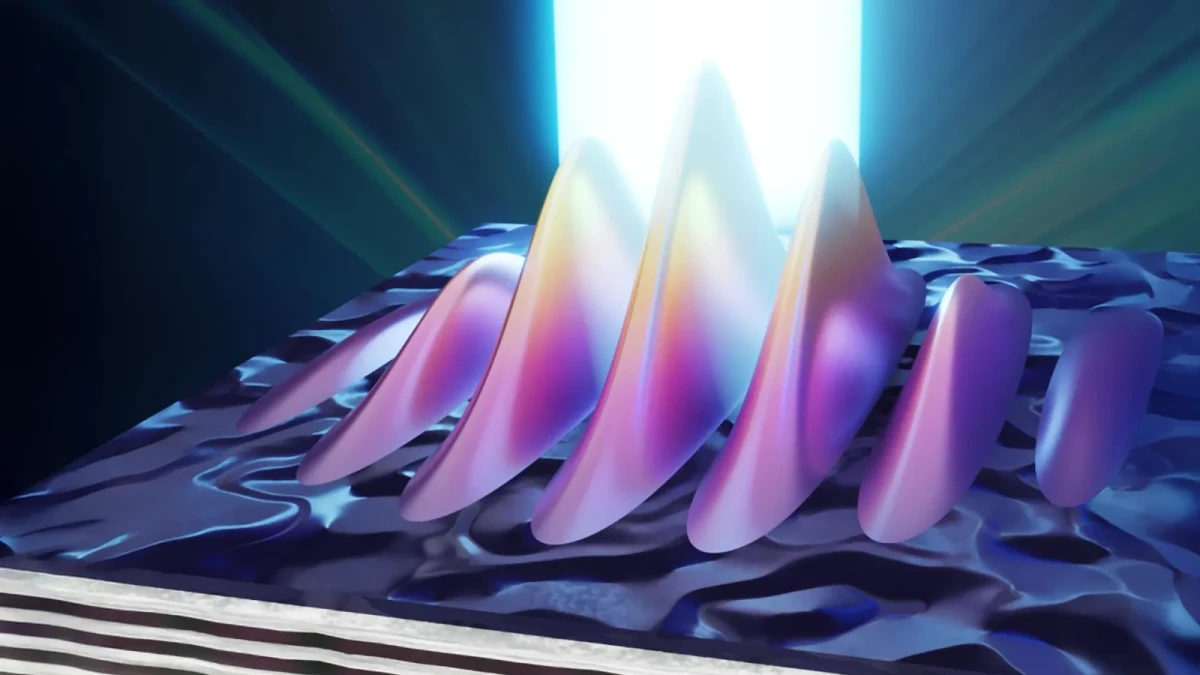
An international team of scientists has demonstrated an unusual quantum state in which light and matter simultaneously exhibit the properties of a solid and a superfluid. The experiment is particularly notable because the researchers managed to produce this system at room temperature, without the cooling to near absolute zero required for most similar experiments. The results were published in the journal Science Advances.
The state in question is a supersolid. It combines two properties that seem incompatible in conventional terms: the ordered structure of a crystal and the ability to flow without viscosity, characteristic of a superfluid.
The experiment involved researchers from the Faculty of Physics at the University of Warsaw, the Military University of Technology in Poland, IBM Research Zurich, and the French National Centre for Scientific Research (CNRS). Instead of ultracold atoms, they used hybrid particles that combine the properties of light and matter.
How matter can be both solid and fluid
Under ordinary conditions, solids and liquids behave very differently. In crystals, particles are arranged in an ordered, repeating structure, whereas a liquid can flow freely and change shape.
Quantum physics allows for more unusual states. One is superfluidity, in which a liquid loses its viscosity, or internal resistance to motion. Such a medium can pass through extremely narrow channels with virtually no friction. However, once a certain speed is reached, quantum vortices—microscopic structures resembling whirlpools—begin to form within it.
As early as the 1960s, physicists proposed that a superfluid medium could acquire another unusual property: crystalline order. This combination became known as supersolidity.
For a long time, the supersolid state remained a theoretical concept. The first experimental evidence emerged in 2017, when researchers observed it in ultracold atomic Bose–Einstein condensates. In such systems, particles enter a collective quantum state and begin to behave as a single entity.
The main difficulty was that the material had to be cooled to temperatures close to absolute zero to achieve the necessary conditions. The new study offers an alternative approach.
Particles of light and matter instead of ultracold atoms
Researchers from the international TopoLight consortium used exciton-polaritons—quasiparticles that arise from strong interactions between light and matter.
To create them, the scientists placed specially selected materials in an optical microcavity, a miniature chamber in which light interacts with matter. This produces hybrid particles with the properties of both photons and excitations in matter.
Exciton-polaritons have extremely short lifetimes, typically just a few picoseconds, or trillionths of a second. Yet even in that time, they can form a Bose–Einstein condensate and exhibit collective quantum behavior, including superfluidity.
For the experiment, the team created a microcavity containing a special liquid crystal and coated it with an organic semiconductor. This design enabled sufficiently strong light–matter interactions to produce the required quantum state without extreme cooling.
According to Professor Wojciech Piecek of the Military University of Technology, the liquid-crystal microcavities developed by his group can operate even at temperatures of around 60 °C. This significantly broadens the conditions under which unusual quantum phenomena can be studied.
Light patterns revealed the supersolid state
The scientists inferred the emergence of supersolidity from the light emitted by the experimental system.
As the condensate transitioned into the new state, regularly spaced bright stripes appeared in the image. They indicated that the particle density in the system had acquired a periodic structure—a hallmark of crystalline order.
But the researchers also noticed another feature: after each laser pulse, the stripes appeared in different positions. Rather than adopting a single fixed configuration, the system settled on one of several equivalent options each time.
This phenomenon is called spontaneous symmetry breaking. The original system allows several equivalent states, but as new order forms, it independently selects one of them. Professor Guillaume Malpuech of the CNRS Institut Pascal noted that this was precisely the behavior predicted by the theory of supersolidity.
The experiment also revealed a so-called persistent spin helix—a periodic variation in the polarization of the emitted light. Polarization defines the orientation of the oscillations of a light wave's electric field.
The scientists thus recorded two types of order at once: one manifested itself in the intensity of the light, the other in its polarization. Together, these observations provided evidence for the emergence of a supersolid state.
Why there were only a few hours to take measurements
The experiment proved challenging not only scientifically but also practically. The organic semiconductor used in the device gradually reacted with the liquid crystal. As a result, the completed samples remained functional for only a limited time.
After assembly, the researchers had just a few hours to take the necessary measurements. The sequence of experiments therefore had to be planned in advance: repeating an individual measurement meant making a new sample.
The main measurements were carried out at IBM Research Zurich. There, thin layers of an organic semiconductor were deposited on specially designed photonic structures. The structures themselves, designed to control light, were fabricated by specialists at the Military University of Technology.
MeLPPP is an organic semiconductor whose properties IBM scientists had been studying for many years. Researchers had previously even observed Bose–Einstein condensation in it, but this was the first time they had managed to combine it with a liquid-crystal microcavity.
It was the combination of these materials that made it possible to produce a supersolid state at temperatures typical of laboratory experiments.
Why quantum matter that works without cooling matters
The practical significance of the discovery stems primarily from the fact that many exotic quantum states have so far been accessible for study only using complex cryogenic systems. These require temperatures close to absolute zero, increasing the cost and complexity of experiments.
The new system shows that some quantum effects can be studied in photonic devices operating at much more accessible temperatures. This potentially paves the way for technologies that use light to process information.
Possible directions include ultrafast photonic devices, computing accelerators, and neuromorphic systems that replicate certain principles of information processing in the human brain. Such approaches could help perform specific computational tasks more efficiently.
Another potential application is optical sensors. The system's observed sensitivity to light polarization could prove useful in developing instruments capable of detecting very small changes in optical signals.
For now, all these applications remain prospects for further research rather than ready-to-use technologies.
The quantum state can be controlled electrically
The experimental platform has another important feature: its optical properties can be changed by applying an external voltage. According to the researchers, it is the first platform for studying supersolid exciton-polariton condensates that allows electrical tuning.
This capability makes it possible to change the system's parameters and observe how the quantum state emerges, interacts with its environment, and responds to external influences. In the future, this could be important for developing photonic devices that require precise control over the behavior of light and matter.
The main outcome of the study is not a finished quantum computer or a new type of sensor, but an experimental platform that allows unusual states of matter to be studied without extreme cooling. The combination of room-temperature operation and electrical control makes it a more flexible tool for exploring quantum physics and potentially brings some laboratory effects closer to practical application.