make preferable
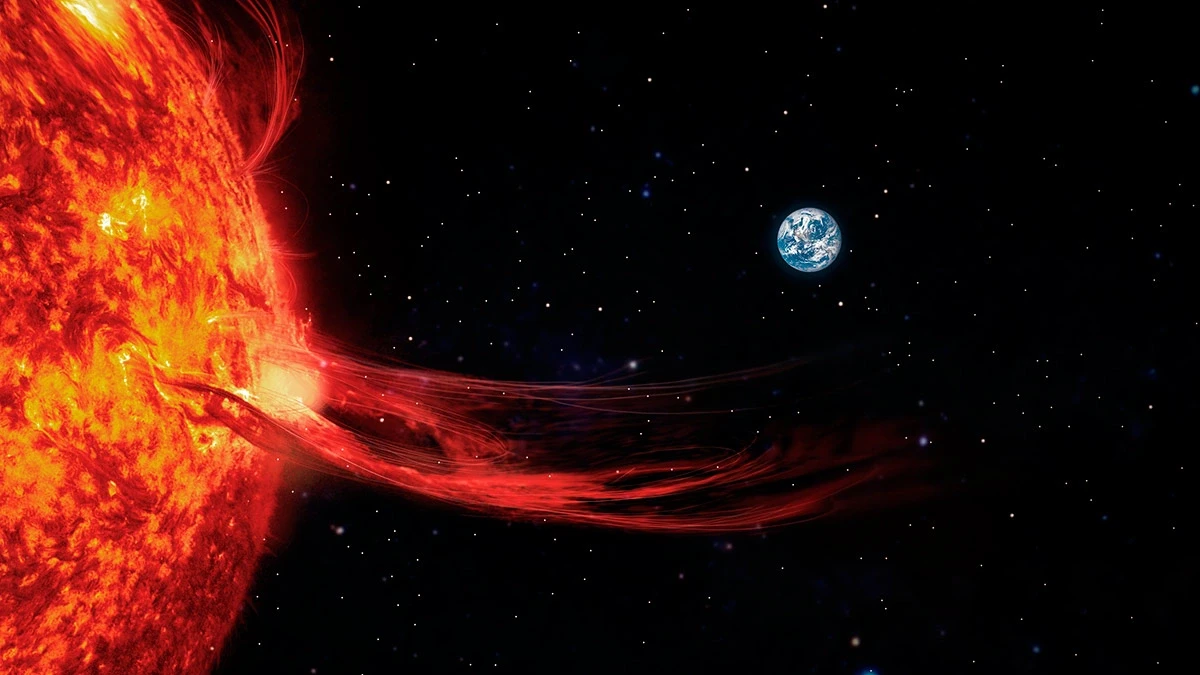
The most powerful solar storms can be intensified by processes occurring not on the Sun, but in Earth’s own atmosphere. Japanese researchers reached this conclusion after studying the magnetic storm of May 2024. Satellite measurements showed that about 85% of the charged particles that formed the ring current around the planet during this event came from the upper layers of Earth’s atmosphere. The discovery changes our understanding of how extreme geomagnetic disturbances develop and could help improve forecasts of hazardous space weather events.
The study’s findings were published in the journal Science Advances. The data were collected by Japan’s Arase satellite, which observed Earth’s magnetosphere during the storm.
The unexpected role of Earth’s atmosphere
In May 2024, several powerful solar eruptions sent successive clouds of magnetized plasma toward Earth. After interacting in space, these streams of charged particles reached the planet’s magnetosphere and triggered one of the strongest geomagnetic storms in recent decades. Bright auroras were observed in regions where such displays are extremely rare.
The storm, known as the Gannon storm or the “Mother’s Day storm,” reached a SYM-H index value of minus 518 nanoteslas. This was the second-largest disturbance since measurements began in 1981. A comparable event was previously observed in November 2004.
One of the main drivers of geomagnetic disturbances is the ring current—a vast region of energetic charged particles circulating around Earth at altitudes of several thousand kilometers. It consists mainly of oxygen and hydrogen ions. Their movement generates a magnetic field of its own that partially opposes Earth’s field. As a result, the magnetic field measured near the planet’s surface weakens.
Until now, scientists had known of two main sources of particles for the ring current: the solar wind, which carries material from the Sun, and the ionosphere—the electrically charged layer of Earth’s upper atmosphere. The solar wind was expected to make a substantial contribution during particularly powerful storms.
However, Arase’s measurements revealed a different picture. About 85% of the detected ions were oxygen originating in Earth’s ionosphere. Particles of solar origin made a relatively small contribution to the ring current’s composition.
According to the study’s lead author, Naritoshi Kitamura of the Institute for Space–Earth Environmental Research at Nagoya University, this was the first simultaneous observation of ring-current ions and solar-wind ions during a storm of this magnitude.
The magnetic field weakened by 40%
The Arase satellite recorded another unusual feature of the May event. Near the storm’s peak, the magnetic field strength at an altitude of about 16,000 kilometers above Earth fell by 40%. Such substantial weakening was recorded much closer to the planet than in previous observations of comparable magnetic disturbances.
At the same time, the satellite’s instruments detected a decrease in the number of energetic electrons that normally circulate in this region of the magnetosphere. A major change in the magnetic field can alter electron trajectories and divert them from their usual orbits. However, the researchers have not yet established whether the weakening of the field was the direct cause of the decline in electron numbers. Further observations are needed to confirm this link.
The scientists suggest that the unusually high concentration of heavy oxygen ions originating on Earth may have intensified the magnetic disturbance and caused the ring current to reach its maximum intensity closer to Earth.
Why the discovery matters for storm forecasting
Geomagnetic storms pose a threat not only to satellites and spacecraft. They can disrupt GPS navigation and communications systems, create radiation hazards for space equipment, and cause failures in power grids.
Understanding how such storms form and develop therefore has practical importance. Until now, forecasting models have relied primarily on solar-wind characteristics. The new data show that assessing the strength of a future disturbance also requires taking into account conditions in Earth’s upper atmosphere—in particular, the number of ions entering the magnetosphere from it.
To investigate this process further, Japanese researchers are proposing the FACTORS mission, which they plan to submit to a future call for proposals by the Japan Aerospace Exploration Agency (JAXA). The mission would involve launching two satellites to study the mechanisms that transport atmospheric ions into the magnetosphere and their influence on geomagnetic storms.
If the mission goes ahead, its data will help improve our understanding of how solar material interacts with Earth’s atmosphere and refine forecasts of extreme space weather events. This will allow risks to satellites, navigation systems, communications networks, and energy infrastructure to be assessed in advance.