make preferable
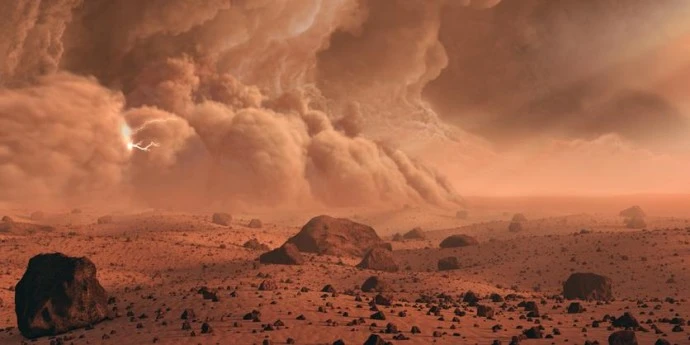
Martian dust storms can engulf the entire planet, blocking sunlight from reaching the surface for weeks. Such events recur roughly every three to four years, but the mechanism behind them long remained a mystery. An international team of researchers led by Aarhus University in Denmark has discovered that the key is not simply strong winds, but the right balance of sand and dust on the Martian surface. It is the interaction between these two components that can trigger a planet-wide storm.
Sand and Dust: Why a Storm Needs Both
At first glance, it might seem that a large quantity of fine particles and strong winds are all it takes to produce a dust storm. However, experiments have shown that the process is much more complex: too much sand prevents dust from being lifted into the atmosphere, yet a complete absence of sand grains also keeps the process from starting.
The difference lies in particle size. Sand grains range from roughly 0.06 to 2 mm in diameter, while dust consists of particles smaller than 0.05 mm. Because of their different masses, they respond to wind in very different ways.
Sand acts as a kind of hammer in this system. Grains picked up by the wind begin to bounce and strike the surface. These impacts dislodge finer dust particles from the soil, which then rise into the atmosphere.
This mechanism is called saltation. The released dust becomes suspended in the air and can be transported over vast distances. Sand grains typically travel only a few meters, while the finest dust can cross entire continents.
But if there is too much sand, the particles become so heavy that they are difficult to lift into the air. If there is too little sand, there are not enough impacts to release dust from the soil. A large-scale storm therefore requires a particular balance between the two components.
How Scientists Recreated a Martian Storm in the Laboratory
To test their hypothesis, the researchers used a specialized climate chamber at Aarhus University that can simulate conditions on Mars.
In their experiments, the scientists reproduced the interaction between sand and dust, taking into account their relative proportions on the planet's surface. The result was revealing: once the simulation began, planet-wide dust storms developed on their own.
The researchers thus demonstrated that wind speed or the amount of dust alone cannot explain these events. The structure of the surface material and how effectively sand grains can lift fine particles into the atmosphere also play an important role.
This helps explain why global Martian storms do not occur constantly, even though dust is present almost everywhere on the surface.
Why Forecasting the Weather on Mars Matters for Future Missions
The discovery could help create more reliable models of Martian weather and predict the onset of particularly large storms. Forecasting weather on an uninhabited planet may seem unnecessary, but it has very practical importance for those exploring Mars.
Dust storms pose a serious threat to equipment. Many rovers and scientific instruments use solar panels. When dust covers their surfaces, electricity generation drops, and sometimes the spacecraft stop receiving enough power to operate at all.
Study leader Jonathan Merrison notes that scientists have to account for such risks when preparing missions to Mars. If a spacecraft is caught in a large-scale storm, it may shut down and communication with it may be lost.
This is how weather forecasting becomes part of the engineering preparations for future expeditions. Knowing the conditions under which a global storm might begin will help specialists choose mission launch dates, plan equipment operations, and assess the risks to future crewed expeditions.
Mars has proved to be a planet where even ordinary dust can determine the success of a space mission. And scientists are now closer to understanding why it sometimes turns into a storm that engulfs an entire world.