




 make preferable
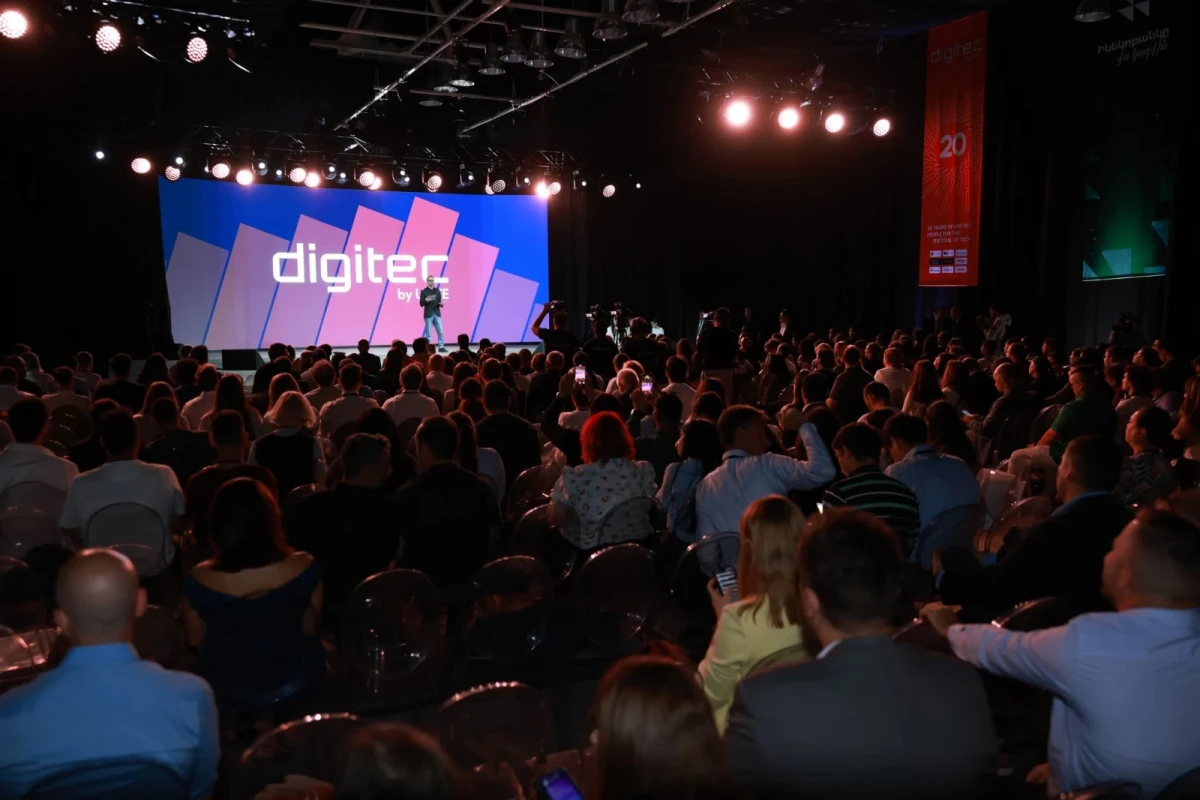
The international technology conference and exhibition Digitec 2026 opened in Yerevan on November 20, with artificial intelligence as its main theme this year. Over three days, representatives of NVIDIA, OpenAI, AWS, Dell Technologies, AMD and other international companies, along with investors, engineers and government officials, will discuss the development of the global AI economy and Armenia’s potential to become one of its regional hubs.
This year’s event is being held under the slogan World’s New AI Hub. The aim is not only to attract international technology companies to the country and build computing infrastructure, but also to develop the domestic scientific, engineering and manufacturing expertise needed to create globally competitive products.
Opening the conference, Armenia’s Minister of High-Tech Industry and Artificial Intelligence David Tadevosyan noted that the high-tech sector has become a significant part of the national economy in recent years. It now accounts for around 7% of the country’s economy. However, the minister said this figure should not set the limit on Armenia’s ambitions.
Tadevosyan stressed that the technology industry must become one of the main drivers of productivity and competitiveness across the economy. To achieve this, the country needs to move beyond a primary focus on software development and technology services toward building its own research, engineering and manufacturing capabilities.
From technology services to homegrown innovation
According to the minister, achieving this goal requires three elements: highly skilled professionals, modern infrastructure and effective collaboration between science and business.
As one step in this direction, Tadevosyan pointed to a government-approved educational program in physical artificial intelligence. The seven-year program envisages bringing in world-class experts to train professionals capable of working on technologies that connect AI with the physical world.
The minister identified computing infrastructure as a second key priority. He said data centers are already operating in Armenia, and their development in the near future should give the country additional opportunities to compete internationally.
However, the availability of skilled professionals and computing capacity does not in itself mean that a fully fledged AI ecosystem has emerged in the country. This also requires developing homegrown expertise, technologies and products, as well as creating conditions for cooperation between the government, business and the scientific community.
According to Tadevosyan, this is precisely the goal reflected in the World AI Hub concept chosen as the theme of Digitec 2026.
Armenia invites international partners to build an AI hub together
Speaking at the opening, Armen Kocharyan, president of Armenia’s Union of Advanced Technology Enterprises (UATE), said the question today is no longer who will adopt artificial intelligence, but who will create it.
He said Digitec should become a platform that brings together governments, investors and technology companies to jointly develop the entire AI economy value chain—from energy and semiconductors to data centers, foundation models and enterprise solutions.
Kocharyan emphasized that Armenia seeks to position itself as a regional hub for AI computing capacity and to develop sovereign AI infrastructure, deep tech, and research and development.
He paid particular attention to training the next generation of professionals. Under the ArmaTech program, implemented as a public-private partnership between the Armenian government and UATE, more than 650 engineering and robotics workshops have already been established across the country’s regions. They give children free access to classes in engineering, robotics, artificial intelligence and entrepreneurship.
In Kocharyan’s view, the technology ecosystem must develop at every level simultaneously—from introductory engineering education to the creation of large computing centers and research units.
He also called on international investors to fund the creation of globally competitive AI companies in Armenia, technology businesses to develop and scale their solutions there, and foreign governments to advance cross-border cooperation, shared infrastructure and digital corridors.
According to the UATE president, cooperation with neighboring countries is particularly important: the region should become a place where companies can easily establish businesses, attract investment and enter international markets.
Three days of discussions on the future of the AI economy
Digitec 2026 takes place on November 20–22 at the Meridian Expo Center. The program features 125 speakers representing NVIDIA, OpenAI, AWS, Dell Technologies, AMD, Mozilla, Revolut, JetBrains, Agile Robots and other companies. The conference brings together representatives of technology businesses, government bodies, investors and international expert communities.
The program covers five layers of AI development: energy, semiconductors, infrastructure, models and applications. Participants will discuss which resource constraints are limiting further AI development, how small countries can secure a place in the emerging technology economy, and what opportunities arise from the transition from digital models to robots and autonomous systems.
One of the highlights of the second day will be a conversation between Armenian Prime Minister Nikol Pashinyan and NVIDIA Vice President for Physical AI Simulation Rev Lebaredian. They will discuss the steps needed to turn the vision of an Armenian AI hub into reality.
The program also includes talks by Firebird co-founders Alexander Yesayan and Razmig Hovaghimian on building an AI factory in Armenia, NVIDIA technical sessions, and discussions on the prospects for physical artificial intelligence and robotics.
On the third day, representatives of Armenia, Kazakhstan, Greece and Bulgaria will discuss AI sovereignty and the development of regional technology hubs. Nobel Peace Prize laureate Kailash Satyarthi will close the main program with a talk on the need to consider human compassion and ethical issues in the development and regulation of artificial intelligence.
In addition to the main conference, Digitec includes a technology exhibition featuring more than 200 companies, a Startup Alley for 64 startups, business meetings with international companies and investors, and the final of the ArmRobotics national championship.
Digitec 2026 is thus becoming a platform for discussing not only technological prospects, but also the practical conditions for Armenia’s participation in the emerging AI economy. The main question facing the country is whether it can move beyond the role of a technology services provider and become a place where homegrown innovations, infrastructure and globally competitive companies are created.