make preferable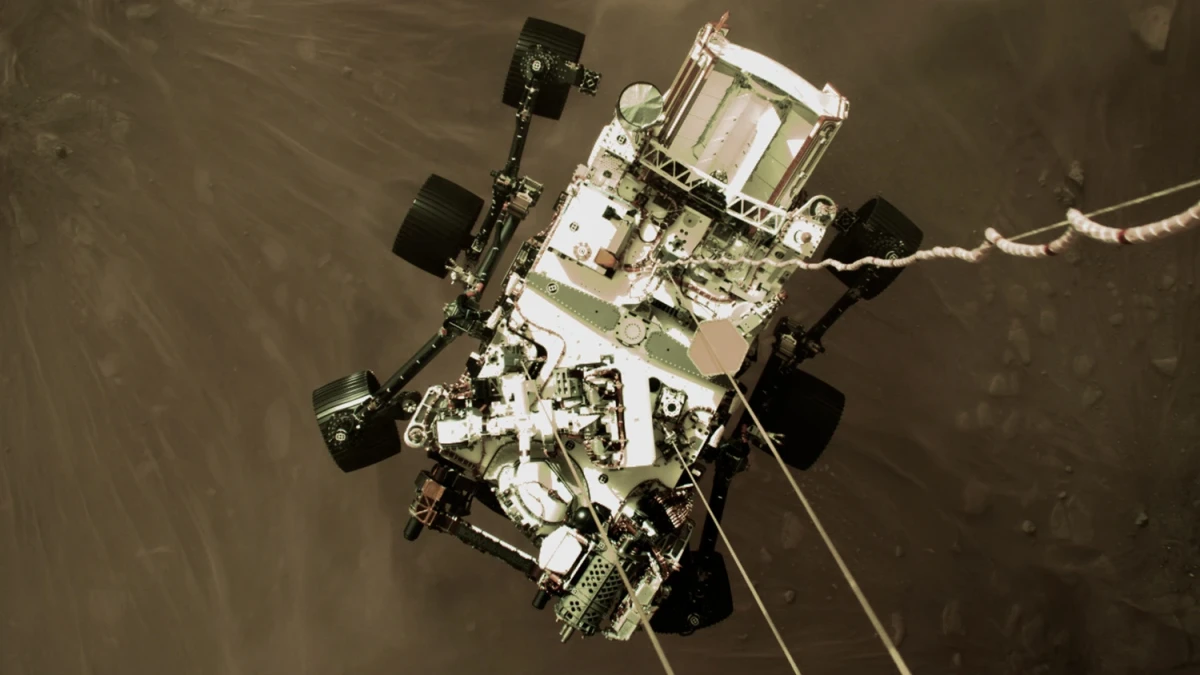
NASA’s Perseverance rover has become the longest-traveling wheeled vehicle ever to move across the surface of another celestial body. On October 11, 2026, its odometer reached 45.22 km — slightly more than the previous record set by the Opportunity rover, which explored the Red Planet from 2004 to 2018. It took Perseverance about five and a half years to achieve this new milestone.
The record was made possible in part thanks to autonomous navigation: the rover independently analyzes the surrounding landscape, identifies obstacles, and chooses a safe route. This allows it to cover greater distances faster and more efficiently than previous generations of rovers.
How Perseverance surpassed Opportunity
The previous record belonged to the Opportunity rover, which traveled 45.16 km over nearly 15 years of operation. Perseverance surpassed that distance on the 2,006th Martian day of its mission, which began in February 2021.
The rover reached the new milestone on its way to the Idubi region, passing through an area near the western edge of Jezero Crater that researchers have nicknamed Lac de Charmes — “Lake of Charm.” There, the rover is studying ancient rocks that may shed light on the early stages of Mars’ history.
Notably, Perseverance surpassed not only the previous Martian record. Its total distance traveled also exceeded that of lunar explorers: the Apollo 17 astronauts drove about 35.7 km on the Moon in 1972, while the Soviet Lunokhod 2 covered roughly 39 km in 1973.
Autonomous navigation allows it to drive almost without stopping
The key role in achieving the record was played by the AutoNav system. It allows the rover to assess the surrounding terrain directly while moving: the vehicle takes images, builds a three-dimensional map of obstacles, and chooses a path between checkpoints set by specialists on Earth.
At NASA, this approach is called “thinking while driving.” Instead of waiting for detailed instructions from Earth for each segment of the route, Perseverance is capable of making decisions on its own within the assigned path.
In a single Martian day, the rover can cover up to 412 meters. More than 90% of its total distance has been completed using AutoNav. For comparison, autonomous navigation accounted for only about 5% of the distance traveled by its predecessors Spirit and Opportunity.
The difference is also evident in the amount of environmental analysis. While NASA’s first rover, Sojourner, navigated using about 20 measurement points, Perseverance can process around 600,000 such points each time it surveys the terrain.
The greater the distance, the more geological history it reveals
Long journeys allow Perseverance to study more sites and compare rocks formed under different conditions. This is especially important for Jezero Crater, where a lake and river system existed billions of years ago.
The rover has already traveled from an ancient lakebed through river delta deposits and continues to explore higher geological formations. Among the findings is a rock called Cheyava Falls, in which signs potentially linked to biological processes have been detected. However, such a finding by itself does not prove that life existed on Mars.
At present, the rover is studying the crater rim, where impact-formed rocks about four billion years old are found. They may preserve information about the planet’s early history, much of which was erased on Earth by later geological processes.
So far, Perseverance has collected 29 samples of rock and regolith. They represent different parts of the crater, including its floor, river delta, and rim. In the future, these materials are expected to help scientists reconstruct the sequence of geological events and assess the conditions that existed on ancient Mars.
The rover will continue extending the record
After studying Lac de Charmes, Perseverance is expected to continue along the crater rim and then head south toward the Rainbow Falls region. There lies a section of ancient crust about 100 meters wide that was lifted to the surface by the impact that formed Jezero Crater.
According to Steven Lee, project manager for the Curiosity and Perseverance rovers at NASA’s Jet Propulsion Laboratory, the mission’s original plan called for a drive of about 20 km. The rover has already far exceeded that distance.
NASA expects that, if its systems remain operational and tests aimed at extending its service life produce favorable results, Perseverance will be able to continue its research for many more years.
The record matters not only in itself. The farther a rover can travel, the more diverse rocks it can study, and the more completely scientists will be able to reconstruct the history of the Red Planet.