make preferable
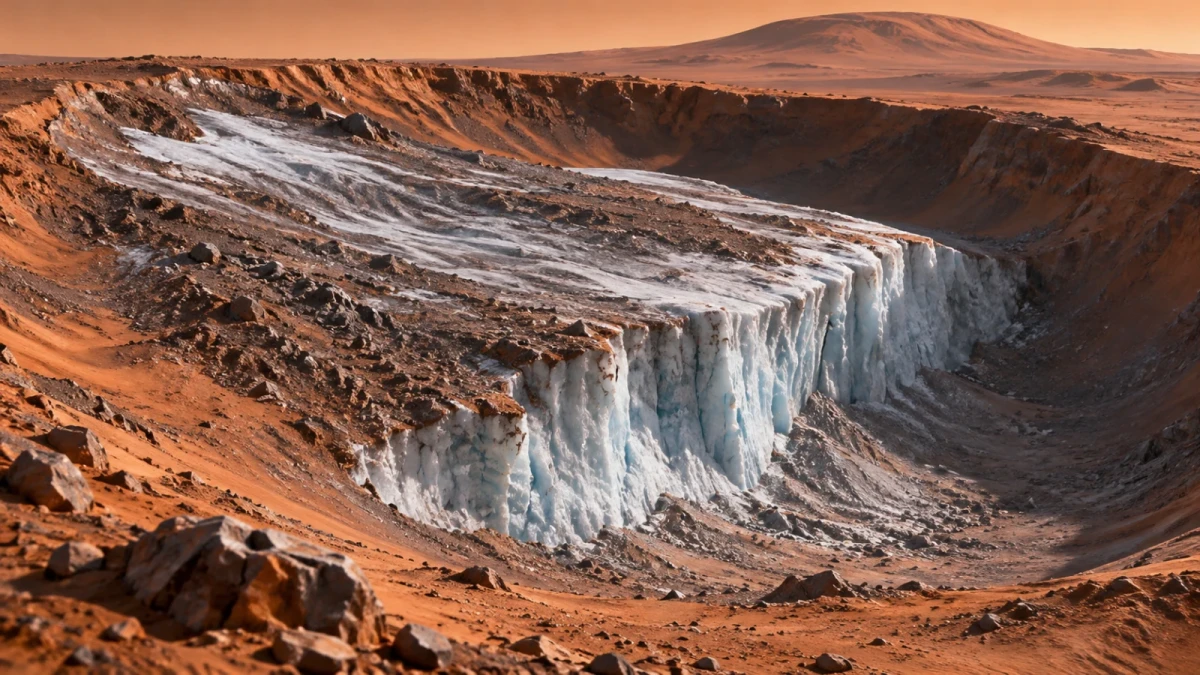
Researchers have discovered 29 unusual geological formations in craters in northern Mars that could be ancient glaciers hidden beneath layers of rock and dust. Some stretch for three kilometers and end in steep cliffs up to 209 meters high. The discovery could help scientists determine where subsurface ice reserves remain on the Red Planet and how its climate has changed.
Glaciers hidden beneath rock and dust
The researchers examined 738 impact craters near the Martian volcano Alba Mons. They used images from two orbiters: Mars Reconnaissance Orbiter and Trace Gas Orbiter. Comparing the images allowed them to reconstruct the terrain and identify 29 unusual formations.
These formations have rounded edges and lie on pole-facing slopes. Their shapes resemble debris-covered glaciers found in places such as Iceland.
Some images show tracks left by rocks that rolled down the crater walls. Scientists suggest that this debris formed a protective layer beneath which ice could survive for long periods. This is especially important on Mars, where the thin atmosphere allows exposed ice to rapidly turn into vapor.
Deposits preserved through climate cycles
According to computer models, the ice may have accumulated during one of the cold periods in Martian history, when the planet's axial tilt was greater than it is today. Under those conditions, the distribution of solar heating changed, and pole-facing crater slopes could have provided suitable conditions for ice to accumulate and survive.
To study the newly discovered structures, the researchers built three-dimensional terrain models. They used images of the same areas taken by orbiters from different angles. The resulting data were then compared with calculations of ice movement.
The new glacier candidates turned out to have a distinctive feature that sets them apart from many previously known Martian ice deposits: a steep front edge. Here, the gently sloping surface ends abruptly in a tall cliff rather than gradually merging into the crater floor.
Where to look for other Martian ice reserves
A combination of features—rounded edges, locations on slopes, and evidence of rockfalls—could help identify similar structures elsewhere on Mars.
If the researchers' interpretation is confirmed and ice has indeed survived beneath the rocky deposits, these sites will become important targets for further study. They may hold information about climate change on the planet and help pinpoint water reserves accessible for investigation.
The study was published in the journal Earth and Planetary Science Letters. It also shows that the search for Martian ice should focus not only on extensive ice deposits but also on small structures inside impact craters, where a protective layer of rock may have preserved ice over geological timescales.