make preferable
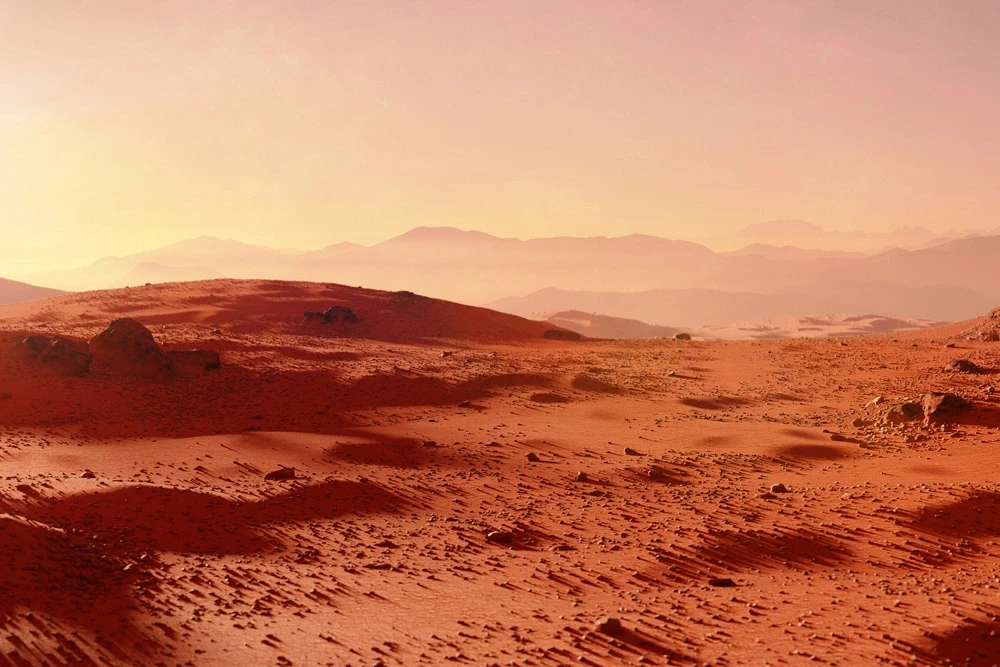
Mineral formations in an abandoned mine in southern Germany could offer clues about where to look for traces of ancient life on Mars. A study has shown that minerals detected by rovers on the Red Planet can form under conditions previously considered less favorable for life. This means that environments potentially suitable for microorganisms may have existed in more places on ancient Mars than scientists had assumed.
An Earth analogue for Martian minerals
A team of geomicrobiologists from the University of Tübingen studied unusual stalactites in the abandoned Segen Gottes mine in the Black Forest mountains of southern Germany. Some reach a meter in length and consist of roughly 50 percent iron.
These formations develop as acidic groundwater seeps through sulfide ores. Along the way, the water becomes enriched with iron, sulfur, and traces of other metals. Minerals gradually precipitate, forming stalactites.
The mineral composition of these formations is of particular interest to the researchers. Similar combinations of minerals have previously been found on Mars, including in Gale Crater, which NASA's Curiosity rover is exploring.
However, the resemblance proved significant beyond geology alone. It helped scientists reconsider what conditions might have existed where similar deposits formed on ancient Mars.
The water may not have been linked to volcanic activity
Mineral assemblages previously found on Mars had been linked to the action of acidic solutions containing high levels of chlorides relative to sulfates. This chemical composition was regarded as evidence of processes associated with volcanic activity.
The study of the German mine showed that similar mineral formations can also develop at very low chloride-to-sulfate ratios. In other words, fluids of volcanic origin are not necessarily required for them to form.
This substantially changes how the Martian findings might be interpreted. If the same mineral combinations can arise under different chemical conditions, they cannot provide an unambiguous account of the planet's water history.
The results also suggest that some regions of ancient Mars may have been more favorable for life than previously assumed. In particular, this applies to subsurface environments where water interacted with rock, creating localized conditions suitable for microorganisms.
Life could have survived in microscopic pores
Another important finding concerns the size of potential refuges for life. The researchers suggest that even small pockets of subsurface rock could have supported fairly diverse microbial communities.
These rocks contain pores of varying sizes and degrees of connectivity. Such a structure can create numerous small spaces that are isolated or partially interconnected, where conditions may differ from those in the surrounding environment.
This is especially important in the search for extraterrestrial life. Even if harsh conditions made the Martian surface uninhabitable long ago, localized environments sheltered from external influences may have persisted underground.
For now, however, the findings concern potential habitability, not the discovery of traces of life. Further research will be needed to determine whether microscopic pores can actually sustain living organisms. The authors identify nanometer-resolution tomography and direct measurements of oxygen levels among the methods required.
A German mine as a model for the Martian subsurface
The Segen Gottes mine provides an accessible natural laboratory on Earth for studying processes that may have occurred on Mars. Its stalactites contain the same minerals as some Martian deposits, although the chemical composition of their impurities differs.
Such terrestrial analogues allow researchers to investigate not only the origins of mineral structures but also the conditions under which they form. This helps them interpret rover data more accurately and avoid premature conclusions about the ancient planet's climate and chemical environment.
The main significance of the study is that identical geological signatures do not necessarily indicate identical formation histories. This is a fundamental point for astrobiology: if scientists misidentify the conditions under which minerals formed, they may underestimate the number of places where life could once have existed.
The findings were published in the journal Scientific Reports.