make preferable

Physicists at Osaka University have discovered unusual electron behavior at the interface between a material just one atom thick and an ordinary metallic crystal. A state known as a heavy-fermion state emerged in this system: electrons in it behave as though their effective mass is far greater than usual. The discovery could point to a new way of creating materials with unusual quantum properties, including those capable of unconventional superconductivity.
Two Quantum States at One Interface
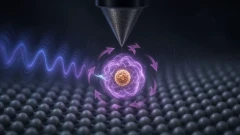
For the experiment, the researchers created a precisely controlled single atomic layer of the ytterbium–copper compound YbCu₂ on the surface of a copper crystal. They then used powerful synchrotron radiation to study the electronic states and interactions at the interface between the two materials.
They found that electrons in the thin layer can interact with mobile electrons in the copper substrate. This gives rise to heavy-fermion states—a quantum effect in which electrons acquire a very large effective mass. This does not mean that the particles themselves physically become heavier: rather, their collective behavior within the material changes.
The experiment revealed two such states. The first was largely confined to the two-dimensional atomic layer. The second extended beyond it, also encompassing the three-dimensional copper crystal beneath it.
It was this second state that proved to be a particularly important finding: for the first time, the researchers obtained direct evidence that a heavy-fermion state can arise through interactions between electrons on opposite sides of an interface between materials.
How Electron Interactions Change a Material’s Properties
The mechanism involves hybridization—the mixing of two types of electronic states. Localized electrons in the ytterbium 4f orbitals of the atomic layer interact with mobile conduction electrons in the copper substrate.
As a result, the system acquires properties that would not be expected from either material on its own. This is an important example of how quantum behavior can be created not only through a substance’s chemical composition, but also through a carefully engineered interface between different materials.
Physicists are interested in heavy fermions for more than just the unusual effective mass of their electrons. These states are associated with a range of complex quantum phenomena, including unconventional superconductivity. The ability to observe and study them in specially created atomically thin structures therefore opens up new experimental possibilities.
Material Interfaces as a Tool for Quantum Engineering
The result could change the approach to developing quantum materials. Rather than searching for the desired properties in a single substance, scientists could combine ultrathin atomic layers with suitable substrates to produce new electronic states directly at their interfaces.
The next step is to learn how to control these states. To do so, the researchers plan to study how they are affected by the interface structure, electronic orbitals, and moiré patterns that arise when atomic lattices with different parameters are overlaid.
According to the study’s lead researcher, Professor Shinichi Kimura, the result was made possible by sustained efforts to create high-quality materials and precisely measure their electronic states. The team now intends to move from observation to the deliberate creation and control of heavy-electron states.
This does not yet mean the creation of a new superconductor or a technology ready for use. But the experiment shows that even the interface between a single atomic layer and an ordinary metal can serve as a platform in its own right for unusual quantum physics to emerge.