make preferable
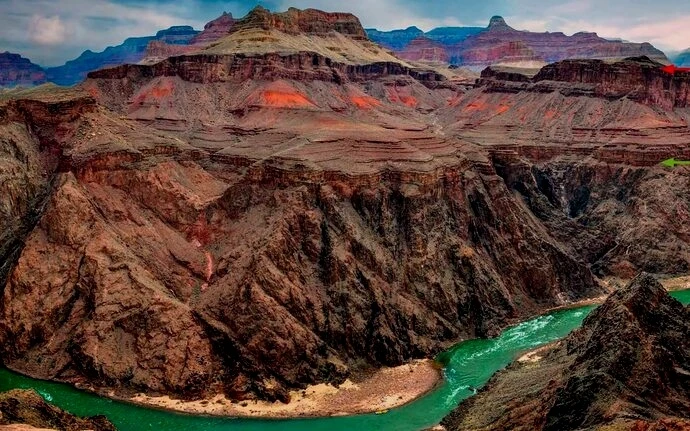
In some parts of Earth's crust, entire layers representing hundreds of millions—and sometimes more than a billion—years are missing between ancient and relatively young rocks. Geologists refer to such gaps as the Great Unconformity. Researchers at the University of Wollongong have proposed an explanation: ancient parts of the continents may have first risen, undergone intense erosion, and then sunk beneath the water. The findings were published in the journal Nature.
A geological record with enormous gaps
One of the best-known examples of the Great Unconformity is found in the Grand Canyon. Here, relatively young sedimentary rocks about 540 million years old directly overlie much older layers that are more than a billion years old. Between them, there are no rocks that could reveal what happened over that vast span of time.
Similar boundaries occur in other regions of the planet. They pose a puzzle for geologists: what happened to the rocks that should have formed during this period? Perhaps the corresponding deposits never formed. But there is another possibility: they once existed and were later destroyed by erosion.
How mantle movement could have erased traces of the past
To test this hypothesis, the researchers modeled the movement of Earth's mantle—the hot layer of rock beneath Earth's crust. Its material moves slowly, and over hundreds of millions of years, these flows can change the elevation of vast areas of the continents.
The calculations showed that during the Neoproterozoic, such processes could have caused the ancient continental cores of North America, Northern Europe, and North China to rise.
Once elevated above the surrounding terrain, these land areas were exposed to water and wind. Erosion gradually wore away the surface, removing rock layer by layer. Along with it disappeared traces of geological events that might otherwise have been preserved in sedimentary layers.
Then mantle movement changed, and the uplifted regions began to sink. Seas gradually covered the smoothed surface, and sediments once again accumulated on the seafloor.
Why the boundary between geological ages survived
An important feature of the proposed model is that it does more than explain the destruction of ancient rocks. It also shows how a distinct boundary between layers of different ages could have been preserved afterward.
When the continental surface was above water, erosion removed rocks. Once the land sank below sea level, conditions changed: instead of the surface being worn away, new sediments began to accumulate. As a result, young deposits were laid down directly on a much older foundation.
This is precisely the transition observed in the Grand Canyon. The duration of the geological gap varies by location: in some places, hundreds of millions of years of history are missing; in others, more than a billion years are absent.
What this changes about our understanding of Earth's history
The proposed mechanism links gaps in the geological record in different parts of the world to a single large-scale process: the slow movement of material within the mantle. It explains why ancient rocks may have disappeared and why the boundaries between the surviving layers appear so sharp.
However, the model does not imply that this scenario alone was responsible for every instance of the Great Unconformity. The geological record is shaped by many processes, and individual gaps may have arisen for different reasons.
But the study shows that the absence of rocks is also an important part of the planet's history. Sometimes geologists must reconstruct the past not from what has survived, but from traces of the large-scale processes that erased entire chapters of that record.