make preferable
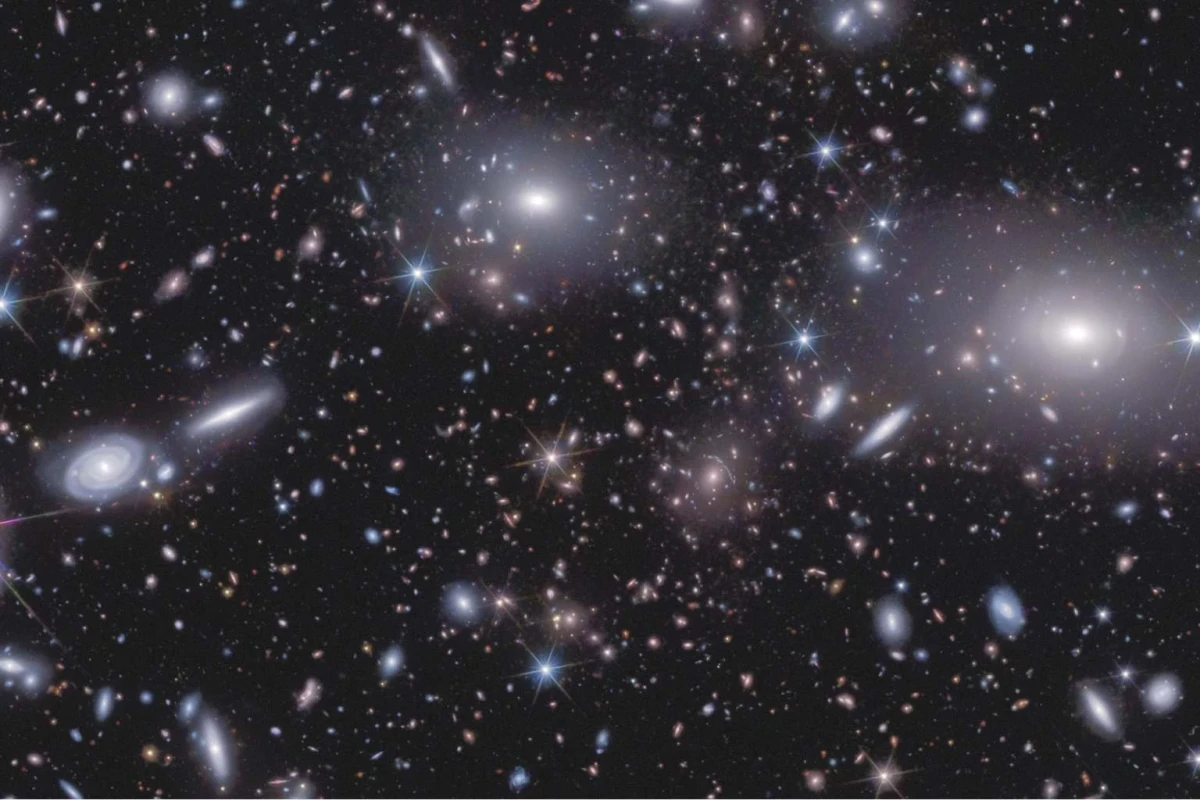
The European Space Agency (ESA) has released the largest dataset to date from the Euclid space telescope mission. It includes observations of more than 900 million galaxies and will form the basis for the most extensive three-dimensional atlas of the Universe. The project also aims to help scientists understand the nature of dark matter and dark energy—two mysterious components that shape the structure and evolution of the cosmos. Reuters reports.
The data, released on November 12, cover about 13 months of observations and total 1.7 petabytes, or 1.7 million gigabytes. The telescope surveyed an area of the sky roughly 9,500 times the apparent size of the Moon as seen from Earth.
Euclid was launched in 2023 from a spaceport in Florida. Its main task is to trace how the Universe has expanded and how its large-scale structure has formed over billions of years. By 2031, the mission is expected to create the largest three-dimensional map of the cosmos in history, covering more than a third of the celestial sphere.
“Euclid will not simply take two-dimensional images of galaxies in the sky, but will also measure their distances—the third dimension. This will allow us to determine where galaxies were in space and time over a span of 10 billion years,” explained Valeria Pettorino, ESA's Euclid project scientist.
How the telescope explores the invisible part of the Universe
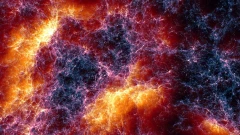
One of the mission's key tasks is to study the so-called cosmic web. Galaxies are not distributed randomly through space: they gather in clusters and elongated structures known as filaments, with vast regions of nearly empty space between them. Scientists call this network the cosmic web.
Its structure and how it changes over time depend on the properties of dark matter and dark energy. According to Pettorino, reconstructing this picture will help scientists better understand how these components are distributed and what role they play in the evolution of the Universe.
According to current estimates, ordinary matter—stars, planets, gas and dust—accounts for only about 5% of the Universe's contents. Dark matter makes up roughly 27%, while dark energy accounts for about 68%. Dark matter reveals itself through its gravitational effects on galaxies and other cosmic objects, while dark energy is thought to be responsible for the accelerating expansion of the Universe. Neither emits nor absorbs light, making direct observation impossible.
Euclid will study these phenomena using methods that include gravitational lensing. This effect occurs when light from a distant galaxy passes near a massive foreground object and is bent by its gravity. The pattern and degree of light distortion can reveal how much matter the object contains, including the presence of invisible dark matter.
15,000 gravitational lenses and 60 million quasars
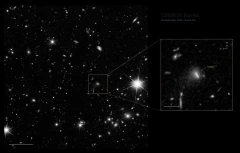
About 15,000 strong gravitational lens candidates have been identified in the new dataset. This exceeds the total number of such objects found over the previous 50 years.
“Gravitational lenses are nature's weighing scales. How strongly light bends tells us how much matter a galaxy contains, including invisible components such as dark matter,” said Natalie Lines, an astrophysics PhD student at the University of Portsmouth and a member of the Euclid Consortium.
She said the large number of these objects will make it possible to study the distribution of dark matter within galaxies and better understand how galaxies form and change throughout cosmic history.
The telescope also detected about 60 million quasars—extremely bright central regions of galaxies powered by the activity of supermassive black holes. Some existed when the Universe was only about 5% of its current age. Light from these objects began its journey toward Earth roughly 13 billion years ago.
One of Euclid's advantages is its ability to capture sharp images across vast areas of the sky. Ground-based telescopes can cover large areas, but Earth's atmosphere limits the quality of their observations. The Hubble and James Webb space telescopes provide highly detailed images but survey relatively small regions of space. Euclid combines a wide field of view with sharp imaging, which is particularly important for detecting rare objects, including strong gravitational lenses.
The current dataset covers about 14% of the total area of sky that Euclid is expected to survey in visible and near-infrared light during its six-year mission. The next data release is scheduled for 2027. The first scientific results specifically addressing the properties of dark matter and dark energy are also expected then.