make preferable
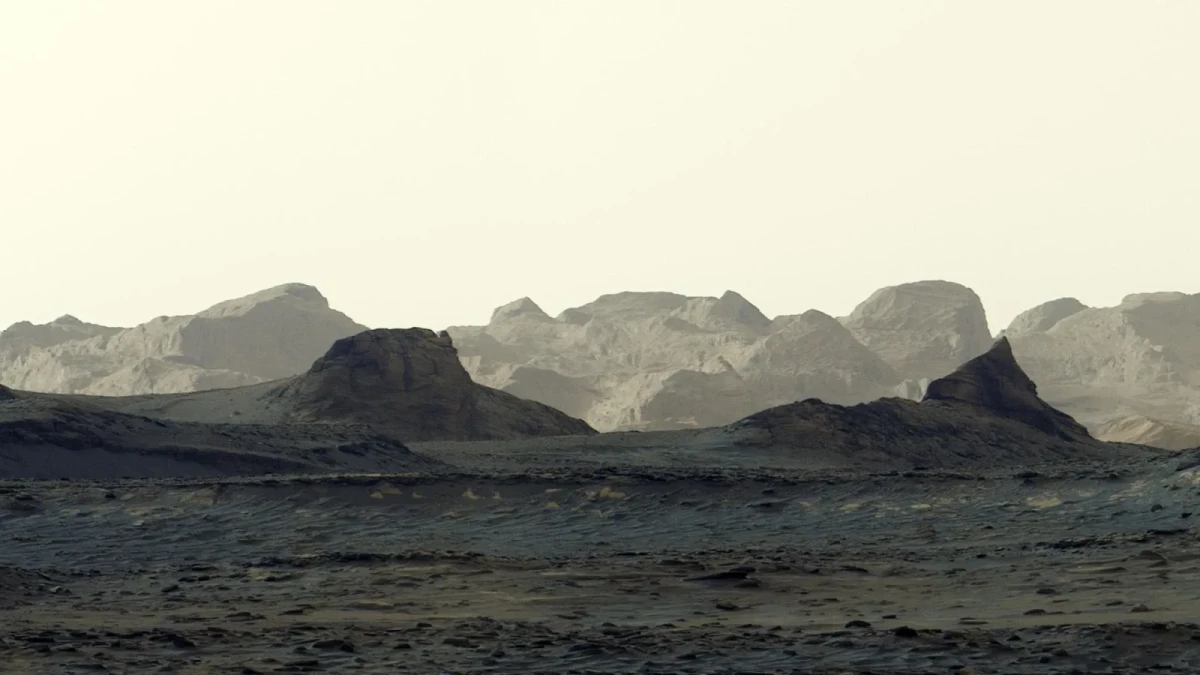
NASA’s Curiosity rover has captured a panorama of unusual rock formations on Mars whose origin remains a mystery for now. The rocks stretch for about 16 kilometers along the northwestern part of Mount Sharp and differ from the surrounding landscape in color and the tilt of their layers. Scientists suggest that, in addition to wind erosion that shaped many Martian landscapes, ancient volcanic processes may also have played a role in their formation.
A panorama of a Martian morning
The images were taken on August 11 using the Mastcam camera aboard Curiosity — during the rover’s 4,982nd Martian day of operations. Six separate photographs were combined into a panorama showing a rocky foreground in bluish tones and cliffs on the horizon illuminated by the morning sun.
The image was processed without the usual white-balance correction procedure. Because of this, the colors convey the characteristic lighting of a Martian morning, although they are not an exact reproduction of how the human eye would perceive this scene.
On the horizon, so-called yardangs can be seen — elongated rocky ridges that form when wind gradually carves away softer rock and leaves behind more resistant landforms. Curiosity has yet to reach these formations, but the new panorama allows scientists to study their shape and features in advance.
Why these rocks look unusual
The yardangs are located on the northwestern slope of Mount Sharp, which rises about five kilometers above the surrounding terrain. Curiosity has been exploring this mountain since 2014, gradually climbing through its many layers of sedimentary rock.
During that time, the rover has gained about one kilometer in elevation — more than any other rover on Mars. As it climbs, it studies geological layers formed during different periods in the planet’s history.
However, this new area stands out even against the mountain’s complex terrain. Its color differs from neighboring rocks, the layers are tilted at an unusual angle, and the formation itself looks as if it was laid on top of the surrounding surface.
“The layer with the yardangs looks foreign. It has the wrong color, the layers are tilted at a strange angle, and it seems as if it is almost stuck onto the surface,” explains Ashwin Vasavada, Curiosity project scientist at NASA’s Jet Propulsion Laboratory.
According to him, it is precisely this unusual character that makes the area especially interesting to study. Scientists still do not know what process created these rocks.
Traces of ancient volcanism?
One hypothesis is that the unusual layer formed from volcanic ash that fell onto the surface after ancient eruptions. If this assumption is confirmed, studying the rocks will help better understand the geological history of the region and the processes that took place on Mars billions of years ago.
Mount Sharp is a kind of chronicle of the Martian environment. Its sedimentary rocks preserve evidence of an era when lakes and streams existed in this area. Over time, the climate changed, the water disappeared, and deposits of salts and other minerals remained in the rocks.
After sediment accumulation ceased, wind began to gradually erode the surface, forming characteristic ridges and cliffs. But if the unusual layer really consists of volcanic ash, its origin may prove to be more complex than the usual sequence of sediment deposition and erosion.
For now, this is only a hypothesis. To test it, researchers need to study the composition of the rocks directly on site, rather than only analyzing their appearance in photographs.
Curiosity will reach the rocks in 2027
The rover is now in the second year of its fifth extended mission. Earlier, it studied unusual ridges resembling spiderwebs, and now it continues moving through geological layers rich in sulfates and carbonates. These minerals help reconstruct the history of Mars’s gradual drying.
According to the mission team’s plan, Curiosity is expected to reach the base of the yardangs during 2027. There, the rover will be able to examine the rocks using its robotic arm and scientific instruments, which make it possible to study their properties and chemical composition.
The results may help determine how this unusual layer formed and refine ideas about how Mars’s environment changed billions of years ago. For now, the panorama offers only a first look at the mysterious rocks, but it is precisely their difference from the surrounding landscape that makes the upcoming expedition especially interesting.