make preferable
When the OSIRIS-REx probe arrived at asteroid Bennu in 2018, scientists discovered an unexpected scene: instead of the relatively smooth surface they had anticipated, the spacecraft saw a landscape almost entirely covered with large boulders. Researchers have now figured out why these rocks heat up and cool down so quickly. The key to the mystery was hidden inside them — in the numerous cracks that prevent heat from spreading through the rock.
Why Bennu’s Surface Left Scientists Puzzled
Before OSIRIS-REx arrived, observations showed that Bennu’s surface changed temperature rapidly as the asteroid rotated. This pointed to low thermal inertia — the ability of a material to heat up quickly under sunlight and cool down in darkness.
Dry sand on a beach behaves in a similar way, for example. Large solid rocks usually retain heat longer and cool more slowly. That is why the observations were so puzzling: how could an asteroid covered in massive boulders lose heat so quickly?
“We expected to see some boulders, but we also thought there would be large areas of finer, looser material that would be easier to collect. Instead, there were rocks almost everywhere,” said Andrew Ryan of the University of Arizona’s Lunar and Planetary Laboratory, who led the working group studying the physical and thermal properties of the samples.
One possible explanation was the rocks’ high porosity: voids inside the material could accelerate heat transfer. Observations by OSIRIS-REx itself supported this hypothesis, but it could only be fully tested after the samples were returned to Earth.
Cracks Inside the Rocks Turned Out to Be the Missing Link
Ryan’s team studied small fragments of Bennu using several laboratory methods. The results were published in the journal Nature Communications.
Measurements confirmed that the rock does indeed contain many voids. But porosity alone was not enough to explain the asteroid’s unusually rapid cooling.
An additional clue came from research conducted at Nagoya University in Japan. Scientists used a thermography method with synchronous heating: a laser heated a small section of a sample, while instruments tracked how heat spread through the material.
The results showed that the thermal inertia of small samples in the lab was noticeably higher than what the spacecraft had measured on Bennu’s surface. A similar discrepancy had previously been found by the team of the Japanese Hayabusa2 mission.
This meant that the properties of small fragments did not fully reflect the behavior of the enormous boulders on the asteroid. Scientists needed to understand how the internal structure of the rocks affects heat movement on a larger scale.
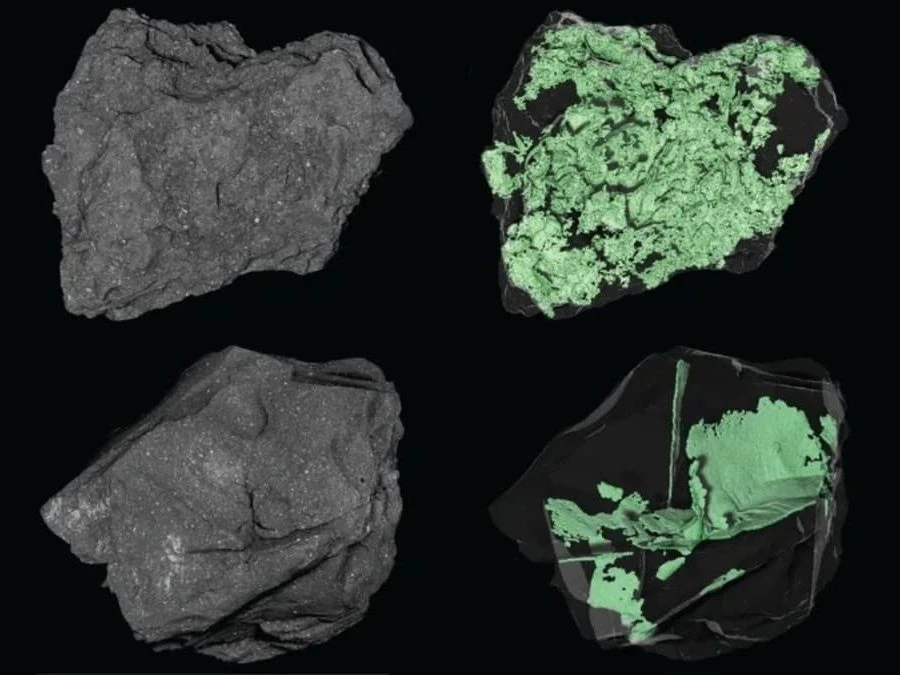
The key finding was that a branched network of cracks runs through the particles. Together with the pores, they alter the pathways by which heat spreads through the rock. This feature helped explain why Bennu’s massive boulders cool faster than would normally be expected for ordinary solid rocks.
X-Ray Tomography Made It Possible to Look Inside the Samples
To study the rock’s internal structure in detail, NASA researchers used X-ray computed tomography — XCT. The method makes it possible to obtain a three-dimensional image of an object without destroying it or cutting it into pieces.
The work was carried out at the Johnson Space Center in Houston. The samples were placed in sealed containers inside a protective nitrogen environment to avoid contamination by terrestrial substances. The containers were then sent for scanning and returned to their original environment without exposing the material to Earth’s atmosphere.
Tomography made it possible to examine not only the surface of the rocks but also their internal structure in three dimensions. The resulting images were preserved as digital models and added to a publicly accessible database. This will allow researchers to study the geometry and structure of the samples without repeated handling of the original material.
Ryan’s team then used the scan data in computer models tracking the movement of heat through the rock. The scientists scaled the calculations from individual particles up to boulders like those covering Bennu. The modeling reproduced the low thermal inertia previously recorded by OSIRIS-REx.
What the Discovery Changes in the Study of Asteroids
The solution is important not only for understanding a single asteroid. Astronomers often assess the properties of celestial bodies by how their surfaces absorb solar energy and release heat into space. Such measurements make it possible to judge the composition and structure of asteroids from a distance, but without samples it is difficult to determine exactly which features of the rock are behind the observed readings.
The Bennu study helps connect remote measurements with the actual characteristics of the material. Scientists can now more accurately account for the effects of porosity and internal cracks when interpreting thermal observations of other asteroids.
According to Ryan, the cracks were the missing element that made it possible to explain the unusual behavior of the boulders. Researcher Ron Ballouz of the Johns Hopkins University Applied Physics Laboratory emphasized that analyzing samples from the same asteroid makes it possible to verify conclusions drawn from telescopic observations.
Thus, Bennu’s mystery turned out to be linked not so much to the size of its rocks as to what is hidden inside them. Even a massive boulder may behave unlike a solid piece of rock if its internal structure is riddled with voids and cracks.