make preferable
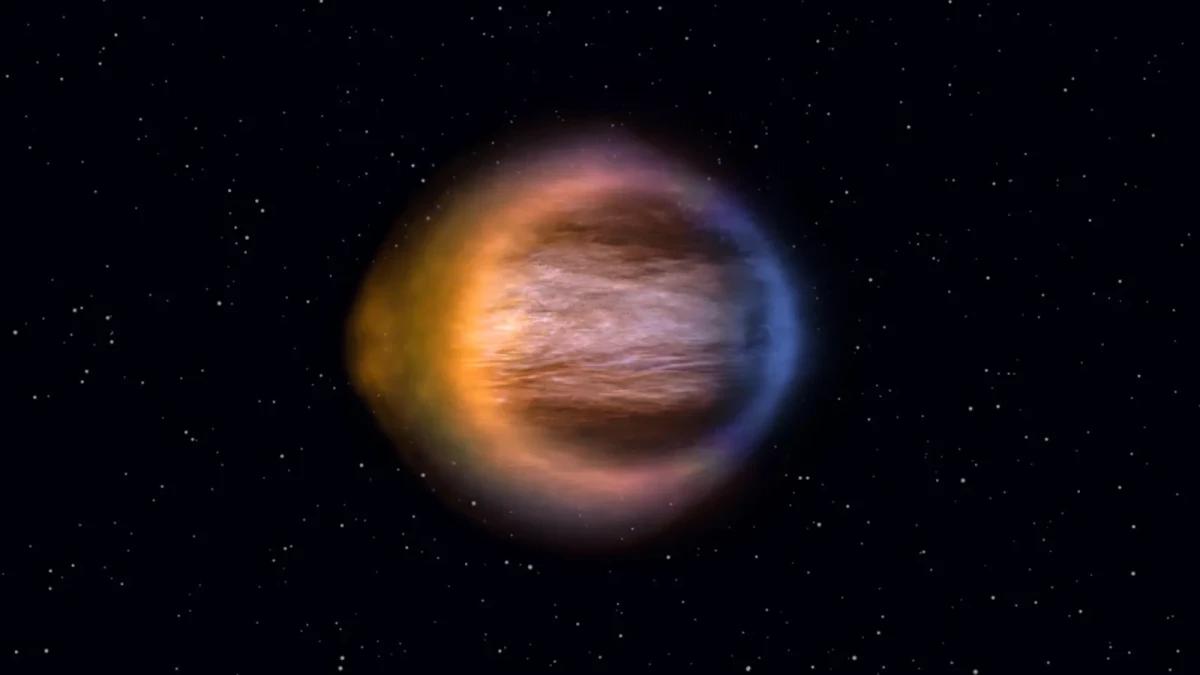
Astronomers have, for the first time, been able to reconstruct in detail the three-dimensional structure of the atmosphere of the exoplanet WASP-17b, a scorching gas giant with an extraordinarily low density. Using the James Webb Space Telescope, scientists identified regions where the atmosphere expands noticeably, forming protrusions that resemble jewels on a ring. The observational results confirmed that the differences between the planet’s day and night sides match theoretical predictions.
WASP-17b is located about 1,300 light-years from Earth. Its mass is about 80% that of Jupiter, but in width the planet is nearly twice as large as the Solar System’s biggest planet. Because of such an unusually low density, it is classified as a “super-puff” exoplanet — in consistency, such worlds resemble fluffy marshmallows.
The planet orbits very close to its star and completes a full revolution in less than four Earth days. As a result, its atmosphere experiences extreme heating and exhibits complex dynamics.
How scientists discerned the structure of the atmosphere
The researchers used data from the James Webb telescope and a new analysis method called transmission strings. It makes it possible to study a planet’s atmosphere as it passes in front of its star — during a transit.
When starlight passes through the atmosphere of WASP-17b, different chemical substances absorb specific parts of the spectrum. By analyzing this light, scientists can determine the atmosphere’s composition and properties. The new method makes it possible to estimate the distance from the planet’s center to the outer boundary of the atmosphere at different points along its edge.
Previously, standard models averaged the data over the planet’s entire visible edge, which left local differences hidden. Now researchers have been able to reconstruct a more detailed picture and see how the shape of the atmosphere changes depending on direction.
“Instead of treating the atmosphere as a circle with the same radius all the way around, our method allows us to determine the distance from the center to the edge of the planet in different places,” explained Lily Alderson of Cornell University.
According to her, scientists have moved from a conventional ring-like picture to understanding exactly where on that ring the protruding sections are located — the very same “jewels.”
Why the atmosphere of WASP-17b looks uneven
The planet is tidally locked to its star: the same side always faces the star. The day side continuously receives stellar radiation, while the night side remains significantly cooler.
According to models, the temperature difference should affect atmospheric circulation and its shape. Observations showed that on WASP-17b, hot winds reach the equator and the night side, where the cooler atmosphere expands. It is in this region that a noticeable protrusion arises, resembling a jewel.
The results also agree with the prediction of a substantial temperature difference between the planet’s morning and evening sides. According to Alderson, WASP-17b displays exactly the pattern scientists expected to see based on theoretical calculations.
Team member Hannah Wakeford of the University of Bristol noted that what is especially impressive is the ability to obtain a coherent picture of the complex dynamics of a planet located more than a thousand light-years away.
A new way to study thousands of distant worlds
The work shows that exoplanet atmospheres cannot always be described as uniform shells with the same properties all the way around. Temperature, chemical composition, and atmospheric height can vary noticeably depending on the region of the planet.
This is especially important for studying hot gas giants, where intense stellar radiation and powerful winds create complex atmospheric processes. The new method will help test such models against observations, not just against the results of computer calculations.
The team’s study was published in Nature Astronomy on October 14. The authors view it as confirmation that the method works, and that in the future it can be applied to the study of other worlds in NASA’s catalog, which includes more than 6,000 exoplanets.
According to Alderson, scientists can now do more than simply calculate how the three-dimensional atmosphere of a distant planet should behave — they can compare those predictions with the observed picture.