make preferable
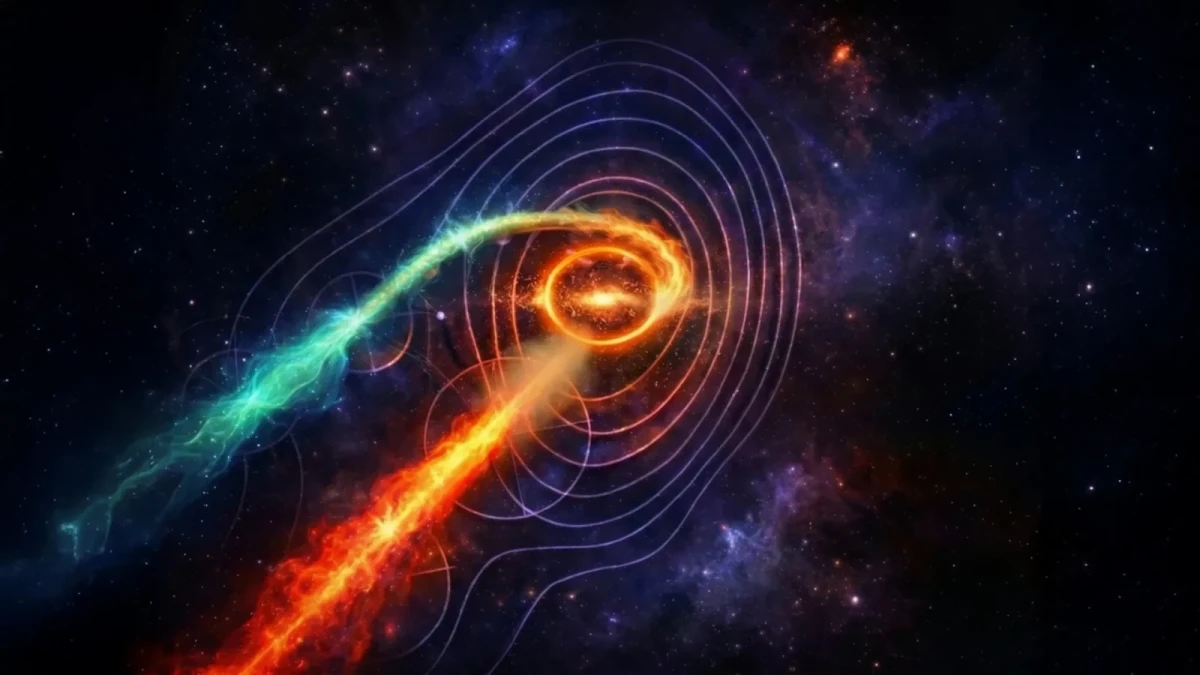
Astronomers have found signs that two supermassive black holes lie at the center of the galaxy Mrk 501, orbiting each other with a period of about 121 days. According to the researchers’ calculations, the distance between them is so small that, depending on their masses, they could merge into a single object in just a century. If the system is confirmed by independent observations, it could help scientists understand how black holes grow and what happens during the final stage of their approach, ScienceDaily reports.
An unusual jet gave away the second black hole
At the centers of most large galaxies, astronomers believe, sit supermassive black holes with masses of millions or even billions of Suns. They grow by consuming surrounding matter, but this mechanism alone may not be enough to explain the size of the most massive objects. Another possible path is the merger of black holes during galaxy collisions.
Such collisions occur regularly in the Universe. According to theoretical models, after galaxies merge, their central black holes gradually draw closer together, begin orbiting a common center of mass, and eventually merge. However, reliably detecting pairs of supermassive black holes at the final stage of their approach has so far been extremely difficult.
An international team led by Silke Britzen of the Max Planck Institute for Radio Astronomy in Bonn studied the galaxy Mrk 501, known for its powerful jet — a stream of particles launched from the vicinity of its central black hole at nearly the speed of light.
The researchers analyzed radio observations at different frequencies collected over about 23 years. The data revealed a second jet whose motion could also be tracked. This became evidence of the possible presence of another supermassive black hole.
The black holes themselves are too close together for modern telescopes to resolve them separately. But the behavior of the jets makes it possible to infer the motion of the hidden system.
Two jets move along an unusual trajectory
The first jet is pointed almost toward Earth, which is why it appears especially bright. The second is oriented differently, which partly explains why it had not been detected earlier.
During observations over several weeks, astronomers noticed sharp changes in the position of the second jet. It seemed to emerge from behind the brighter jet and then move counterclockwise around it. The repeatability of these changes points to regular motion of the entire system.
According to Britzen, watching what was happening was like being on a ship where the entire surrounding landscape is moving. The two-black-hole model explains this by proposing that the system’s orbital plane periodically changes its orientation.
The scientists got another clue in June 2022: for a time, the system’s emission took on the shape of a ring. The researchers suggest this may have been related to gravitational lensing. If the two black holes and Earth were almost aligned, the gravity of the foreground object could have bent the light from the jet behind it, creating a ring-shaped image.
This explanation remains a hypothesis for now, but it is consistent with the possible geometry of the system.
The orbit lasts just 121 days
From changes in the jets and recurring fluctuations in brightness, the team estimated that the black holes orbit each other roughly every 121 days.
According to the calculations, the distance between them is only 250–540 times the distance from Earth to the Sun. For ordinary astronomical objects this is enormous, but for black holes with masses from 100 million to 1 billion solar masses, it is extraordinarily small.
In such a configuration, the orbit could shrink rapidly because of energy loss through the emission of gravitational waves. Therefore, if the estimates of the masses and system parameters are correct, the black holes could merge in just 100 years.
For astronomy, this is an extraordinarily short timescale. Still, this is a forecast based on observations and models, not a precisely established collision date. The real timescale depends on the characteristics of the black holes and the further dynamics of their motion.
Gravitational waves could help test the hypothesis
Directly seeing both black holes separately is not yet possible. Even the Event Horizon Telescope, which produced the first images of black holes in 2019 and 2022, does not have sufficient resolution to observe this pair as two separate objects.
But the hypothesis can be tested another way — with gravitational waves. When massive bodies orbit each other, they create ripples in spacetime that spread across the Universe.
For the pair in Mrk 501, a very low-frequency signal is expected. It could potentially be detected by pulsar timing arrays — observing systems in which scientists track the arrival times of radio signals from rapidly rotating neutron stars, or pulsars. The slightest changes in these signals may indicate the passage of gravitational waves.
In 2023, several international research collaborations, including the European Pulsar Timing Array, reported evidence for the existence of a common background of such waves. One of the main suspected sources of this background is believed to be the numerous pairs of supermassive black holes in distant galaxies.
If a specific gravitational-wave signal can be linked to Mrk 501, astronomers will gain the opportunity to study an individual system rather than only the combined effect of many distant sources. A change in the signal’s frequency over time could also help determine whether the black holes really are gradually drawing closer together.
The study’s results have been accepted for publication in the journal Monthly Notices of the Royal Astronomical Society. For now, scientists still need to confirm that the second jet is indeed associated with a second black hole. If the hypothesis withstands further tests, Mrk 501 could become a unique laboratory for studying how supermassive black holes approach their final merger.