make preferable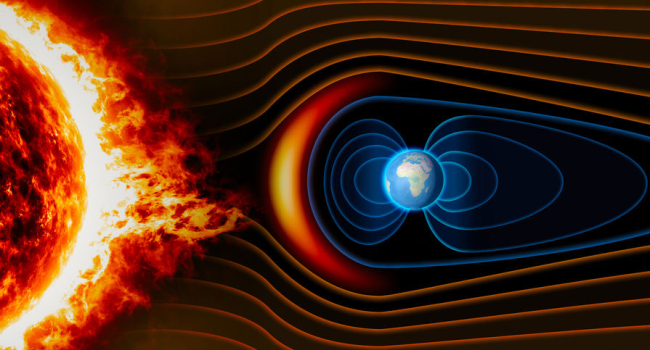
An international group of astronomers has developed a method that makes it possible to look into the Sun’s magnetic past up to 100 years back and to forecast future solar cycles more accurately. The work was published in The Astrophysical Journal.
Why This Matters
Solar cycles, which last about 11 years, determine the number of sunspots, solar flares, and coronal mass ejections. These, in turn, control magnetic storms on Earth that can damage satellites, disrupt power grids, and interfere with radio communications. At present, scientists can confidently predict solar activity only a few years ahead. However, long-term space missions, including NASA’s lunar and Mars programs, require forecasts extending decades into the future.
The difficulty lies in the fact that direct measurements of the Sun’s polar magnetic field have been available only since the 1970s. Before that, no systematic data existed because the Sun’s poles are visible from Earth only a few times a year due to the tilt of Earth’s orbit.
The Kodaikanal Archive as a Key to the Past
To overcome this limitation, scientists turned to the unique archive of the Kodaikanal Observatory at the Indian Institute of Astrophysics. Since 1904, the Sun has been observed there in the calcium Ca II K spectral line, which makes it possible to study the chromosphere and the magnetic structures associated with it.
The historical data had to be carefully calibrated to modern standards. Errors related to rotation, time shifts, and other distortions were removed. An automated analysis system was created to process tens of thousands of images and identify signatures of magnetic activity.
As explained by researcher Bibhuti Kumar Jha from the Southwest Research Institute, the chromosphere turned out to be a reliable indicator of the Sun’s magnetic state.
What Was Reconstructed
The method made it possible to reconstruct the behavior of the Sun’s polar magnetic field over more than 100 years. This significantly improves models for long-term predictions of solar activity. The results are already helping scientists better estimate the strength of future cycles, including Solar Cycle 26.
The accuracy of the model will be tested in practice within the next four to five years.
In Brief
Astronomers have reconstructed the Sun’s magnetic history going back 100 years using the Kodaikanal Observatory archive and observations in the Ca II K calcium line. The new method allows solar cycles and magnetic storms to be predicted decades in advance, which is crucial for space missions and for protecting technology on Earth. While direct observations of the Sun’s poles remain limited, the chromosphere has proven to be a reliable substitute. The discovery is already contributing to more accurate space weather forecasts.