make preferable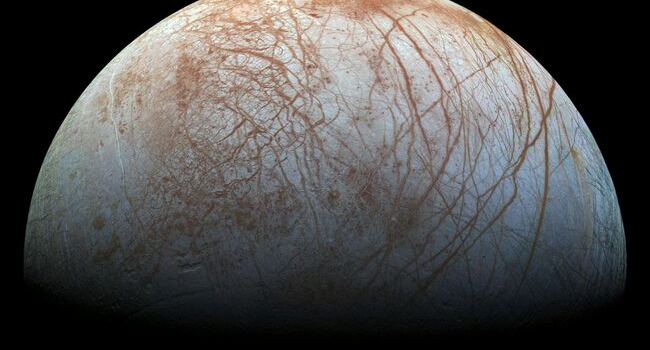
Europa, one of the most intriguing candidates for extraterrestrial life in the Solar System, may be less promising than previously thought. New modeling conducted by a research team led by Paul Byrne from Washington University in St. Louis suggests that tectonic activity on the floor of Europa’s hidden ocean is probably almost nonexistent. Without such activity, there would be no constant supply of fresh chemical compounds needed to sustain life.
Why tectonics are so important
On Earth, life in the deep ocean exists thanks to hydrothermal vents, often called black smokers. Tectonic fractures allow water to penetrate deep into the rock, where it is heated and enriched with minerals before returning to the ocean. This process supplies energy and nutrients for microbial life.
On Europa, beneath an ice shell tens of kilometers thick, lies a global ocean in contact with a rocky core. If tectonic fractures are absent there, fresh rock is not exposed, and the chemical reactions that provide energy and essential elements for life would quickly diminish.
The study leader Paul Byrne explained that without faults and cracks it is difficult to understand how new rock could enter the ocean and sustain the chemical reactions that microbes would need to survive.
What the modeling showed
The scientists considered three main factors that could potentially drive tectonic activity on Europa’s ocean floor:
- tidal stresses from Jupiter due to Europa’s slightly eccentric orbit;
- gradual contraction of the moon’s core as it cools;
- heat convection within the mantle.
The results were discouraging. None of these mechanisms produced stresses strong enough to form deep fractures.
Tidal forces were found to be too weak because Europa’s orbital eccentricity is only about 0.009, whereas strong tectonics would require a much larger value.
Core contraction over billions of years would amount to only a few hundred meters, far too small to create fractures several kilometers deep. For comparison, the Moon’s contraction is estimated at tens of meters, and Mars at up to about seven kilometers.
Mantle convection also failed to generate sufficient stress.
Without tectonics, classic powerful hydrothermal vents like Earth’s black smokers are unlikely on Europa. Only weaker and cooler hydrothermal systems might exist. Such systems are more common on Earth but are less energetic and probably short-lived.
Are there other possible energy sources?
Potential alternatives include:
- radioactive decay within Europa’s core, although its intensity is currently unknown;
- delivery of material from above, such as meteorites striking the ice and sinking into the ocean, though it remains unclear whether there are pathways through the ice shell in both directions.
These questions are expected to be addressed by NASA’s Europa Clipper mission, which is already on its way to the Jovian system.
Implications for other ocean worlds
Byrne’s modeling may apply to most icy moons with subsurface oceans. The main exception is Enceladus, Saturn’s moon, where tectonic activity has been directly observed through geysers that eject water into space.
Byrne emphasized that the results do not prove that life cannot exist on Europa. Rather, they indicate that, based on current findings, the conditions for life there are more difficult than previously assumed.
The study was published on January 6, 2026, in the journal Nature Communications.
In brief
The modeling suggests that Europa’s ocean floor is probably tectonically inactive because tidal forces, core contraction, and mantle convection are all too weak to form deep fractures. Without tectonics, there is no steady supply of fresh chemicals or strong hydrothermal activity, which significantly reduces the chances for life. Enceladus remains a notable exception. The Europa Clipper mission should provide more definitive answers. Europa is still a fascinating target, but it now appears less promising than before.