make preferable
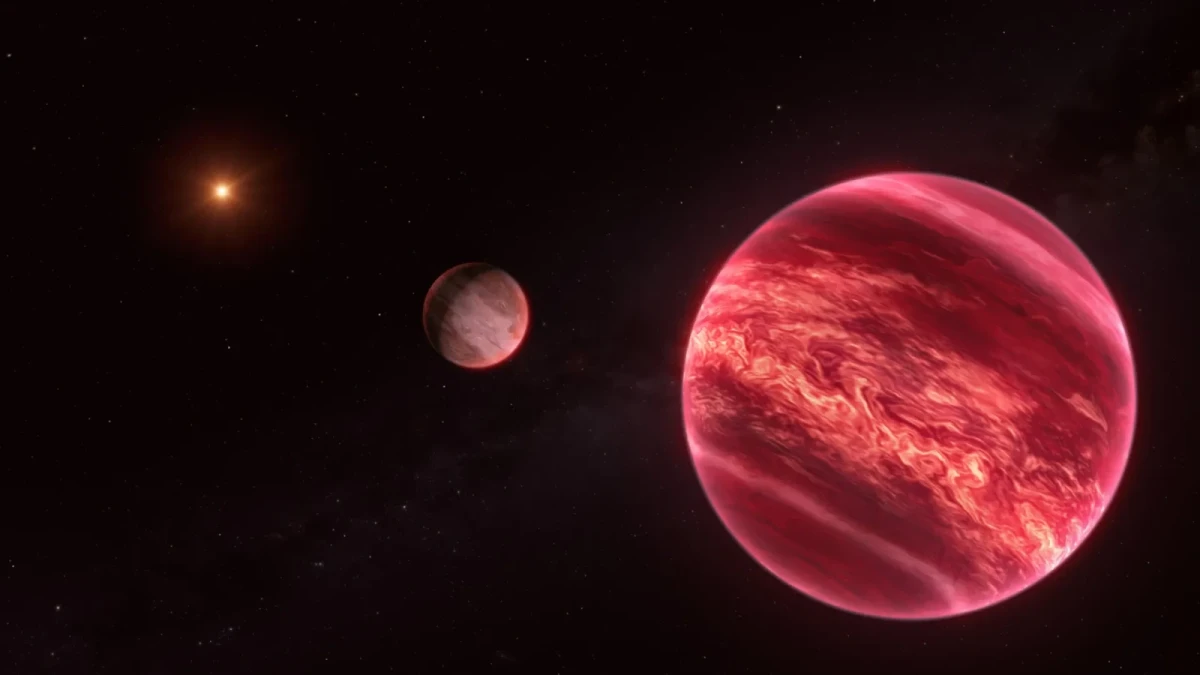
Astronomers have found possible evidence for the existence of the first moon beyond the Solar System. The unusual object in the CD-35 2722 system is at least comparable in mass to Jupiter and orbits not a planet, but a brown dwarf — a body that occupies an intermediate position between planets and stars. If the discovery is confirmed, it could call into question the usual division of celestial bodies into planets and their satellites.
The study was conducted by an international team using the European Southern Observatory’s Very Large Telescope (ESO). The scientists refer to the proposed object as an exomoon. For now, this is only a possible discovery: the existence of such a moon has yet to be definitively confirmed, ScienceDaily reports.
An unusual system where it is hard to distinguish a planet from a moon
The CD-35 2722 system is relatively young. At its center is a star with a mass of about half that of the Sun. Orbiting it is a brown dwarf — an object more massive than ordinary planets, but not massive enough to sustain the stable hydrogen fusion characteristic of stars.
The proposed satellite orbits this brown dwarf. Its mass is no less than that of Jupiter, while the mass of the brown dwarf itself exceeds 30 Jupiter masses.
For comparison, the largest natural satellites in the Solar System are significantly less massive than this object. However, the main feature of the find is not only its size: the potential exomoon is massive enough to be considered a planet under some classifications, yet it does not orbit a star directly.
“This system is difficult to describe using concepts familiar from the Solar System — such as ‘planet’ and ‘moon,’” notes Kevin Hsu, the study’s lead author, who works at ESO in Chile and is affiliated with Diego Portales University.
Alice Zurlo, head of the YEMS scientific center and a participant in the study, also emphasizes the unusual nature of the configuration: it involves a giant gaseous body orbiting a very massive companion that is itself many times heavier than Jupiter.
How the possible exomoon was discovered
To search for the satellite, the researchers used the CRIRES+ instrument installed on ESO’s Very Large Telescope. They applied the radial velocity method — one of the main ways of detecting exoplanets.
The method is based on measuring small changes in the speed of a celestial body’s motion relative to the observer. Two objects bound by gravity orbit a common center of mass. Therefore, a satellite, even if it cannot be seen directly, can cause noticeable changes in the motion of the more massive companion.
By analyzing such changes in the brown dwarf’s motion, the scientists found signs of the presence of another massive body in orbit.
“However exotic this system may be, it is truly unique and represents a breakthrough: this is the first credible detection of an exomoon,” says Zurlo.
At the same time, the detected signs are not yet equivalent to final confirmation. That is why the researchers cautiously speak of a possible first exomoon rather than a proven discovery.
Astronomers have been searching for the first exomoon for many years
Astronomers have long been trying to detect natural satellites around objects beyond the Solar System, but there are still no convincingly confirmed exomoons. At the same time, scientists have already discovered more than 6,000 exoplanets, while only a few exomoon candidates have been identified.
At the beginning of 2026, another research group led by Quentin Kral reported possible signs of a satellite in the HD 206893 system. The observations were carried out using ESO’s Very Large Telescope Interferometer. However, in this case as well, the data proved insufficient for final confirmation.
The new finding in the CD-35 2722 system may become another important step in the search for such objects. It also shows just how unusual the configurations of distant star systems can be.
Why the discovery matters for astronomy
The discovery of exomoons would help us better understand how planetary systems form, how their components interact, and why some of them are arranged differently from our Solar System.
In the case of CD-35 2722, the question of classification also arises. If a planet-sized body orbits a brown dwarf that, in turn, revolves around a star, should it be considered a planet, a moon, or an object of a separate class? Astronomers still do not have a single generally accepted definition of an exomoon.
The future ESO Extremely Large Telescope (ELT) may help in the search for answers. Its 39-meter primary mirror and advanced scientific instruments will make it possible to study objects that are currently beyond the reach of existing observatories, including the search for smaller exomoons.
If future observations confirm the existence of a satellite in the CD-35 2722 system, astronomers will gain not just another unusual object, but also a reason to reconsider the boundaries between planets and their moons.