make preferable
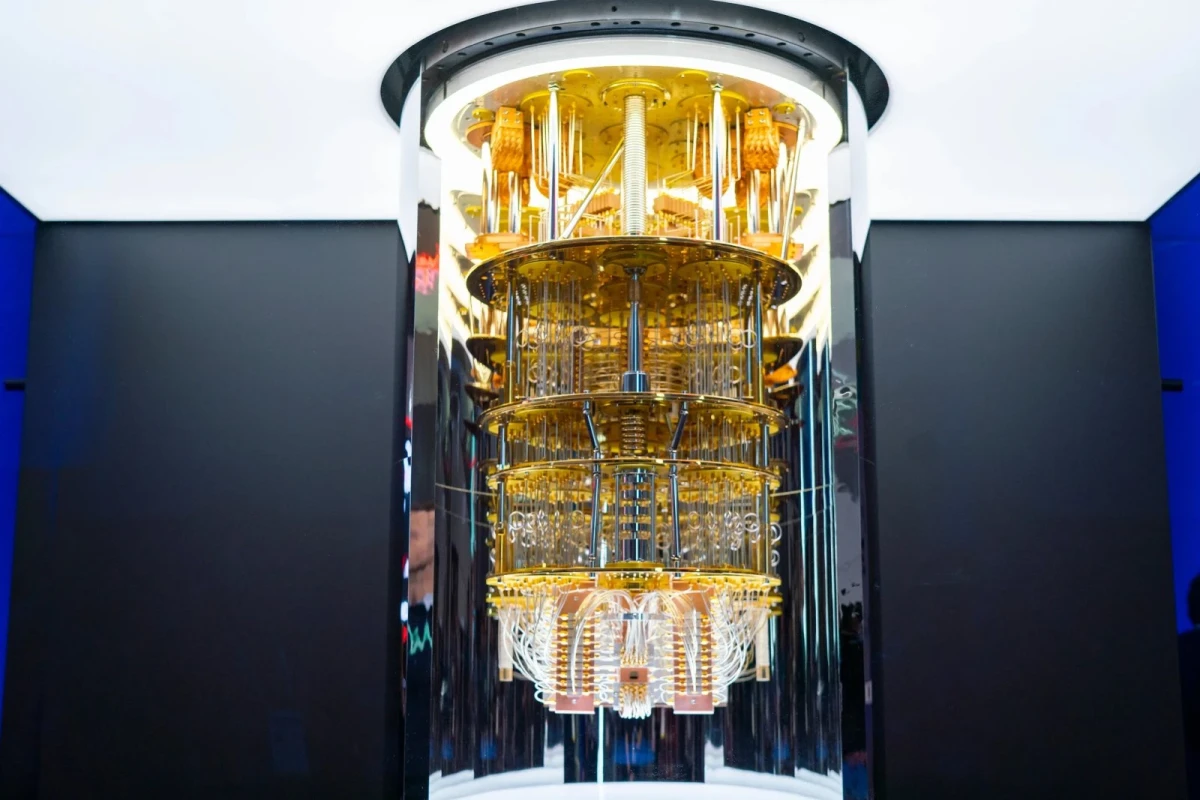
Physicists at the Swiss Federal Institute of Technology in Zurich (ETH Zurich) have developed an experimental quantum computer architecture in which information is stored not in electromagnetic states, as in most existing systems, but in microscopic mechanical oscillations. These vibrations resemble the motion of a guitar string, although they occur at frequencies far beyond the range of human hearing. The researchers have already demonstrated that this memory can participate in actual quantum computations, ScienceDaily reports.
Quantum Memory Based on the Principle of a Conventional Computer
In traditional computers, the central processing unit (CPU) performs calculations, while the data needed for current operations is temporarily stored in random-access memory (RAM). This separation allows the processor to access information as needed without devoting its own resources to storing it continuously.
Physicist Yiwen Chu's team sought to implement a similar principle in a quantum computer. A superconducting qubit serves as the processor—an element that controls quantum states and performs computational operations. A separate component temporarily stores information that the processor can retrieve, modify, and return.
What makes this development unusual is the method of data storage itself. Instead of the electromagnetic states used in many modern quantum systems, information is encoded in the mechanical oscillations of specialized microscopic structures known as mechanical resonators.
These oscillations cannot be heard: they occur at extremely high frequencies inside the quantum chip. From a physics perspective, however, they can serve as a carrier of quantum information—much as the string of a musical instrument conveys information about sound through its pattern of vibration.
How Mechanical Memory Could Be Better
One of the main challenges facing quantum computers is the need to control fragile quantum states precisely. Even minor external disturbances can disrupt them and cause information loss. The processor and memory must therefore exchange quantum states with high fidelity, preserving their properties during computation.
In ETH Zurich's architecture, resonators hold information in specific vibrational modes. When the processor needs data, it accesses the mechanical memory, performs an operation, and returns the modified state.
This approach has several potential advantages.
· Compactness. Mechanical resonators are significantly smaller than many electromagnetic memory elements, which could make it easier to build more compact quantum devices.
· Capacity. A single resonator can support many different vibrational modes. This opens up the possibility of storing multiple information states in a single structure.
· Storage time. Mechanical memory may preserve quantum states for longer before the information begins to degrade. This is particularly important for computations consisting of many successive operations.
The last of these properties could potentially enable more complex computations that require data to remain available over extended periods.
Electromagnetic storage systems, however, also have significant advantages: researchers have extensively studied how to control them and read and modify quantum states. The new architecture therefore does not mean that previous solutions have become obsolete. It offers an alternative way to organize quantum memory.
Researchers Tested the System with Actual Computations
The study, published in the journal Science, provided the first experimental demonstration that mechanical resonators can interact with superconducting qubits not only to store data but also to perform quantum computations.
The team tested the architecture using two important procedures: the quantum Fourier transform and a period-finding algorithm.
The quantum Fourier transform is one of the fundamental operations used in many quantum algorithms. Period finding, in turn, demonstrates how this operation is applied as part of more complex computational procedures.
To complete such tasks successfully, a computer must simultaneously store multiple quantum states, manipulate them, and preserve their interrelationships. The experiments showed that the ETH Zurich system can meet these requirements.
This is an important distinction from simply demonstrating quantum storage: the researchers showed that mechanical memory can be a fully integrated part of a computing architecture.
From a Laboratory Chip to a Universal Quantum Computer
According to the researchers, the system they have developed possesses the basic capabilities needed to perform arbitrary quantum computations. In other words, this is not a device designed for a single specific operation, but an architecture that could, in principle, be used to build a programmable universal quantum computer.
However, a substantial gap remains between a laboratory demonstration and a practical machine. The next step is to scale up the system: the number of components and the complexity of computations must increase without sacrificing control precision or reliable information storage.
Yiwen Chu's team continues to explore the technology's capabilities. Its prospects will depend on whether the advantages of mechanical memory can be maintained as the technology scales up to larger quantum systems.
It is too early to say that vibrating resonators will replace established methods of storing quantum information. But ETH Zurich's work shows that future quantum computer architectures need not be built solely around qubits and electromagnetic signals. Mechanical oscillations can also become part of the computational process—and may help overcome some of the limitations of today's experimental systems.