make preferable
Physicists at the University of Ottawa have carried out a series of new calculations for an alternative cosmological model in which the universe could be 26.7 billion years old—almost twice the generally accepted estimate. The authors argue that their approach can explain some observations without dark matter or dark energy. For now, however, this remains a hypothesis, not a revision of the scientific consensus.
An alternative model changes the interpretation of redshift
The standard cosmological model estimates the age of the universe at approximately 13.8 billion years. It relies, among other things, on the existence of dark matter and dark energy: the former helps explain gravitational effects that cannot be accounted for by visible matter alone, while the latter is associated with the accelerating expansion of the cosmos.
Rajendra Gupta and Nikolaos Samaras of the University of Ottawa are investigating an alternative framework known as CCC+TL. It combines two ideas: coordinated changes in certain fundamental physical quantities and the “tired light” hypothesis.
According to the latter, photons lose some of their energy as they travel through space. In this model, the observed redshift—the increase in the wavelength of light from distant objects—is therefore not explained solely by the expansion of the universe. The relationship between redshift and cosmic history differs from that in the standard picture.
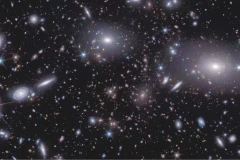
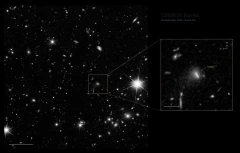
Changing this relationship allows the authors to derive a substantially greater age for the cosmos—around 26.7 billion years. In such a universe, early galaxies would have had more time to form and evolve. The researchers suggest this could help explain some observations by the James Webb Space Telescope, which has detected unexpectedly mature galaxies in the early universe.
The model was tested against the formation of light elements
One important test of any cosmological theory remains its ability to explain primordial nucleosynthesis—the formation of light chemical elements shortly after the Big Bang.
The standard model describes fairly accurately how much hydrogen, helium, and other light elements should have formed in the early universe. An alternative theory must reproduce these results or explain any discrepancies with observations.
In a new paper published in the journal Universe, the researchers calculated light-element abundances within the CCC+TL framework. They report that the results were virtually identical to those of the standard cosmological model. To achieve this, however, they had to account for coordinated changes in the universe’s expansion rate, nuclear reaction rates, and the neutron lifetime.
This is an important test: an alternative model must not only propose a different age for the universe but also remain consistent with established observations and calculations.
Testing galaxies without dark matter
In other studies, Gupta and Samaras compared their model with estimates of the universe’s expansion rate derived from galaxy ages, as well as with the rotation curves of 175 galaxies.
Rotation curves show how fast stars and gas move around the centers of galaxies at different distances. In the standard picture, the observed motion is often explained by the presence of dark matter, whose additional gravity affects galactic dynamics.
The authors argue that these data can be reproduced within CCC+TL without introducing dark matter. This does not mean its existence has been disproved: it is an attempt to explain specific observations in a different way.
Why the hypothesis does not yet change the age of the universe
The new calculations show that the CCC+TL model can pass several important cosmological tests. But successfully reproducing individual observations does not, by itself, prove that an alternative theory is correct.
It still needs to be tested against a much broader set of cosmological data and demonstrate that, overall, it explains the observed universe at least as well as the standard model. Moreover, the very idea that photons lose additional energy as light travels requires a convincing physical justification.
The estimate of 26.7 billion years therefore remains a result of an alternative theoretical description. The standard estimate of the universe’s age—around 13.8 billion years—remains generally accepted. The new studies by Gupta and Samaras are interesting primarily because they propose testing whether dark matter and dark energy are truly necessary to explain the cosmos we observe.