make preferable

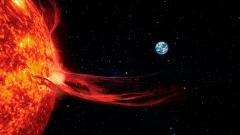
During one of the most powerful geomagnetic storms in recent decades, near-Earth space was dominated not by solar wind particles, but by oxygen ions that had risen from Earth's atmosphere. Researchers reached this conclusion after examining data from Japan's Arase satellite. The discovery shows that Earth itself can influence the strength of disturbances in space caused by solar activity.
Atmospheric oxygen in the ring current
Researchers from Nagoya University and their colleagues studied the geomagnetic superstorm of May 2024. Several powerful ejections of solar plasma reached Earth at the time, causing severe disturbances in the magnetosphere accompanied by unusually bright auroras.
One of the key elements of such events is the ring current—a flow of charged particles moving around the planet. Its magnetic field opposes Earth's, weakening the overall magnetic field in the affected regions. The stronger the ring current, the more pronounced the magnetic disturbance can be.
The particles forming this current come from two main sources: the solar wind and Earth's ionosphere—the upper part of the atmosphere, where gas is ionized by solar radiation and other processes.
To determine which source played a greater role during the superstorm, the scientists used measurements from Japan's Arase satellite. Its instruments allowed them to determine the composition and energy of charged particles in the magnetosphere.
The result was unexpected: oxygen of terrestrial origin accounted for about 85% of the ions in the region studied. Solar wind particles made up only a small fraction.
The magnetic field weakened by 40%
Near the storm's peak, the satellite also recorded a local weakening of the magnetic field by approximately 40%. The measurement was taken at an altitude of about 16,000 kilometers.
Importantly, this refers to a specific region of the magnetosphere, not a 40% weakening of Earth's magnetic field across the entire planet. The observation describes local conditions in the magnetic environment during an extreme event.
The study's authors suggest that the substantial proportion of heavy oxygen ions may have strengthened the ring current, thereby intensifying the magnetic disturbance. In other words, the atmosphere was not merely affected by the solar storm; it also helped shape its consequences.
The study was published in the journal Science Advances.
Earth is not a passive participant in space weather
The findings add to our understanding of the mechanisms behind geomagnetic storms. Attention usually focuses on solar ejections: their speed, density, and magnetic properties. However, Arase's observations show that assessing the strength of extreme events also requires accounting for processes within Earth's own magnetosphere.
The ionosphere plays a particularly important role. If large numbers of heavy ions rise from it during a severe disturbance, they can significantly alter the composition of the ring current and affect the magnetic field around the planet.
For now, the researchers are describing a possible mechanism for intensifying the storm, rather than proving that oxygen from Earth was its main cause. Nevertheless, the data point to an important feature of extreme space weather: its intensity is determined not only by what arrives from the Sun, but also by how Earth itself responds.