make preferable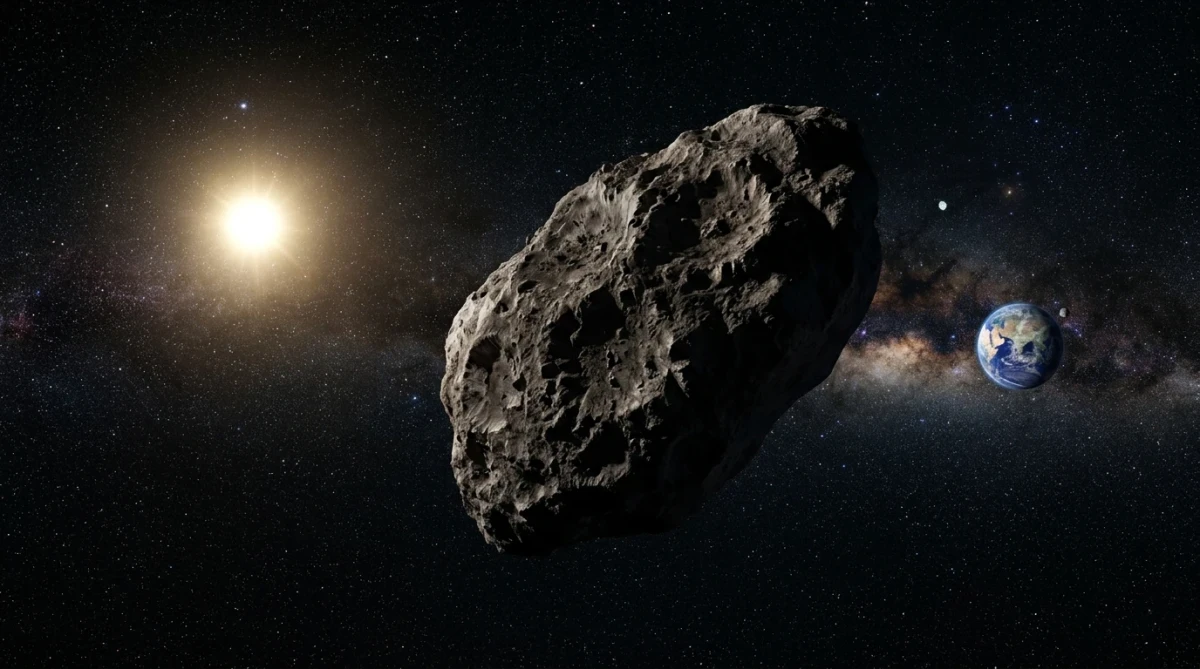
Astronomers have discovered the largest known asteroid that rotates at an extreme speed. The object, designated 491384, has an estimated diameter of about 2.53 km and completes a full rotation around its axis in just 4.18 minutes. Such rotation creates a mystery: a loose collection of rocks under these stresses should have broken apart.
The study was conducted by an international team led by Dmitry Vavilov of the University of Washington in Seattle, with the participation of specialists from the Institute of Astronomy of the Russian Academy of Sciences in St. Petersburg. The results were published on the arXiv server, where scientific papers that have not yet undergone peer review are posted.
Why asteroids are not supposed to rotate this fast
Many asteroids are not solid rocky boulders but so-called “rubble piles” — accumulations of fragments held together mainly by their own gravity. If such an object spins too fast, centrifugal forces can overcome the weak attraction between the fragments, and the asteroid will begin to break apart.
For asteroids larger than about 150 meters in diameter, there is a characteristic limit: most of them do not spin faster than roughly one rotation every 2.2 hours. This restriction is called the spin barrier.
Objects that surpass it are of particular interest to scientists. To remain intact under such rapid rotation, they likely must possess significant internal strength — for example, be relatively solid rocky bodies rather than loose aggregates of debris.
Asteroid 491384 is especially remarkable because of the combination of its size and rotation speed. With a diameter of more than two kilometers, it completes a rotation in a matter of minutes, making it an exceptional object among known super-fast rotators.
How scientists distinguish true record-holders from observational errors
The rotation speed of asteroids is often determined by changes in their brightness. Since most such bodies have irregular shapes, they reflect different amounts of sunlight as they rotate. From the periodic fluctuations in brightness, astronomers can estimate the rotation period.
However, observations do not always provide a continuous picture. Telescopes record the object at separate moments, and there may be significant gaps between them. Because of such gaps, real brightness variations can easily be mistaken for other fluctuations, leading to incorrect estimates of the rotation period.
To reduce the number of such errors, Vavilov’s team developed software that automatically analyzes brightness measurements, accounts for incomplete observations, and flags suspicious data.
The researchers applied the system to a sample of 9,417 asteroids. As a result, they identified 66 candidates for super-fast rotators. Two objects in this group have diameters of more than two kilometers and rotate in about five minutes, but asteroid 491384 turned out to be the fastest among them: its period is 4.18 minutes with an estimated diameter of 2.53 km.
Importantly, these are candidates identified through the analysis of observations. Since the study has not yet undergone peer review, the conclusions still need additional verification.
What the record-setting asteroid can reveal about the structure of small bodies
If the rotation period and size of asteroid 491384 are confirmed, its existence will become important evidence that large asteroids can withstand much higher stresses than typical loose objects.
The most likely explanation lies in high internal strength: the body may be comparatively monolithic or have such a strong structure that it does not break apart under the effects of rapid rotation. However, brightness measurements alone do not make it possible to definitively determine exactly how its interior is structured.
Going forward, the researchers plan to use automated analysis to study large volumes of astronomical observations. This will help determine asteroid rotation periods more reliably and find out how common such extreme objects are.
Such data are important not only for the search for new record-holders. They may refine our understanding of how asteroids form, collide, accumulate debris, and gradually change their structure over time.