make preferable
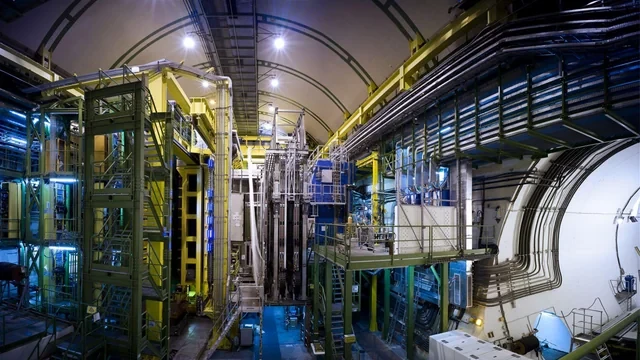
Physicists working on the LHCb experiment at the Large Hadron Collider (LHC) have found evidence of one of the rarest known processes in particle physics. It involves the decay of a Bd meson into a muon and an antimuon—an event that, according to theoretical calculations, occurs roughly once in every 10 billion decays of particles containing a b quark. Scientists have spent more than 40 years searching for this process.
The results were presented at a seminar at CERN. This is the first time a single experiment has collected enough data to obtain statistically significant evidence of such a rare decay. While this does not yet constitute definitive confirmation of a discovery, the result brings physicists closer to studying processes that could point to the existence of unknown particles, Science Daily reports.
Rare decays as a way to search for new physics
The subject of the study is the Bd meson, which consists of a b quark (bottom quark) and a d antiquark. In the observed process, this particle decays into a pair of muons: positively and negatively charged particles that resemble electrons but are much heavier.
A distinctive feature of these decays is that their probability can be influenced by other particles, even if those particles are too heavy to be produced directly at the Large Hadron Collider. According to quantum theory, such particles can participate in intermediate processes and leave indirect traces in measurement results.
This is why physicists closely study extremely rare decays: if the experimentally measured rate of a process differs from theoretical predictions, it could indicate unknown interactions or new particles.
The Bd → μ⁺μ⁻ decay is one of the so-called golden channels in the search for physics beyond the Standard Model—the main theory describing known elementary particles and their interactions. The more precisely scientists measure the probability of such an event, the greater their chances of detecting deviations from theoretical calculations.
Why the search took more than 40 years
Physicists have already studied a similar process involving another meson, Bs. In 2015, a joint analysis by the LHCb and CMS experiments confirmed the Bs → μ⁺μ⁻ decay for the first time. Initial evidence of the rarer Bd decay emerged at the same time.
However, subsequent studies, which included data collected through 2018, were unable to confirm those preliminary results.
The difference between the two processes is substantial. The Bs decay occurs roughly three times per billion decays of particles containing a b quark. The process involving Bd is about 30 times rarer, making it extremely difficult to detect.
To detect the signal, researchers have to isolate just a handful of events of interest from the enormous number of other processes occurring in particle collisions.
An upgraded detector and machine learning helped uncover the signal
An upgrade to the LHCb experiment played an important role in the new result. Following the upgrade, the detector began collecting data in 2024 at five times the rate achieved between 2010 and 2018. Its ability to identify different particles also improved.
The researchers combined these new technical capabilities with machine learning methods. Algorithms helped distinguish rare events producing muons from the numerous background processes that could obscure the signal they were looking for.
An international team of 19 scientists combined data from 2024 and 2025. The resulting statistical significance was 3.0 standard deviations. After adding results from earlier measurements taken between 2011 and 2018, the figure rose to 3.2.
According to Marco Santimaria, one of the research team's leaders, detecting the decay required exceptionally precise work: the muon signals had to be isolated from an enormous background of other events.
Why this is not yet a discovery
In particle physics, the reliability of a result is assessed using a statistical measure—the number of standard deviations, or sigma. It indicates how unlikely it is that the observed signal could arise from random statistical fluctuations.
A threshold of three sigma is considered sufficient to claim evidence of a new phenomenon. At this level, the probability that random fluctuations would produce a signal just as strong or stronger is about 0.3%.
But to confirm a discovery, physicists need to reach five sigma. The new LHCb result does not yet meet this criterion: 3.2 sigma provides evidence of the rare decay, but not definitive experimental confirmation.
As part of the same study, the scientists also obtained the most precise measurements to date of the Bs → μ⁺μ⁻ decay. This will enable better comparisons of the properties of the two processes and more rigorous tests of theoretical predictions.
What future collider upgrades will make possible
The next major milestone for this research is the start-up of the upgraded High-Luminosity Large Hadron Collider (HiLumi LHC), scheduled for 2030. Another major upgrade to the LHCb experiment is also planned for the middle of the next decade.
Together, these changes could increase the data collection rate by another factor of ten. The more collisions researchers can study, the more rare decays physicists will be able to detect, and the more precise their measurements will become.
This is particularly important in the search for particles that cannot be produced directly at existing accelerators. Their influence may appear only as small deviations in the probabilities of rare processes from Standard Model calculations.
As Harry Cliff, LHCb's rare decays coordinator, noted, the current result opens up new opportunities to investigate physics beyond the collider's direct experimental reach. Further upgrades will make it possible to observe significantly more events of this kind.
After four decades of searching, scientists have finally obtained compelling evidence of the Bd → μ⁺μ⁻ decay. The main task now is to collect enough data to confirm it with the required precision. This does not in itself mean that new physics has been discovered, but it gives researchers one of the most sensitive tools for searching for it.