make preferable
Astronomers have detected a real sugar in interstellar space for the first time — erythrulose, an organic molecule from the same family as fructose. The compound was found in the molecular cloud G+0.693−0.027 about 27,000 light-years from Earth. According to the researchers’ calculations, such molecules can form directly on the icy particles of cosmic dust and could potentially take part in the chemical processes that preceded the emergence of life.
The study by an international team led by Izaskun Jiménez-Serra of Spain’s Center for Astrobiology was published in the journal Nature Astronomy.
The Sugar Signal Came from the Center of the Galaxy
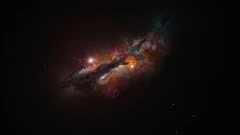
The molecular cloud G+0.693−0.027 lies in the direction of the center of the Milky Way and is considered one of the regions richest in organic compounds in the Galaxy.
To search for erythrulose, the scientists used two radio telescopes in Spain — the 40-meter telescope in Yebes and the 30-meter telescope at Pico Veleta. Molecules can be detected by their characteristic set of radio signals: each compound interacts with radiation at specific frequencies, creating a kind of spectral fingerprint.
The researchers identified 17 such lines corresponding to erythrulose. The probability that the observed set of signals arose by chance was estimated at just 0.2%.
Erythrulose became the largest known non-cyclic molecule detected in the interstellar medium. It consists of 14 atoms and became the first compound found there that contains as many as four oxygen atoms.
Sugar Is Likely Forming Directly in Space
Observations indicate that erythrulose did not necessarily originate somewhere outside the cloud and get carried there. According to the researchers’ models, the molecule is capable of forming directly on the surface of icy particles of interstellar dust.
For this, simpler two-carbon compounds — glycolaldehyde and ethylene glycol — may serve as the initial “building blocks.” They undergo chemical reactions on the icy surface of dust grains, gradually forming a more complex molecule.
Calculations showed an amount of erythrulose close to what was determined from observations. The molecule likely enters the gas phase after collisions between clouds destroy or knock icy material off the surface of dust grains.
This is especially important for understanding the chemistry of space: complex organic compounds may form even before the birth of new stars and planets.
Cosmic Sugars May Have Reached the Young Earth
The authors of the study link the discovery to the question of the origin of the building components of the first biological molecules.
In laboratory experiments simulating conditions on the young Earth, sugars form relatively slowly and in small quantities. At the same time, ribose and glucose have already been detected in meteorites, as well as in samples obtained from the asteroid Bennu.
This suggests that some organic compounds could have reached the early Earth along with cosmic material.
The researchers estimated that during the period of intense meteorite bombardment about 4.1–3.9 billion years ago, between 500,000 and 50 million tons of erythrulose could theoretically have reached the planet.
In water, erythrulose can transform into other sugars. Some of these compounds are used by living organisms to build nucleic acids, including RNA. Therefore, cosmic organic matter may have added to the set of chemical substances available on the young Earth before the first forms of life appeared.
The First Real Sugar in the Interstellar Medium
More than 340 different molecules have already been detected in interstellar space, but until now there had been no real sugars among them.
The closest known relative of erythrulose — glycolaldehyde — was discovered back in 2000. It belongs to simpler organic compounds and is not considered a sugar in the strict sense.
Astronomers have now obtained the first direct evidence of the presence of a real sugar in the interstellar medium. This in itself does not mean that erythrulose caused life to arise on Earth: between the detection of an organic molecule in space and the emergence of biology lies a vast chain of chemical processes, many of which remain unknown.
But the discovery shows that some compounds potentially important for prebiotic chemistry may have formed even before the birth of planets and then become part of the material from which young planetary systems were assembled.