make preferable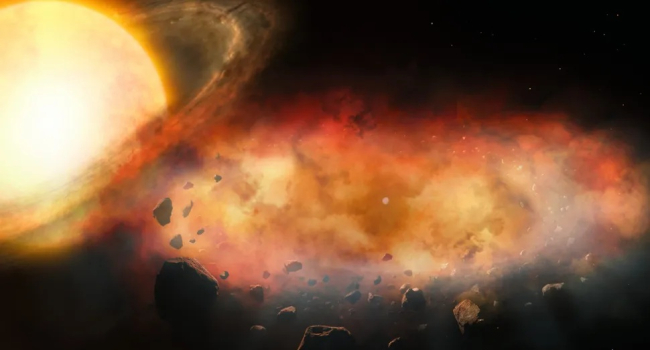
Astronomers from Johns Hopkins University have discovered a colossal cloud of gas and dust that dimmed the Sun-like star J0705+0612 for nine months. The star is located about 3,000 light years from Earth. The cloud consists of evaporated metals and is held together by the gravity of an unknown massive body, possibly a giant planet or a low-mass star. The study was published on January 21, 2026, in The Astronomical Journal.
How the cloud was found
According to Space.com, in September 2024 the star J0705+0612 suddenly became 40 times dimmer. This state lasted until May 2025. Such events are extremely rare, because ordinary stars do not fade without a serious physical cause.
The lead author of the study, Nadia Zakamska, explained that stars similar to the Sun do not simply stop shining, which is why such dramatic dimming events are highly unusual.
The team used the Gemini South, Apache Point, and Magellan telescopes, as well as archival data. They determined that the star had been temporarily obscured by a huge, slowly moving cloud of gas and dust about 200 million kilometers wide, which is roughly 15,000 Earth diameters. At the moment of maximum dimming, the cloud was located about 2 billion kilometers from the star, roughly 13 times farther than the distance between the Earth and the Sun.
What is inside the cloud
Spectral observations made with the GHOST instrument on Gemini South showed that the cloud is rich in heavy elements, which astronomers refer to as metals, meaning everything heavier than helium. It contains large amounts of gaseous iron and calcium. For the first time, scientists were able not only to detect these metals but also to measure their motion inside the cloud in three dimensions.
Zakamska emphasized that the sensitivity of GHOST made it possible not only to detect gas in the cloud but also to determine how it moves, something that had never before been achieved for a system of this kind.
What holds the cloud together
The cloud is gravitationally bound to a massive object orbiting J0705+0612. Its mass must be at least several times that of Jupiter, otherwise it could not retain such a gigantic structure. There are two main possibilities.
One option is that it is a low-mass companion star, in which case the cloud is a circumstellar disk.
The other option is that it is a giant planet, in which case the structure is a circumplanetary disk.
Both scenarios are extremely rare to observe in such a way that the disk or cloud passes directly in front of the star from our point of view.
Origin of the cloud
Scientists believe that the cloud formed as a result of a collision between two planets in the J0705+0612 system. Such events are common in young and dynamically chaotic systems, but they are very rare for a star that is about 2 billion years old.
Zakamska noted that this event shows that even in mature planetary systems, dramatic large-scale collisions can still occur. She added that it is a vivid reminder that the Universe is far from static and represents a continuous story of creation, destruction, and transformation.
In brief
Astronomers have discovered a cloud of evaporated metals about 200 million kilometers wide that dimmed the star J0705+0612 for nine months. The cloud is held together by the gravity of an unknown massive object, either a giant planet or a low-mass star, and likely formed during a collision between two planets. For the first time, scientists were able to measure the motion of gas inside such a structure. The discovery shows that even mature planetary systems about 2 billion years old can still experience catastrophic events that shape their evolution.