make preferable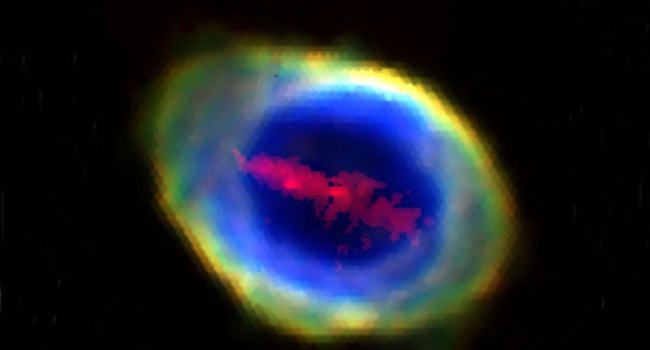
An international team of astronomers led by researchers from University College London UCL has discovered an unusual structure inside the famous Ring Nebula M57 in the constellation Lyra. It is an extended ribbon made of ionized iron atoms. The length of this ribbon is about three trillion kilometers and its mass is comparable to that of the planet Mars. This was reported by the press service of UCL.
An unexpected discovery during testing of a new instrument
The discovery happened almost by accident during test observations with the new WEAVE spectrograph installed on the 4.2 meter William Herschel Telescope in the Canary Islands. WEAVE was specifically designed to obtain detailed spectra of very extended objects, from nearby galaxies to planetary nebulae.
UCL researcher Roger Wesson explained that when the team processed the data obtained by WEAVE after its connection to the William Herschel Telescope, they identified a previously unknown object inside the nebula. According to him, it turned out to be a huge ribbon of ionized iron atoms that runs through the very center of this cloud of gas and dust.
The structure stretches across the central region of the nebula, which is the remnant of an exploded star surrounded by glowing gas. Its nature and origin remain unknown. Scientists suggest that it could have formed due to an uneven distribution of matter during the stellar explosion or as a result of physical processes in the central part of the nebula that are not yet fully understood.
Why this is important
The Ring Nebula is one of the most studied and visually striking planetary nebulae in the sky. The discovery of such a massive and clearly defined iron structure inside it forces astronomers to reconsider existing ideas about the chemical composition and dynamics of these objects.
Iron is a heavy element that is usually formed in the interiors of massive stars and released during supernova explosions. Its presence in such a concentration and in such a distinct form inside a planetary nebula, which is the remnant of a low or intermediate mass star, requires new explanations.
This discovery became possible thanks to the high sensitivity and spatial resolution of WEAVE. The instrument represents a new generation of astronomical equipment that allows scientists to study extended cosmic objects with unprecedented detail.
In brief
Astronomers from UCL have discovered a giant ribbon of ionized iron in the Ring Nebula, about three trillion kilometers long and with a mass comparable to that of Mars. The structure passes through the center of the nebula and was detected during test observations with the WEAVE spectrograph on the William Herschel Telescope. This is the first time such a formation has been found in a planetary nebula, raising new questions about the chemical composition and evolution of these objects. The discovery highlights the power of new instruments in the study of distant cosmic structures.