make preferable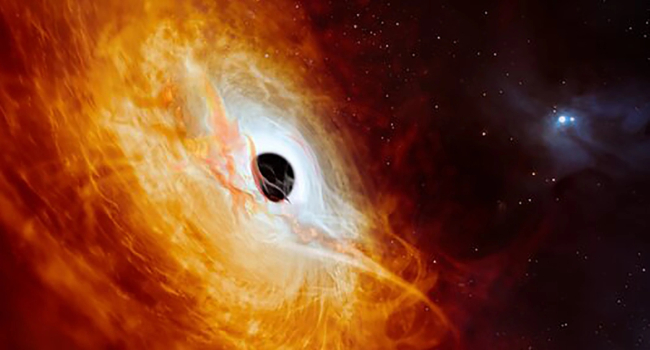
Astronomers have recorded one of the most powerful cosmic flares ever observed, an event nicknamed “Whippet” (AT2024wpp). It released an amount of energy equivalent to the radiation of 400 billion Suns. Scientists identify it as a record-breaking tidal disruption event (TDE), in which a massive star was torn apart and consumed by a black hole.
What Whippet is
The flare resembles rare luminous fast blue optical transients (LFBOTs), extremely bright blue events that can be observed from billions of light-years away. Such phenomena typically last only a few days and emit radiation ranging from blue optical light to ultraviolet and X-rays.
According to the study’s lead author, Daniel Perley of Liverpool John Moores University, the observations show a black hole interacting with a massive neighboring star, shredding it into a disk of material that then feeds the black hole. He explained that this type of event is both rare and striking. Perley also noted that even when researchers suspect what they are observing, the scale of the phenomenon remains astonishing. He emphasized that the event is several times more energetic than any similar phenomenon previously recorded and more powerful than any known flare produced by stellar collapse. He added that such events not only help astronomers locate black holes but also provide a new way to study where they form, how they grow, and the physics governing these extreme processes.
Whippet is comparable to the famous flare AT2018cow but is estimated to be between 10 and 100 times brighter than a typical supernova.
How it was discovered and studied
The event was first detected by the Zwicky Transient Facility at the Palomar Observatory in California. Follow-up observations were carried out using the Liverpool Telescope in the Canary Islands and NASA’s Swift space observatory, which confirmed the blue color of the emission and the presence of X-rays.
Measurements of distance and temperature indicated that this was not an ordinary supernova but a tidal disruption event. In this scenario, the black hole effectively “spaghettified” the star, creating an accretion disk and powerful outflows.
The resulting shock wave propagated at roughly 20 percent of the speed of light, or about 215 million kilometers per hour, which is around 90,000 times faster than an F-16 fighter jet. Researchers report that the shock wave dissipated after about six months as it collided with the remaining stellar debris.
An additional notable detail was the detection of helium moving away from the source at about 21 million kilometers per hour, roughly 750 times faster than a NASA space shuttle. Scientists suggest this material may represent a stream from the stellar core or an outflow linked to a third object in the system.
Why this matters
Tidal disruption events allow astronomers to identify otherwise dormant supermassive black holes at the centers of galaxies. Whippet stands out as one of the most energetic such events ever observed, providing valuable new data on accretion physics and black hole evolution.
The findings were presented at a meeting of the American Astronomical Society in Phoenix and have been accepted for publication in Monthly Notices of the Royal Astronomical Society.
In brief
The flare AT2024wpp, known as “Whippet,” is a record-setting tidal disruption event in which a black hole tore apart a massive star, releasing energy equivalent to 400 billion Suns. The event is more powerful than any known supernova or comparable phenomenon. Its shock wave reached 20 percent of the speed of light, while helium outflows reached 21 million kilometers per hour. The discovery offers a unique opportunity to study dormant black holes and extreme astrophysical processes, marking a dramatic start to astronomical research in 2026.