make preferable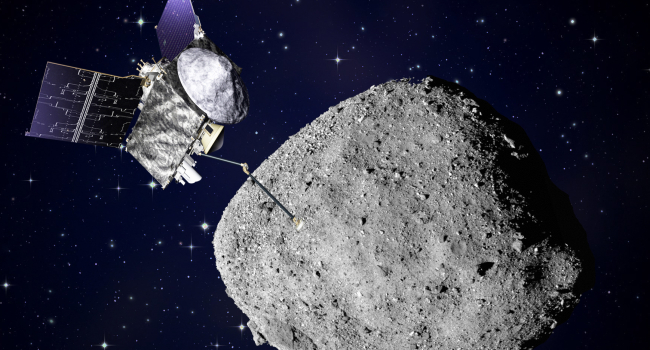
On December 2, 2025, NASA announced three sensational discoveries in the material from asteroid Bennu, delivered to Earth by the OSIRIS-REx probe in 2023. Among 600 milligrams of pristine dust and gravel, scientists detected ribose (a key component of RNA), glucose and other sugars, as well as a previously unknown polymeric substance that researchers are already calling “cosmic chewing gum.”
Sugars Without Which Life Could Not Exist
A Japanese team led by Yoshihiro Furukawa of Tohoku University confirmed for the first time the presence of ribose — the sugar that forms the “backbone” of RNA molecules — in extraterrestrial material. Glucose, the primary energy source for all modern organisms, was also found.
“These sugars add to the list of ingredients that are critically important for life,” the authors wrote in their paper published in Nature Geoscience.
Importantly, 2-deoxyribose — the sugar that forms part of DNA — was not detected, which fits perfectly with the RNA-world hypothesis: early life began with RNA, while DNA and proteins emerged later.
“They were everywhere,” commented NASA astrobiochemist Danny Glavin. He added that the presence of such molecules on an asteroid makes him far more optimistic about the search for life on Mars, Europa, or Enceladus: “I am becoming much more confident that we will be able to find life beyond Earth, even within our own Solar System.”
“Cosmic Chewing Gum”: A New Type of Extraterrestrial Polymer
A second team led by Zach Gainsforth of the University of California, Berkeley found in Bennu’s samples a strange flexible polymer rich in nitrogen and oxygen. Long ago it was soft and elastic, but over billions of years it hardened.
“It was unlike anything we had seen before,” Gainsforth said. “For months we were drowning in data and theories, trying to understand what it is and how it could have formed.”
The polymer appears to have arisen during the earliest stages of Bennu’s parent body, possibly as one of the first chemical precursors of life. The results were published in Nature Astronomy.
Bennu as a Keeper of Dust from Exploding Stars
The third discovery: the samples contain six times more interstellar dust from ancient supernovae than any other known meteorite. This indicates that Bennu’s parent body formed within a region of the early solar nebula enriched with the products of dying stars.
“On this primitive asteroid, formed in the first days of the Solar System, we are seeing events from the very beginning of beginnings,” noted NASA astrophysicist Scott Sandford.
In Brief
Pristine samples from asteroid Bennu contain ribose (the basis of RNA), glucose and other sugars, confirming that the building blocks of life were widespread in the early Solar System. They also contain a mysterious polymeric material (“cosmic chewing gum”) — possibly one of the earliest precursors of life — and a record concentration of interstellar dust from supernovae. Three papers in Nature Geoscience and Nature Astronomy published on December 2, 2025 significantly strengthen the case for finding traces of life on Mars and the moons of the giant planets.