make preferable
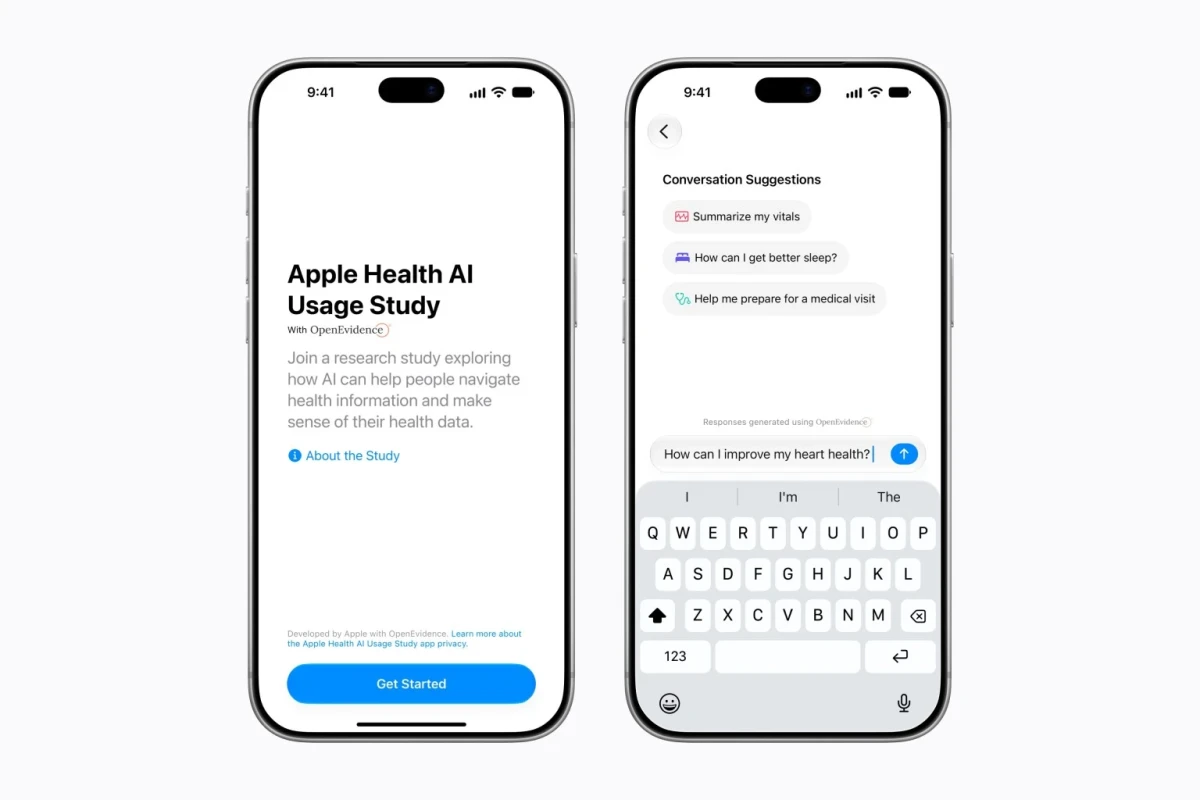
Apple has released an experimental app to study how users turn to artificial intelligence for medical advice and how useful they find the answers. The company has partnered with medical AI developer OpenEvidence for the project and aims to recruit up to 200,000 participants in the United States. The study will run for more than a year, and its findings could influence how Apple develops its own health services, TechCrunch reports.
Medical AI based on scientific publications
The new project differs from efforts by OpenAI and Anthropic to bring general-purpose AI health assistants to market. Apple is not announcing its own medical chatbot at this stage: the company first wants to study how people use such tools and how much they trust their recommendations.
The app lets users ask health questions in a familiar conversational AI format. Answers are generated using clinical data and scientific publications, including The New England Journal of Medicine, the Journal of the American Medical Association, and Nature.
The developers promise to explain medical information in plain language to help users understand everyday health issues. After receiving an answer, participants will be able to rate its usefulness and leave feedback. Researchers will also invite them to complete monthly surveys.
The app will be able to use data from iPhone and Apple Health
Study participants will be able to voluntarily grant the app access to information from HealthKit. This includes resting heart rate, physical activity, sleep quality, and laboratory test results.
Using this data will allow for more personalized answers that take individual health metrics into account. The app will also help users prepare for a doctor's visit, for example by formulating questions and organizing information worth discussing during the appointment.
If a user raises an issue that requires medical attention, the service will be able to direct them to an appropriate specialist. Apple is thus positioning the app not only as a source of reference information but also as a tool to help people navigate the healthcare system.
Apple promises not to use the data to train AI
The company is paying particular attention to the privacy of medical information. According to Apple, data will be anonymized before being sent to a third-party cloud provider. It will not be used to train artificial intelligence models.
Apple's partner, OpenEvidence, also commits to deleting records of users' queries and responses after 24 hours.
However, taking part in the study involves sharing certain medical information, so it is important for users to understand exactly which data they are allowing to be used. The ability to receive more accurate recommendations based on personal health metrics comes with the need to share sensitive information.
Apple is not yet promising to integrate medical AI into Siri
The study is open to users in the United States over the age of 21. Participation requires an iPhone 15 or newer, iOS 26 or later, and Apple Intelligence enabled. The company plans to recruit up to 200,000 people, and data collection will continue for more than 12 months.
Apple has not yet said whether it plans to integrate similar capabilities directly into the Health app or the Siri voice assistant in the future. However, the experiment itself shows that the company sees medical AI as a promising area and wants to study it from both a technological and a clinical perspective.
The potential market is indeed vast. According to figures OpenAI shared earlier this year, ChatGPT users ask more than 300 million health questions every week. Judging by the new study, Apple wants to understand how to make these interactions not just convenient but also reliable enough to become part of everyday health management.