make preferable
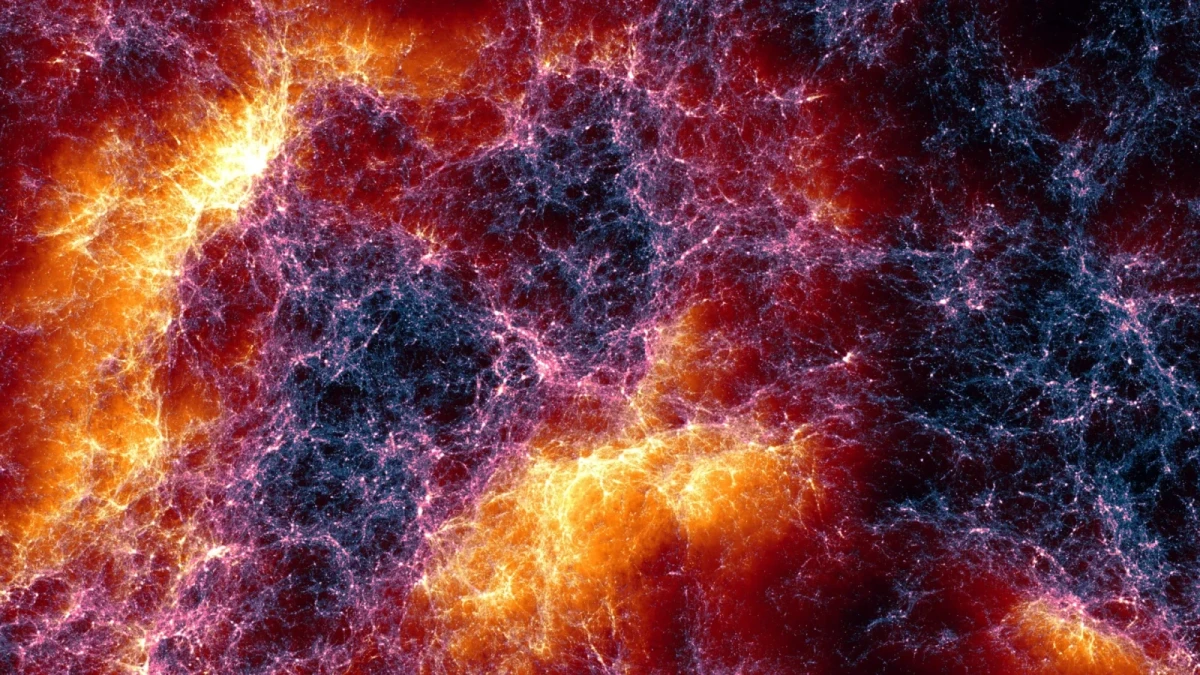
Astrophysicists have created one of the largest and most detailed computer models of the early Universe. The Lumina simulation recreates the first 2 billion years of cosmic history, making it possible to trace how the interaction of ordinary matter, dark matter, and radiation influenced the formation of galaxies. The model will help scientists test theories about the evolution of the cosmos and compare their predictions with telescope observations, including those from James Webb.
The project was developed by researchers at the Center for Astrophysics | Harvard & Smithsonian. The results were published in the journal Monthly Notices of the Royal Astronomical Society.
Lumina is intended not just for visualizing the distant past. It makes it possible to calculate how the Universe should have evolved according to modern physical theories and then compare the simulation results with real astronomical observations. If significant discrepancies are found, this could point to processes that existing models do not yet take into account, sciencedaily.com reports.
What the young Universe looked like
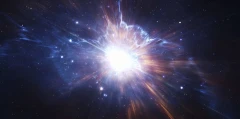
After the Big Bang, the cosmos gradually cooled, matter clumped together under the influence of gravity, and the first stars and galaxies formed. Their radiation changed the properties of the surrounding gas, gradually transforming the Universe.
Recreating this history is not easy: it requires simultaneously accounting for gas motion, the gravitational influence of dark matter, and the propagation of radiation. All these processes are interconnected, and modeling them on large scales requires enormous computing resources.
Lumina calculates the interaction of ordinary matter, dark matter, and light throughout the first 2 billion years after the Big Bang. Thanks to this, researchers can study not only the emergence of the first galaxies, but also how their development affected the gas filling the space between them.
“Thanks to the James Webb telescope, the early Universe has become a new exciting frontier in astrophysics. To understand what we are seeing with this telescope, we need to turn our theories into detailed predictions,” says the study’s lead author, Oliver Tsir, a researcher at the Institute for Theory and Computation at the Center for Astrophysics | Harvard & Smithsonian.
According to him, after several years of work, the team finally obtained results that can be compared with observations and explored through visualizations.
A Universe 1.5 billion light-years across
In scale, Lumina exceeds previous comparable simulations by more than 100 times. The model covers a cube of space with each side measuring about 1.5 billion light-years.
At the same time, the researchers managed to preserve the level of detail needed to study individual galaxies and other bright objects. This makes it possible to examine both the large-scale evolution of the cosmos and the processes taking place inside individual galaxies.
This approach is especially important for interpreting observations from modern telescopes. James Webb detects galaxies that existed in the early stages of the Universe’s history. To understand how these objects could have formed and why they have exactly these properties, astronomers need models capable of reproducing cosmic evolution on comparable scales.
In the future, Lumina’s results can also be compared with data from the Nancy Grace Roman Space Telescope, which is intended for large-scale surveys of the Universe.
How hydrogen and helium changed
One of the project’s main achievements is the simulation of helium reionization. During this process, electrons are knocked out of helium atoms by radiation, changing the state of the gas in intergalactic space.
Previously, it was difficult for researchers to simultaneously reproduce this process on enormous cosmological scales while maintaining enough detail to track the galaxies and other radiation sources that cause it.
Lumina makes it possible to trace how hydrogen and helium transitioned to the states characteristic of the modern Universe and how this process depended on the activity of galaxies.
“For the first time, we can observe how hydrogen and helium transitioned to their modern state across such an enormous volume of the Universe, while still preserving the ability to distinguish galaxies and other luminous objects that caused these changes,” notes Aaron Smith, associate professor of physics at the University of Texas at Dallas and a co-author of the study.
The study of reionization helps us understand how radiation from the first generations of stars and galaxies transformed the surrounding environment and influenced the further evolution of the cosmos.
15,000 graphics processors for a single simulation
To create Lumina, the researchers used more than 15,000 graphics processors from the Frontier supercomputer located at Oak Ridge National Laboratory in Tennessee, USA. Frontier is among the most powerful supercomputers in the world.
Such computing power made it possible to model a huge region of the early Universe without sacrificing the detail of individual galaxies and other structures. The system calculated how radiation propagates, how gas moves, and how cosmic objects form under the influence of gravity.
The resulting model gives scientists the opportunity to study various aspects of early cosmic history, including the movement of gas between galaxies, the influence of radiation, and the emergence of regions with especially intense star formation.
What the simulation can reveal about the mysteries of the cosmos
The next stage of the work is to compare Lumina’s predictions with astronomical observation data. Researchers expect that the model will help clarify the features of the early galaxies discovered by James Webb and refine our understanding of the processes that shaped the young Universe.
If the observations prove incompatible with the simulation results, scientists will have to determine the cause: whether it lies in the incompleteness of physical models, the inaccuracy of the initial assumptions, or processes that are still not well enough understood.
Lumina is not an exact reconstruction of every event that took place after the Big Bang. It is a computer model based on physical theories and computational approximations. Its value lies in the fact that it makes it possible to test these theories across an enormous volume of space while simultaneously taking many interconnected processes into account.
The more accurately such simulations reproduce the observable Universe, the better astronomers will be able to explain the origin of the first galaxies and the conditions in which the main structures of the cosmos formed.