make preferable
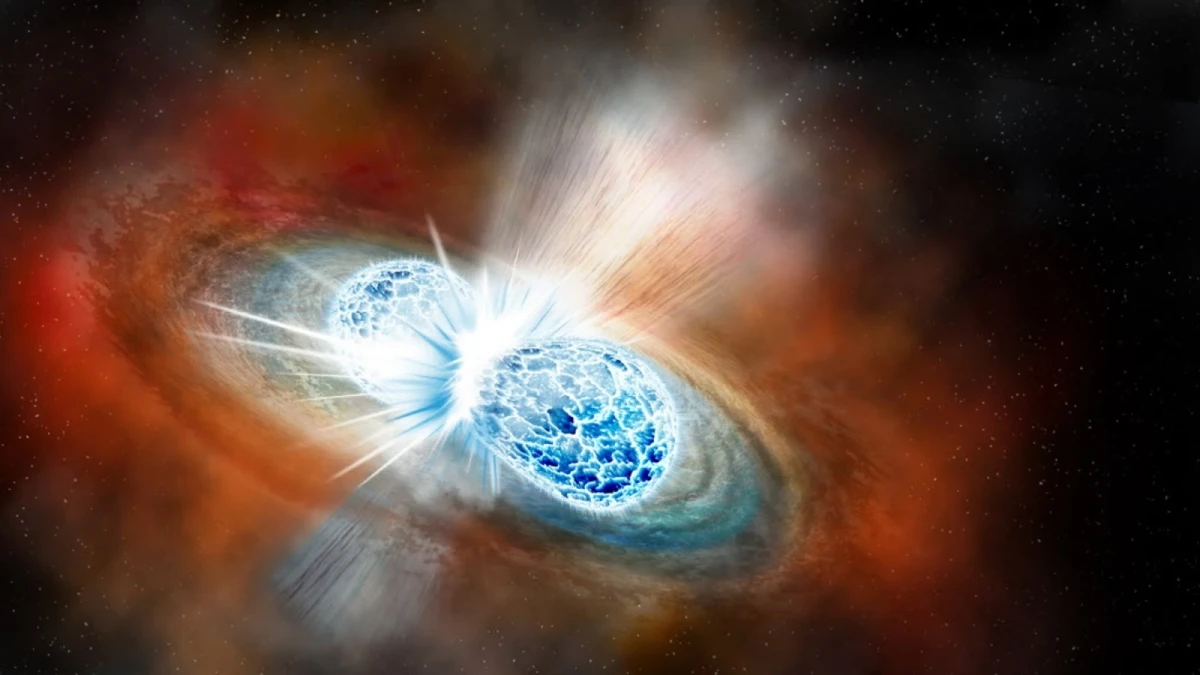
In 1967, astronomers detected mysterious radio signals that repeated with astonishing regularity. Scientists even considered that the source might be extraterrestrial civilizations. However, the answer turned out to be linked to some of the most unusual objects in the Universe. These cosmic bodies can rotate hundreds of times per second, possess magnetic fields of incredible strength, and allow researchers to study states of matter that cannot be reproduced on Earth. We are talking about neutron stars, whose properties are no less astonishing than the story of their discovery.
How neutron stars are born
Neutron stars form after the death of massive stars. When such a star exhausts its fuel supply, its core begins to collapse under the force of gravity, while the outer layers are ejected into space during a supernova explosion. What remains is an extraordinarily dense object — a neutron star.
What exactly forms after the explosion depends on the mass of the original star. In some cases, the remnant becomes a neutron star; in others, a black hole.
A supernova explosion can briefly outshine an entire galaxy. At the same time, the matter ejected into space continues to exist and be studied for thousands of years, helping scientists reconstruct the history of stars.
A density that is hard to imagine
Neutron stars are among the densest objects that astronomers can observe directly. Their mass can reach about two solar masses, even though their diameter is comparable to the size of a city.
To illustrate the density of such an object, NASA offers a vivid comparison: a cube of neutron-star matter the size of a sugar cube would weigh about a trillion kilograms on Earth — roughly as much as a mountain.
Under such conditions, our usual ideas about matter no longer fully apply. Exactly how matter behaves at such extreme density remains one of the unsolved problems of modern physics.
Unlike black holes, neutron stars are not hidden behind an event horizon. Therefore, observations of them give scientists an opportunity to study the properties of matter under conditions that are inaccessible to direct experiments on Earth.
Cosmic clocks operating with incredible precision
Some neutron stars are called pulsars. They emit directed beams of radiation that, as the star rotates, periodically cross the line of sight from Earth. That is why astronomers record repeating pulses — like signals from a cosmic lighthouse.
The fastest known pulsars rotate hundreds of times per second. One of the record holders, PSR J1748-2446ad, makes about 43,000 revolutions per minute — approximately 717 revolutions per second.
The regularity of the pulses makes pulsars especially interesting to astronomers. Over weeks, months, and longer periods, some of them demonstrate stability that surpasses the accuracy of atomic clocks. By measuring the arrival times of the signals, researchers can track changes in the behavior of these objects and use the resulting data to study the cosmos.
Magnetic fields capable of causing starquakes
The magnetic fields of neutron stars can be billions and trillions of times stronger than Earth’s. There are also especially magnetically active varieties — magnetars — whose fields can be about a thousand times stronger than those of ordinary neutron stars.
Such conditions can trigger starquakes: stress in the magnetic field and the object’s crust leads to sudden changes on its surface. These processes are accompanied by powerful bursts of gamma radiation.
Some bursts are so intense that their effects can be detected even from thousands of light-years away. Radiation from magnetars can cause measurable changes in the upper layers of Earth’s atmosphere.
Studying such phenomena helps scientists better understand how matter and magnetic fields behave under extreme stresses.
Why scientists initially suspected aliens
The story of the discovery of pulsars began in 1967, when astronomers detected extraordinarily regular radio pulses whose source could not immediately be identified.
One of the first explanations that researchers briefly considered was the possibility of an artificial signal from an extraterrestrial civilization. That is why the original object received the informal designation LGM-1 — an abbreviation of the English phrase Little Green Men.
It later became clear that the signals have a natural origin: they are emitted by a rotating neutron star. The object was renamed PSR B1919+21, and the discovery itself became an important milestone in the study of neutron stars.
Today, pulsars help researchers investigate the properties of matter, magnetic fields, and processes that occur under extreme conditions. These compact objects show just how unusual the laws of physics can be where enormous amounts of matter are compressed into a space the size of a city.