make preferable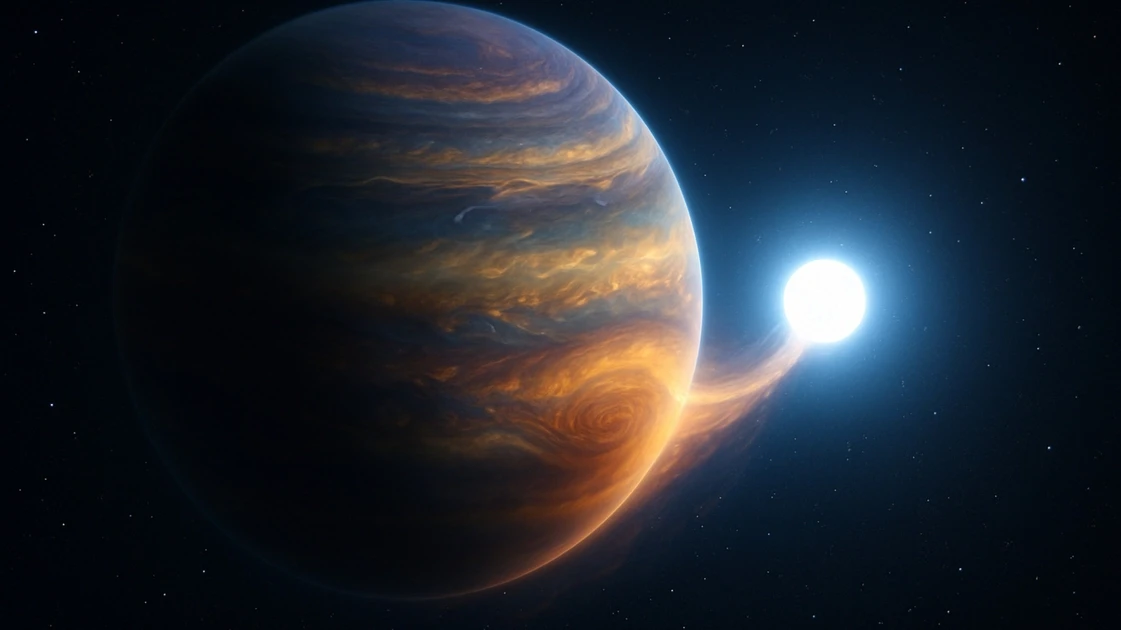
Astronomers have discovered the first candidate for a second-generation planet that may have formed after its star died — from matter ejected into space by that star. The object is associated with the white dwarf HS 0209+0832, and the unusual chemical composition of its atmosphere points to an origin in material processed inside a dying star.
If the hypothesis is confirmed, this will be the first known example of a second-generation planet around a white dwarf. Previously, such worlds were expected to be found around pulsars, but evidence for their existence has been extremely scarce.
A planet that appeared after the death of its star
Ordinary planets form at the same time as their star from a protoplanetary disk — a cloud of gas and dust left over after the birth of a stellar system. Second-generation planets arise differently: their building material is matter expelled by the star after it has already evolved.
In the case of HS 0209+0832, the scenario looks especially unusual. When the star ran out of fuel, its outer layers were shed, and the remaining core turned into a white dwarf. Later, part of the ejected material may have formed a new disk, within which a giant planet appeared.
In other words, this is a world that may have been born after its star had ceased to exist in its previous form.
The white dwarf reveals the planet through its chemical trace
The main clue emerged from studying the white dwarf’s atmosphere. Such objects have strong gravity and can absorb matter from nearby planets. The chemical composition of this material can then be detected in the white dwarf’s atmosphere.
Usually, among such elements astronomers find silicon, iron, and other components of rocky material. But HS 0209+0832 turned out to be unusual.
Zinc, copper, and especially a large amount of niobium were found in its atmosphere. Its concentration is more than a thousand times higher than the Sun’s. Moreover, niobium has been detected in the atmosphere of this white dwarf for the first time.
This set of elements is important because it is associated with the s-process — a chain of nuclear reactions that occurs inside stars in the late stages of their evolution and leads to the formation of heavy elements.
If the planet had formed from the ordinary material of a young stellar system, such a chemical composition would not be expected. But it is naturally explained by a scenario in which the planet formed from matter recently ejected by a dying star.
Where the disk for a new planet came from
This hypothesis has a serious problem: to form a planet, a disk of matter is needed, but when a single star loses its outer layers, it ejects them in roughly all directions. The material would simply disperse into space instead of forming a sufficiently dense structure from which new planets could arise.
The researchers suggest that HS 0209+0832 may have had a companion star. Its gravity could have captured part of the ejected matter and kept it in orbit around the system.
This could have created a new disk already enriched with heavy elements forged inside the dead star. A second-generation giant planet could then have formed from it.
It may be precisely the complexity of this scenario that explains why such planets should be extremely rare.
TESS spots a possible gas giant
The researchers obtained an additional clue using NASA’s TESS space telescope. Observations showed weak periodic changes in the system’s brightness with a period of about 4.4 days.
The signal is consistent with the presence of a large object in a very close orbit — presumably a gas giant about the size of Jupiter.
If this is indeed a planet, its position explains another feature of the system. At such a small distance from the white dwarf, intense radiation should gradually heat and strip away the outer layers of the planet’s atmosphere.
The escaping matter could then fall onto the white dwarf. It is this process that could explain the unusual set of heavy elements found in its atmosphere.
For now, it is a candidate, not a definitively confirmed planet
Despite the unusual combination of chemical and observational signs, the researchers are still referring to it as a candidate second-generation planet.
If further observations confirm the object’s existence and its connection to HS 0209+0832, the system will become the first known example of a second-generation planet around a white dwarf.
At the same time, the idea itself opens up a new way to search for such worlds. Instead of directly observing an extremely faint planet next to a bright or compact stellar remnant, astronomers can look for chemical traces of matter that the planet is losing and that then falls onto the white dwarf.
If this method works, similar chemical “fingerprints” may be found in the atmospheres of other white dwarfs — a kind of evidence for the existence of planets born after the death of their stars.