make preferable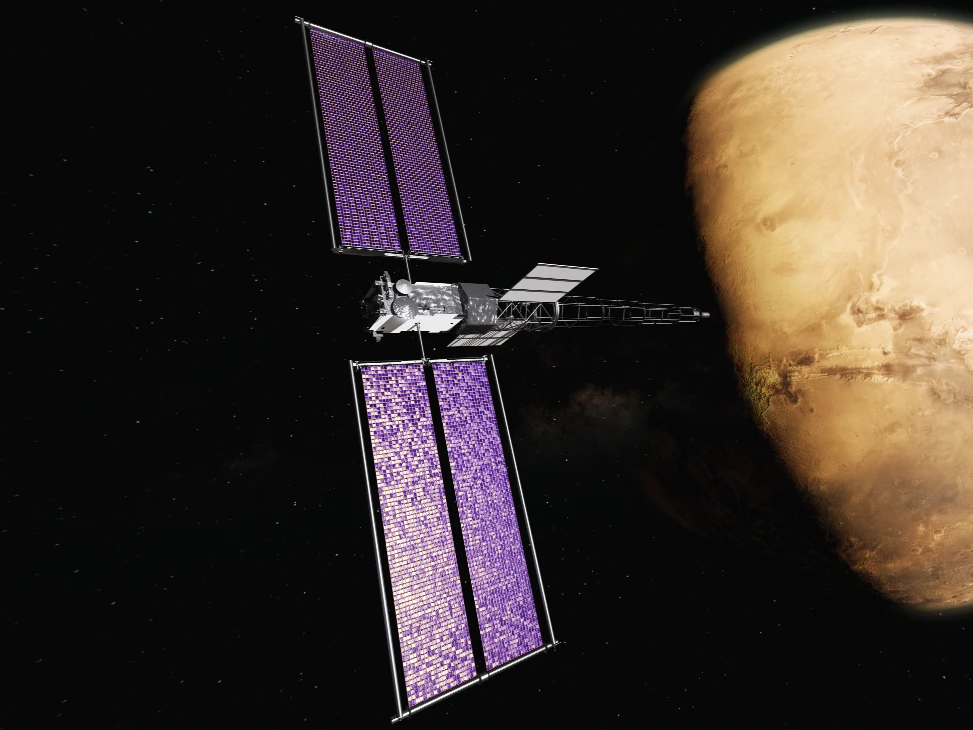
In December 2028, NASA plans to send Space Reactor-1 Freedom to Mars — the first spacecraft intended to use a nuclear fission reactor for electric propulsion beyond Earth orbit. The spacecraft will serve as a technology demonstrator: its mission is to test a nuclear-electric propulsion system in interplanetary flight and deliver three autonomous SkyFall helicopters to Mars.
This is not a nuclear rocket
SR-1 Freedom will not launch from Earth on nuclear propulsion. After launch, the spacecraft must enter an Earth-escape trajectory, and only then will the reactor be activated. NASA says this should happen within 48 hours after liftoff. Electricity from the reactor will be used to power the electric engines.
The reactor is designed to generate about 20 kilowatts of electrical power. A closed Brayton cycle is used to convert heat, while thrust is produced by an electric propulsion system with a 12-kilowatt Hall thruster. Unlike a chemical rocket, such a system does not provide a powerful short burst of thrust, but it is designed for long-duration operation and efficient use of propellant.
That is precisely the point of the technology: SR-1 is meant to show that nuclear power can be used not only to supply energy to spacecraft systems, but also directly for interplanetary propulsion.
The first interplanetary spacecraft with a fission reactor
NASA has been using nuclear power sources in deep space for decades. For example, the Curiosity and Perseverance rovers are powered by radioisotope thermoelectric generators. But SR-1 belongs to a different category: it will carry a full-fledged fission reactor whose electricity will be used for the propulsion system.
NASA calls Freedom the first spacecraft with a fission reactor to travel beyond Earth orbit. At the same time, it is important not to confuse it with the first nuclear-powered spacecraft in general: radioisotope power sources were used in space long before this mission. The novelty of SR-1 lies precisely in the combination of a fission reactor and electric propulsion in interplanetary flight.
Why NASA is sending helicopters to Mars
SR-1 will not only be a testbed for the engine. As noted above, the spacecraft is also expected to deliver three SkyFall helicopters to Mars, developed based on the experience of Ingenuity.
Each vehicle will receive cameras, radar for detecting subsurface ice, temperature sensors, and other instruments. Their tasks are to study the terrain, search for water beneath the surface, and collect data that could help in selecting future areas for human landings.
There is an important timing detail here: SR-1’s first flyby of Mars is expected in 2029, but SkyFall is not supposed to reach the surface immediately. NASA indicates that the helicopter deployment is planned after the second encounter with Mars — in the fall of 2030.
A reactor begins with the question of fuel
SR-1 is intended to use HALEU fuel — high-assay low-enriched uranium, which is used in advanced nuclear systems. In July 2026, the U.S. Department of Energy announced a conditional commitment to provide HALEU to NASA for the Freedom mission.
That is why the project matters far beyond space exploration. For NASA, it is a test of the reactor and electric propulsion, while for the United States it is also a test of its ability to establish supplies of fuel and components for future nuclear space systems.
What remains of the lunar Gateway
To accelerate the program, NASA plans to use the Power and Propulsion Element (PPE), originally developed for the lunar Gateway station. This spacecraft was initially intended to supply Gateway with power and provide electric propulsion, but it is now expected to be used as part of SR-1.
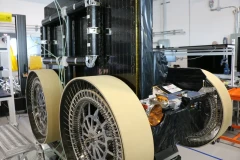
This approach makes it possible not to design the entire interplanetary spacecraft from scratch. At the same time, the architecture itself remains complex: the reactor, energy conversion system, radiators, engines, communications equipment, and scientific payload must all work together throughout the interplanetary flight.
From Mars to the Moon and beyond
For NASA, Freedom is not the end point. The agency sees SR-1 as the first stage of a program that is meant to lead to the creation of nuclear power systems for the Moon and more powerful systems for future missions to Mars and the outer Solar System. The next major project in this logic is Lunar Reactor-1.
That is why the significance of SR-1 lies not so much in how quickly it reaches Mars. Its main task is to prove that a fission reactor can operate in deep space and power electric propulsion beyond Earth orbit. If the experiment succeeds, 20 kilowatts will not be the limit, but the first step toward far more powerful nuclear space systems.