make preferable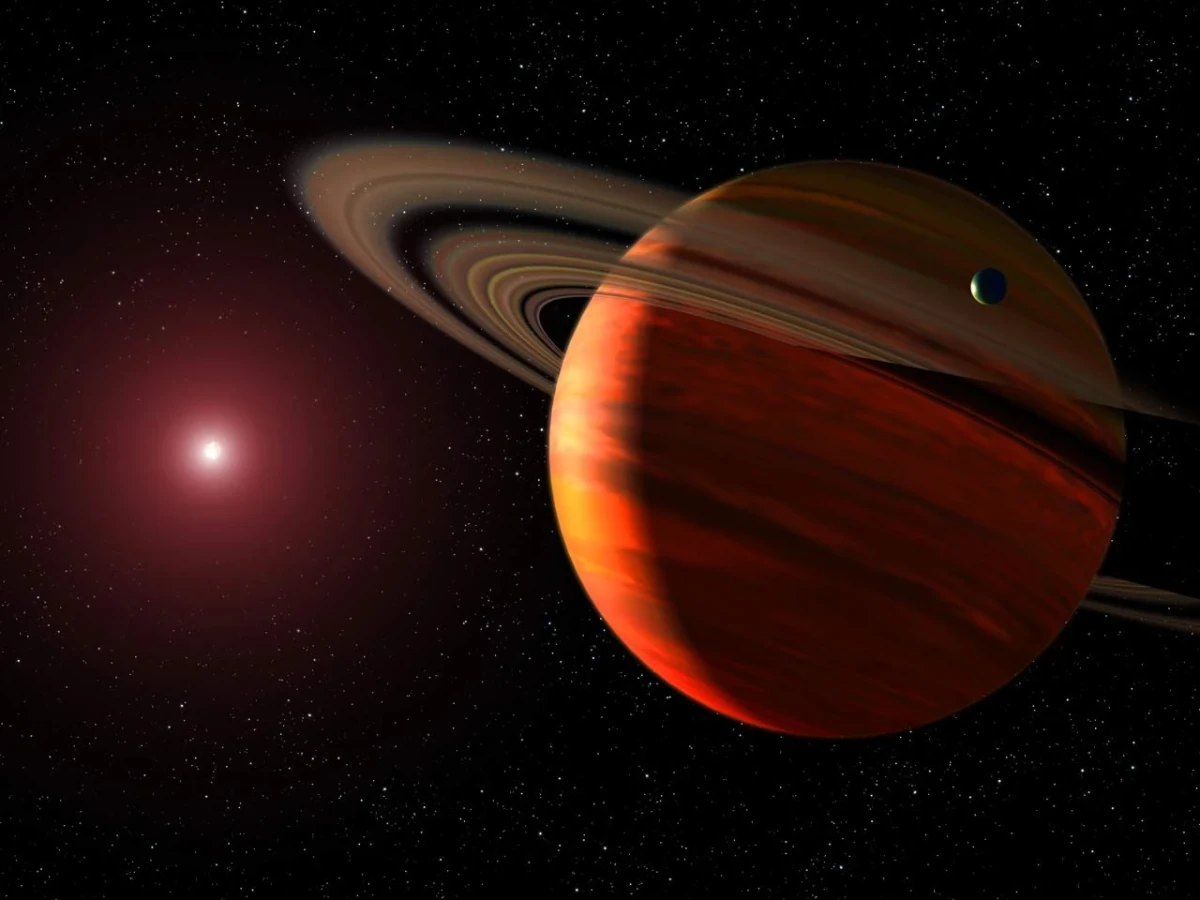
The James Webb Space Telescope detected water, methane, and ammonia in the atmosphere of the exoplanet HATS-6 b, but the main discovery was not related to its chemical composition. The gas giant, roughly the size of Jupiter, turned out to be significantly colder than calculations had predicted — despite orbiting its star in just three days.
HATS-6 b is located about 500 light-years from Earth and orbits a small red dwarf. The very existence of such a large planet next to a relatively small star already poses a problem for current models of planet formation. The results of the study by astronomers from the University of Maryland were published on Phys.org.
A Jupiter Next to a Small Star
HATS-6 b is comparable to Jupiter in size, but its environment is completely different. Its parent star is a red dwarf, much smaller and cooler than the Sun.
According to widely accepted models of planet formation, such stars should not have enough material to form large gas giants. That is why the appearance of a Jupiter-sized planet around a red dwarf is already considered unusual in itself.
At the same time, HATS-6 b is located very close to its star. It completes one full orbit in about three Earth days, so it was expected to have a fairly high temperature.
However, observations by James Webb showed a completely different picture.
The Planet Turned Out to Be More Than Three Times Colder Than Expected
The researchers used transit spectroscopy — a method that makes it possible to study a planet’s atmosphere by the way it alters the starlight passing through it.
Using this method, scientists detected water, methane, and ammonia in the atmosphere of HATS-6 b. But at the same time, they found that the upper layers of the atmosphere have a temperature of about 120 degrees Celsius.
Preliminary calculations had suggested a value of about 425 degrees.
One possible explanation is related to the planet’s own atmosphere. Astronomers suggest that HATS-6 b may be surrounded by a dense layer of clouds and haze that reflects a significant portion of the star’s light back into space. A similar mechanism operates, for example, in the atmosphere of Venus.
As a result, the planet receives less energy than expected, and its atmosphere remains much colder than the calculated value.
An “Impossible” Planet Tests Formation Models
HATS-6 b is unusual in several ways at once. For a red dwarf, its size appears too large, while its temperature is unexpectedly low given its proximity to the star.
“These small stars do not have enough material or time to create planets the size of Jupiter or Saturn. The fact that HATS-6 b can exist at all is very interesting, because according to our knowledge this is impossible,” noted the study’s lead author, Giannina Guzman Caloca.
That is why the planet is of interest not only as a rare object, but also as an opportunity to test current ideas about how gas giants are born.
Of the more than 6,000 known exoplanets, only about 40 are large gas giants orbiting red dwarfs. HATS-6 b became one of seven planets that researchers are studying as part of a special program to compare such unusual worlds with more familiar gas giants.
A Cold Atmosphere Could Change the Interpretation of Data
The discovery is also important for methods of studying exoplanets. Atmospheric temperature is one of the parameters used when interpreting chemical composition.
If the real conditions on a planet differ significantly from preliminary calculations, this could also affect how scientists interpret spectroscopic data.
In this sense, HATS-6 b becomes a kind of test for the models. James Webb did not just detect several molecules in the atmosphere of a distant gas giant — it showed that even the basic characteristics of some exoplanets may turn out to be different from what scientists expected.
And the more such unusual worlds can be studied, the more accurately astronomers will be able to understand which processes shape planets around the most common stars in our galaxy.