make preferable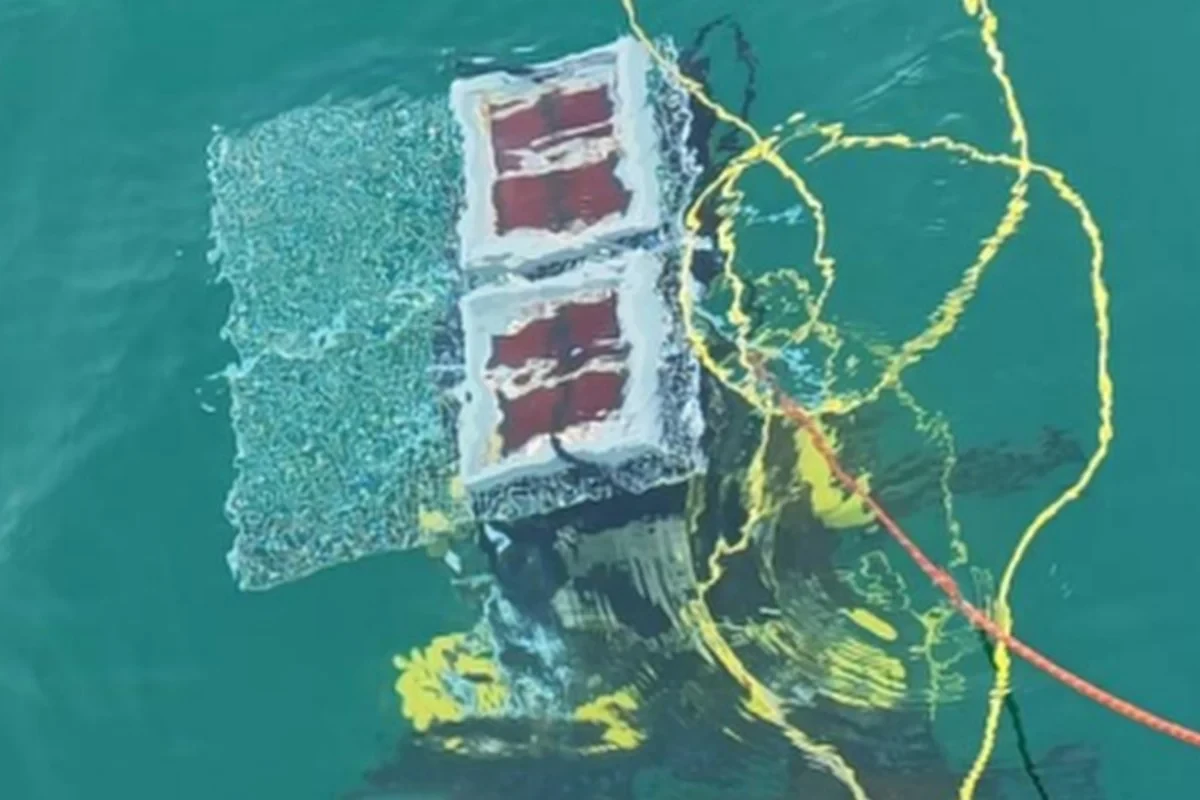
Chinese scientists have for the first time tested a perovskite solar installation in the open sea at a depth of 10 meters. Even under such weak lighting, the system was able to generate electricity, charge batteries, and power an LED panel. The development could become the basis for autonomous power sources for underwater robots, sensors, and other devices.
The work by the Yunnan University team was published on September 11 in the journal Joule. The main problem the researchers had to solve was the sharply changing spectrum of sunlight underwater.
At a depth of 10 meters, only about 10% of sunlight remains
Solar energy seems like an obvious power source for underwater devices, but in practice it is much more difficult to use. Water quickly absorbs sunlight, so at a depth of just 10 meters only about 10% of its original intensity remains.
At the same time, the red part of the spectrum, in which conventional silicon solar cells work especially efficiently, is almost completely absorbed by water. Underwater, predominantly blue-green light remains — and it was specifically for this light that the researchers selected the material for the new solar cells.
The team used perovskite photovoltaic cells based on lead halide with a wide band gap of about 1.96 electron volts. Such material can be tuned to a specific light range, and perovskites themselves are capable of working efficiently under low-light conditions.
But the technology has a serious problem: seawater is hostile to perovskite cells. Corrosion, pressure, and water penetrating through the protective shell can quickly put them out of action. In addition, the lead contained in the cells creates an additional risk if the structure is damaged.
Scientists protected the cells from seawater
To improve the stability of the material, the researchers added polyhexamethylene guanidine hydrochloride — PHMG — to the perovskite, using it as an additive to improve crystallization.
The solar cell itself received multilayer protection. It included butyl rubber and protective glass, while the outer layer was a transparent epoxy polymer. Such a design is intended to simultaneously prevent water ingress, withstand pressure, and protect the material from corrosion.
In a laboratory experiment, a small cell with an area of 0.0895 sq. cm achieved an energy conversion efficiency of 34.71% under simulated lighting conditions at a depth of 10 meters. A larger module with an area of 28.79 sq. cm reached 29.4%.
The researchers also tested the durability of the design. After 1,000 hours of continuous immersion in illuminated seawater under conditions corresponding to a depth of 10 meters, the cell retained 99.58% of its initial efficiency.
The calculations yielded an even longer projected estimate. At a temperature of 25 degrees Celsius, the calculated T80 value was 48,094 hours. This means that under the specified conditions, the cell could theoretically retain at least 80% of its initial power for about 5.5 years.
An underwater robot charged a battery at a depth of 10 meters
Laboratory experiments alone were not enough for the scientists. The team conducted sea trials near Weizhou Island in the South China Sea, installing perovskite modules on an underwater robot.
The system operated at three depths — 2, 6, and 10 meters. Over two hours of illumination, it accumulated 1416, 752, and 324 mWh of energy respectively, charging lithium-ion batteries. At a depth of 10 meters, the generated energy was enough to turn on an LED panel.
Thus, the experiment demonstrated not only the ability of an individual photovoltaic cell to work underwater, but also the possibility of assembling it into a functioning power supply system.
“Previous underwater solar cells worked at a very shallow depth — only up to 2 meters — which is far from practical application,” noted Yunnan University professor Zhang Wenhua. According to him, the new work demonstrated for the first time the functioning of submerged solar cells at a depth of about 10 meters.
Why underwater devices need their own solar power plant
An autonomous energy source is especially important for equipment that must operate underwater for long periods without constantly returning to the surface or connecting to an external power source.
The authors of the study see several potential applications for the technology: underwater sensors and detectors, cameras, communication systems, robots, and submersibles. Solar modules could serve as continuously operating energy hubs for them, allowing them to remain at sea longer without maintenance.
At the same time, this is not yet about creating a full-fledged underwater power plant capable of supplying energy to large facilities. The tested system was small, and its purpose was to demonstrate the technology’s fundamental operability in real marine conditions.
Nevertheless, the experiment shows that solar power can work where conventional solar panels are practically useless. Perovskite makes it possible to use the blue-green light remaining underwater, while multilayer protection solves some of the problems associated with seawater.
If the technology withstands further scaling and long-term operation, underwater robots and sensors will be able to obtain energy directly from the surrounding environment, turning from devices with limited battery reserves into more autonomous systems.