make preferable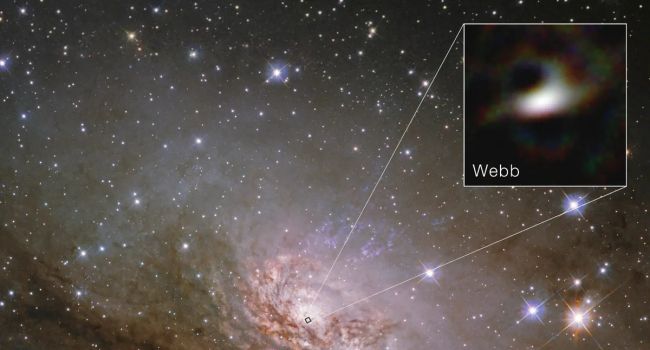
The James Webb Space Telescope (JWST) has produced the clearest image to date of the surroundings of a supermassive black hole in the spiral galaxy Circinus, located about 14 million light-years from Earth. NASA announced the result on January 13, 2026.
What Astronomers Saw
The images reveal a bright infrared region at the center of the galaxy. For a long time, scientists believed that most of this radiation was generated by powerful winds and outflows of matter from the black hole. The new data show the opposite: 87 percent of the infrared light comes from a dense, flat disk of gas and dust that feeds the black hole. This is the inner part of the so-called torus, the dusty “donut” that surrounds the event horizon.
The dark patches in the image are the outer ring of dust, while a faint arc in the north, known as the “North Arc,” is the only visible sign of hot dust being expelled by the black hole’s activity. It accounts for less than 1 percent of the emission. The remaining 12 percent comes from dust farther from the center, heated by the black hole’s radiation and by a small radio jet.
How Such Sharp Images Were Achieved
The team, led by Enrique López-Rodríguez of the University of South Carolina, used a special observing mode of JWST: a high-contrast coronagraph with seven hexagonal apertures. This setup creates interference patterns that make it possible to separate the light from the central source and reveal fine details.
Julien Girard of the Space Telescope Science Institute pointed out that this was the first time JWST’s high-contrast mode had been used for an extragalactic object.
Joel Sánchez-Bermúdez of the National Autonomous University of Mexico added that the images are effectively twice as sharp. In practical terms, observing with JWST in this mode is equivalent to studying the region with a 13-meter space telescope rather than a 6.5-meter one.
Why This Matters
Understanding how black holes accrete matter is directly linked to the evolution of galaxies. When a black hole actively feeds, it releases enormous amounts of energy that can either suppress or stimulate star formation, shaping the structure of its host galaxy.
Previously, models attributed most of the infrared excess to winds and outflows. Earlier telescopes, however, could not separate the light from the accretion disk, the dusty torus, and the winds, so everything blended into a single unresolved glow. JWST has now clearly distinguished these components for the first time.
Enrique López-Rodríguez noted that a statistical sample of black holes is needed, perhaps a dozen or two objects, to understand how the mass in their accretion disks and outflows is related to their overall power.
In Brief
The James Webb Space Telescope has shown for the first time that the main source of infrared emission in active galaxies is not winds, but the dense dusty disk that feeds the black hole. In the galaxy Circinus, 87 percent of the light comes from the inner torus, while less than 1 percent is produced by outflows. This overturns decades-old models and provides new insight into how supermassive black holes grow and how galaxies evolve. Scientists now plan to study dozens more objects to confirm these conclusions.