make preferable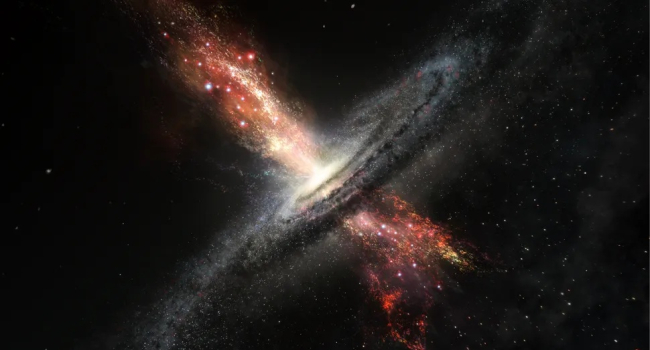
Black holes cannot simultaneously produce powerful jets and strong winds. Instead, they switch between these two modes like a swing. This conclusion was reached by an international team of scientists after three years of observations of the system 4U 1630–472 using the NICER X ray instrument on the ISS and the MeerKAT radio telescope. The study was published on January 5, 2026, in the journal Nature Astronomy.
Jets and winds cannot coexist
When a black hole actively accretes matter from a companion star, part of this material forms an accretion disk. Two types of outflows originate from it.
Relativistic jets are narrow streams of plasma moving at speeds close to the speed of light.
Powerful X ray winds are wide flows of gas spreading in all directions.
The researchers found that these two mechanisms never operate at the same time. When a jet is active, the winds almost disappear. When the winds become strong, the jet vanishes.
A member of the team, Jiachen Jiang from the University of Warwick, explained that their observations revealed what could be described as an energetic struggle inside the black hole’s accretion flow. According to him, when the black hole launches a high speed plasma jet, the X ray wind weakens, and when the wind becomes dominant, the jet fades away.
His colleague Zhibin Zhang from the University of Oxford stated that their data provided clear evidence that black hole binary systems switch between powerful jets and energetic winds and never produce both at the same time.
Self regulation and stable energy output
It is notable that the total amount of energy and mass expelled from the system remains roughly constant. Jets and winds compete for the same material, but together they carry away approximately the same total energy.
The scientists believe that the switching between modes is determined not by the amount of incoming matter, but by the configuration of magnetic fields within the accretion disk. These magnetic fields decide which outflow mechanism becomes dominant at any given moment.
Significance for galaxies
Black holes do not only consume gas and dust in galaxies. They actively regulate how much of this material is returned to the surrounding space. Gas and dust are the building blocks of new stars, so these cosmic swings between jets and winds directly influence the rate of star formation and the evolution of entire galaxies.
In brief
Astronomers have discovered that active black holes in binary systems cannot simultaneously produce powerful jets and X ray winds. They switch between these two modes instead. The total outflow of energy and mass remains stable, and the switching is controlled by magnetic fields in the accretion disk. This finding explains how black holes regulate star formation and influence the evolution of galaxies. The research is based on three years of observations of the system 4U 1630–472.